Words as Pre-Execution Force – How Language Patterns Reality Before Action
Most people treat language as a reporting tool. But before action happens, words do something more important: they organize what people notice, what they believe is possible, and what they do next.
That shift matters because it turns speech from background habit into a practical lever. Once you see language as pre-execution force, you can work with it deliberately instead of letting inherited scripts work through you.
Opening
You speak thousands of words each day, and most of them arrive automatically through inherited phrases, cultural scripts, and reactive responses. That feels normal because we're usually taught that language is descriptive, as if words simply report what already exists. But that view misses the moment when language does its most important work.
Before action, language compresses interpretation. It frames what a situation is, what matters inside it, and what kind of response feels legitimate. In that sense, words don't just describe reality after the fact. They help pattern reality before execution begins.
Words matter not only because they express thought, but because they organize the field in which thought becomes action.
Once you see that, the central question changes. It isn't whether language has power. It's whether you're using that power consciously.
TL;DR
Language is generative before it's descriptive. It organizes perception, authorizes certain actions, and coordinates people around a shared frame before anything is executed. Most speech is still automatic, which is why so much of it reproduces old patterns rather than creating better ones. What changes outcomes isn't better vocabulary alone, but directed speech under clear intent. Generative AI makes this easier to see because it amplifies the structure already present in your language.

Definitions
To make that claim usable, a few terms need to be precise. Pre-execution force is language operating at the intent boundary, the point where meaning becomes orientation just before action begins. At that boundary, words carry assumptions, values, constraints, and implications that shape what becomes thinkable and doable.
Directed speech is language used consciously under intent rather than repeated automatically from habit or culture. It doesn't enter a conversation as a reflex. It enters as an orienting act, one designed to clarify what this situation is and what should happen next.
The language-reality loop names the mechanism that follows. Words shape perception, perception guides action, action creates outcomes, and those outcomes strengthen or weaken the original framing. That loop is always running. The difference is whether you're participating in it unconsciously or governing it with intent.
Core Argument
The real power isn't vocabulary by itself. It's directed speech under intent.
When you speak automatically, you operate inside symbolic structures you didn't choose or test. You inherit their assumptions, their limits, and their likely consequences. When you speak intentionally, you intervene earlier, at the point where a situation is being defined and where future action is being made more or less likely.
Consider the difference between saying, “We have some challenges to work through” and saying, “We're facing three specific constraints that require decisions by Friday.” The facts may be similar, but the operative effect isn't. The second statement narrows ambiguity, directs attention, introduces a timeline, and creates decision pressure. It doesn't just describe the situation more clearly. It structures the next move.
This is where the Triangulation Method becomes useful. A phrase is only strong enough to guide action if it survives four tests: it has to hold across multiple perspectives, withstand feedback, respect real constraints, and still produce governed action. A faint signal becomes structure only when it survives that sequence. Without triangulation, language can feel powerful while remaining vague. With triangulation, speech becomes operational.
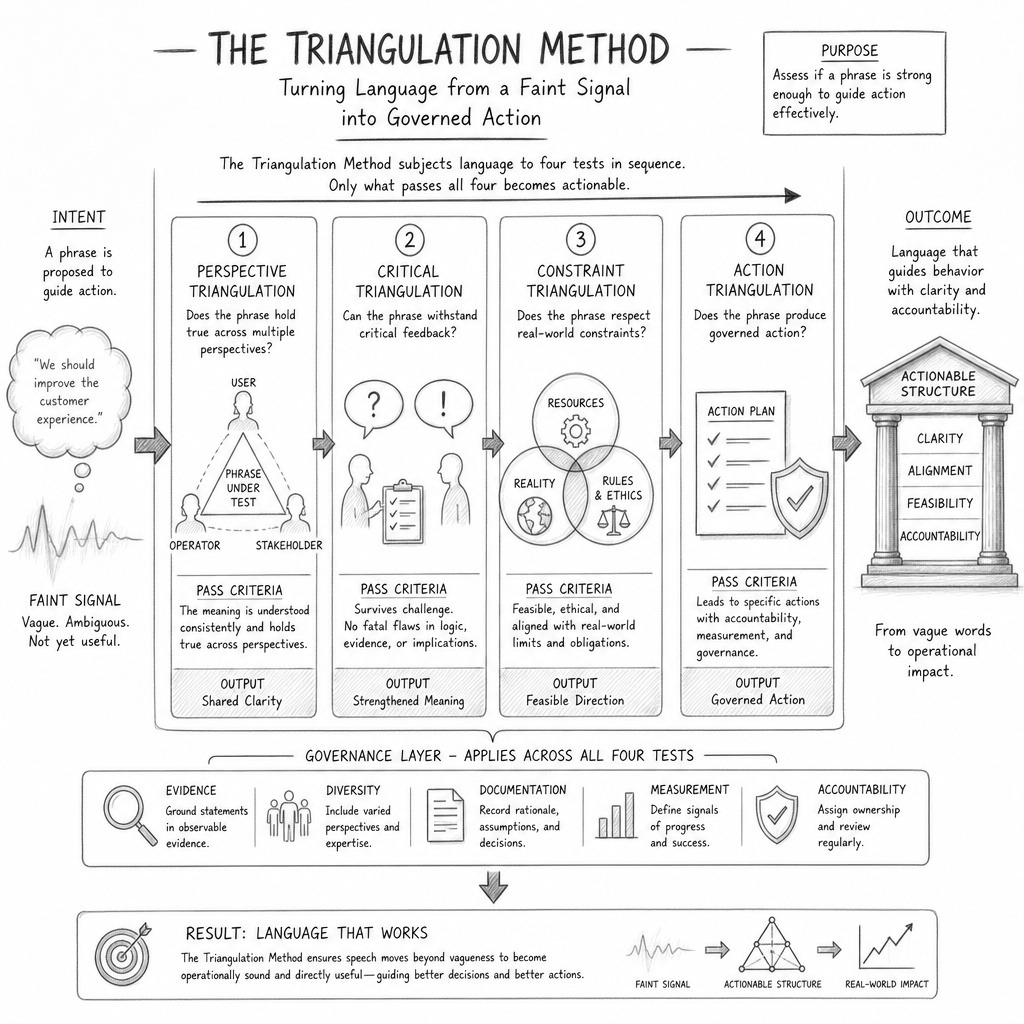
The test of language isn't whether it sounds insightful. The test is whether it organizes perception clearly enough to support better action under real constraints.
That also explains why so many people feel reactive in important conversations. Their words may be fluent, but fluency isn't the same as authorship. If your language comes preloaded with someone else's assumptions, your speech may carry momentum without carrying intent. You sound active while reproducing a frame you never chose.
So the deeper question isn't what words mean in abstraction. It's what they authorize, what they constrain, and what they launch. That is the practical meaning of pre-execution force.
Examples
This mechanism has become easier to see because generative AI makes language effects more visible. When you prompt a model, you're not accessing detached wisdom. You're shaping an output space through instruction, framing, emphasis, and constraint. The quality of the response depends heavily on how well your language specifies the situation and the kind of result you want.
Ask, “How should I handle this difficult conversation?” and you'll usually get broad, generic advice. Ask, “What are three ways to frame this conversation so the other person feels heard while I maintain my boundary?” and the result becomes more precise because the prompt carries clearer intent, sharper constraints, and a better defined success condition. The model hasn't suddenly become wiser. Your language has become more operational.
That same pattern shows up in organizations. A founder I know stopped saying, “We need to pivot, ” and started saying, “We're testing three revenue hypotheses over the next six weeks.” The strategic reality hadn't changed much yet, but the team's orientation did. The first framing broadcast uncertainty and anxiety. The second created a bounded experiment with a time horizon, a method, and an implied standard of evaluation. Her words didn't merely communicate a shift. They gave the shift structure.
This is the practical payoff of the argument: language shapes coordination before coordination becomes execution. In teams, in strategy, and in AI interaction, the words that survive triangulation create better action because they define the situation in a way people can actually work from.
If you want a simple way to test your own phrasing, use this short protocol. Before an important conversation, ask four questions: what exactly is being named, what constraint is being acknowledged, what action is being authorized, and what result would show that the framing was useful. That won't make language perfect, but it will move it from impression toward governed use.

Close
Once you understand words as pre-execution force, language stops looking neutral. It becomes the medium through which attention is organized, options are narrowed, and action becomes legitimate or unlikely. That doesn't mean every sentence carries equal weight. It means important moments are often decided earlier than we think, at the level of framing.
The useful shift isn't toward perfect wording or clever persuasion. It's toward conscious speech that can survive triangulation, absorb feedback, respect constraints, and still guide action. That's what turns a phrase from mere expression into structure.
In that light, the difference between automatic speech and directed speech is the difference between repeating a pattern and governing one. Your words are already participating in reality-making before execution begins. The only open question is whether they're doing it by habit or by design.