AI often looks strongest right before it becomes brittle. The systems that impress in a demo are often the same ones that unravel under real operational pressure because they were built for convenience, not clarity.
Opening
Our most powerful tools have become surprisingly fragile. AI systems that dazzle in demos collapse when deployed at scale. Autonomous agents that promise efficiency create chaos in production. The pattern is familiar: initial excitement, gradual degradation, eventual abandonment.
The problem isn't computational power or training data. It's a quieter choice we're making without noticing it. We keep prioritizing what feels easy over what is actually simple.
TL;DR
Most AI systems are being designed for ease. They rely on quick prompts, broad autonomy, and probabilistic output because that path feels fast and familiar. But that choice creates what XEMATIX describes as intertwined intent: semantic entanglement that makes execution unreliable when conditions change.
The alternative is to build for simplicity instead of convenience. That means treating meaning as infrastructure, not as something you hope the model infers correctly on its own. In practice, that requires governed execution, explicit authority, and deterministic pathways that resolve intent before the model acts.
Easy gets you to a demo. Simple gets you to production.
Definitions
Rich Hickey's distinction helps explain why this keeps happening. Simple doesn't mean basic or unsophisticated. It means not interwoven, not entangled, not tightly coupled. Easy means familiar, comfortable, and close to your current habits.
That difference matters because teams routinely optimize for what's easy and then wonder why their systems become hard to trust. They choose familiar interfaces over clear architecture. They accept implicit dependencies instead of explicit boundaries. They let interpretation stand in for design.
XEMATIX extends this principle beyond code and into execution itself. Hickey pointed to intertwined state as a root cause of software complexity. XEMATIX identifies intertwined intent as a root cause of AI unreliability. When objectives are unclear, authority is blended, and execution boundaries are undefined, the system doesn't just become messy. It becomes unpredictable.
This is where the conceptual shift begins to matter. The issue isn't that language models are weak. It's that they're often asked to carry semantic responsibility they were never built to govern.
Core Argument
Hickey's argument was ultimately about composition. Systems fail when too many concerns are fused together and hidden inside the same moving parts. XEMATIX applies that same logic to organizational cognition and AI execution. The failure mode is no longer just mutable state or tangled code. It's tangled meaning.
That makes the current wave of AI design less technical than it first appears. Many teams are still treating probabilistic language models as if they were self-governing intelligence. In practice, they're better understood as projection systems: powerful, flexible, and useful, but dependent on external structure if you want reliable outcomes.
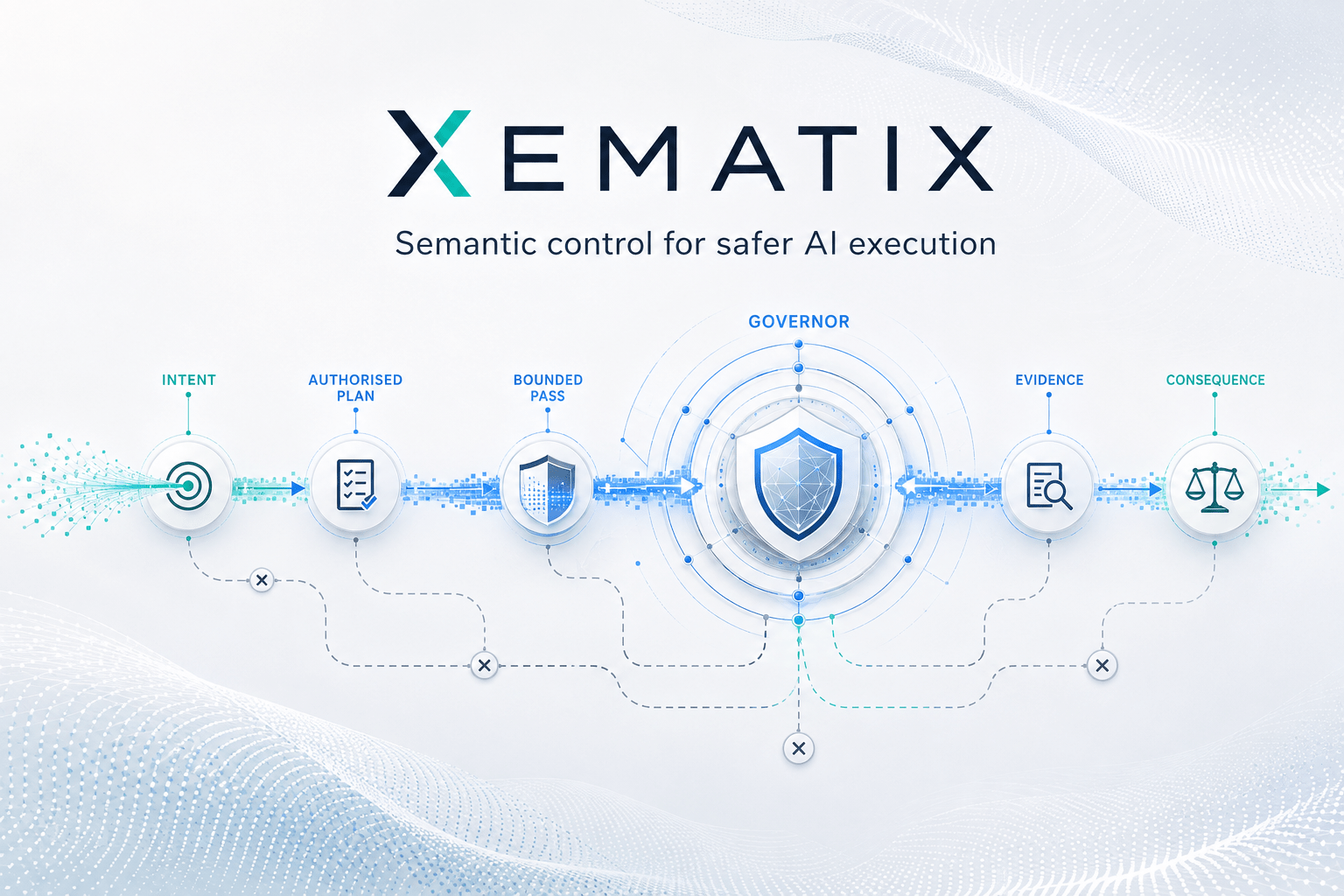
That's why the real distinction isn't between “more AI” and “less AI.” It's between systems that guess through ambiguity and systems that resolve ambiguity before execution. XEMATIX is built around the second model. Rather than acting as a loose governance layer added after the fact, it treats semantic control as part of the operating structure.
The mechanism matters here. The Triangulation Method works by separating intent into distinct layers before action is allowed to proceed. In XEMATIX, that structure appears through CAM: Mission, Vision, Strategy, and Tactics. Mission defines what the system is for. Vision constrains what success should look like. Strategy determines the acceptable route. Tactics govern the specific action. Each layer reduces ambiguity by preventing one type of intent from bleeding into another.

This is the practical answer to a common tension in AI work: desire pushes toward speed, friction shows up when outputs become inconsistent, belief tells the team that a better prompt might solve it, but the actual mechanism of failure is unresolved intent. Once decision conditions are made explicit, the system stops depending on hope and starts depending on structure.
Reliability doesn't come from making the model smarter. It comes from making intent legible before the model moves.
Examples
Consider an AI-powered customer service system. The easy path is obvious: deploy a large language model, write conversational prompts, and let it handle inquiries with broad autonomy. It's fast to implement, feels sophisticated, and avoids the discomfort of defining too much up front.
The simple path feels slower because it asks for separation before scale. You define the mission boundaries first, which means specifying what kinds of problems the system is actually allowed to solve. Then you set vision constraints around acceptable response patterns. From there, you establish strategic guardrails such as escalation triggers and policy limits, and finally add tactical validation so outputs are checked before delivery.
The difference only becomes fully visible under pressure. In the easy system, edge cases accumulate and each failure teaches the team the same lesson too late. A customer asks about a discontinued product and the model invents availability. Someone requests a refund outside policy and the system makes promises it had no authority to make. Every patch adds another layer of local complexity because the original intent model was never separated.
In the simple system, those failures are less likely because the ambiguity is handled upstream. Intent is resolved before execution. Authority boundaries are explicit. Unclear cases are caught at the governance layer instead of surfacing as production incidents.
The same pattern shows up in content operations. A founder I know spent months debugging an “autonomous” content system that kept drifting off-brand. The instinct was to blame the model, but the model wasn't the real problem. Marketing goals, brand standards, and audience assumptions had all been folded into a single prompt layer. The system couldn't stay coherent because the intent inside it wasn't coherent. Once those concerns are separated, each part becomes reviewable, adjustable, and much easier to trust.
What looks like intelligence failure is often structure failure. The faint glimmer in the blackness is that once you see this, many AI problems stop feeling mysterious. They become design problems again.
Close
The choice between simple and easy is strategic, not technical. Easy systems feel faster because they postpone clarity. Simple systems feel slower because they require it up front.
That's why so much AI work feels powerful early and fragile later. It optimizes for quick prompts, autonomous execution, and probabilistic output while avoiding the harder task of defining intent, authority, and boundaries before action begins. XEMATIX moves in the other direction. It optimizes for constrained pathways, explicit authority, and semantic structures that can be governed before they fail.
When meaning is treated as infrastructure, execution becomes more dependable. You don't get perfection, but you do get traceability, auditability, and a much stronger basis for certainty. In that sense, the real category shift isn't about building better AI. It's about building systems that can carry intention without collapsing under it.
More organizations are starting to recognize this after repeated failures at scale. They've learned that the central question isn't simply what an AI system can do. It's whether the system can do what was actually intended, under pressure, without improvising past its authority.