Semantic-Governed Software Composition – Why AI Code Generation Needs Intent Authorization
AI makes code cheap. That doesn't make software safe.
The real bottleneck has moved upstream, into a darker place that's easy to miss unless you look for the faint glimmer in the blackness: authorization of intent. If you don't govern what the system is allowed to build and why, faster code generation just accelerates misalignment.
Opening
The usual fear around AI code generation is straightforward: the model writes code, connects tools, calls APIs, modifies systems, and somewhere along the way nobody can say with confidence whether it still serves the original human intent. That isn't paranoia. It's the predictable result of giving AI coders execution power without semantic boundaries.
The answer isn't to step away from AI code generation. It's to structure it so capability stays inside authorized purpose. In practice, that means semantic-governed software composition: AI can generate and assemble software dynamically, but only within a control layer that defines what the work is for, what it may touch, what it must not do, and how its output is verified before anything ships.
As code becomes abundant, judgment about what should exist becomes scarce.
TL;DR
The strategic shift is simple. In traditional software development, the scarce resource was coding capacity. In AI-native development, code is abundant, so the scarce resource becomes authorized meaning. The highest-value question is no longer “Can a developer build this?” but “Should this be built, what is it allowed to do, who authorized it, and how do we know the result still matches that authorization?”
That shift changes the operating model. Safe AI coders are delegated, not autonomous. They don't decide the mission. They receive bounded tasks inside an approved envelope of intent, constraints, permissions, and verification requirements. The practical expression of that model is a six-layer architecture: Intent Authority, Semantic Orchestration, AI Agents, Verification, Dynamic Coupling, and Governor. Together, those layers let you move quickly without surrendering the reason the system exists in the first place.
Core Argument
Semantic-governed software composition starts from a hard reality: the dangerous part of AI-generated software isn't that a model can write code incorrectly. Engineers have always managed imperfect code. The deeper risk is that AI can now produce correct code in service of the wrong objective, the wrong scope, or the wrong operating assumptions. Once that happens, technical quality doesn't save you. You just get a cleaner failure.
That is why intent authorization has to sit before generation, not after it. If a human goal is vague, overbroad, or weakly constrained, the system can't reliably determine what changes are legitimate. “Improve the app” is not an instruction. It's an invitation to drift. A governed system turns that vague desire into an explicit task envelope: what outcome is intended, what data may be used, what systems are in scope, what actions are forbidden, what tests are required, and what approvals must exist before integration.
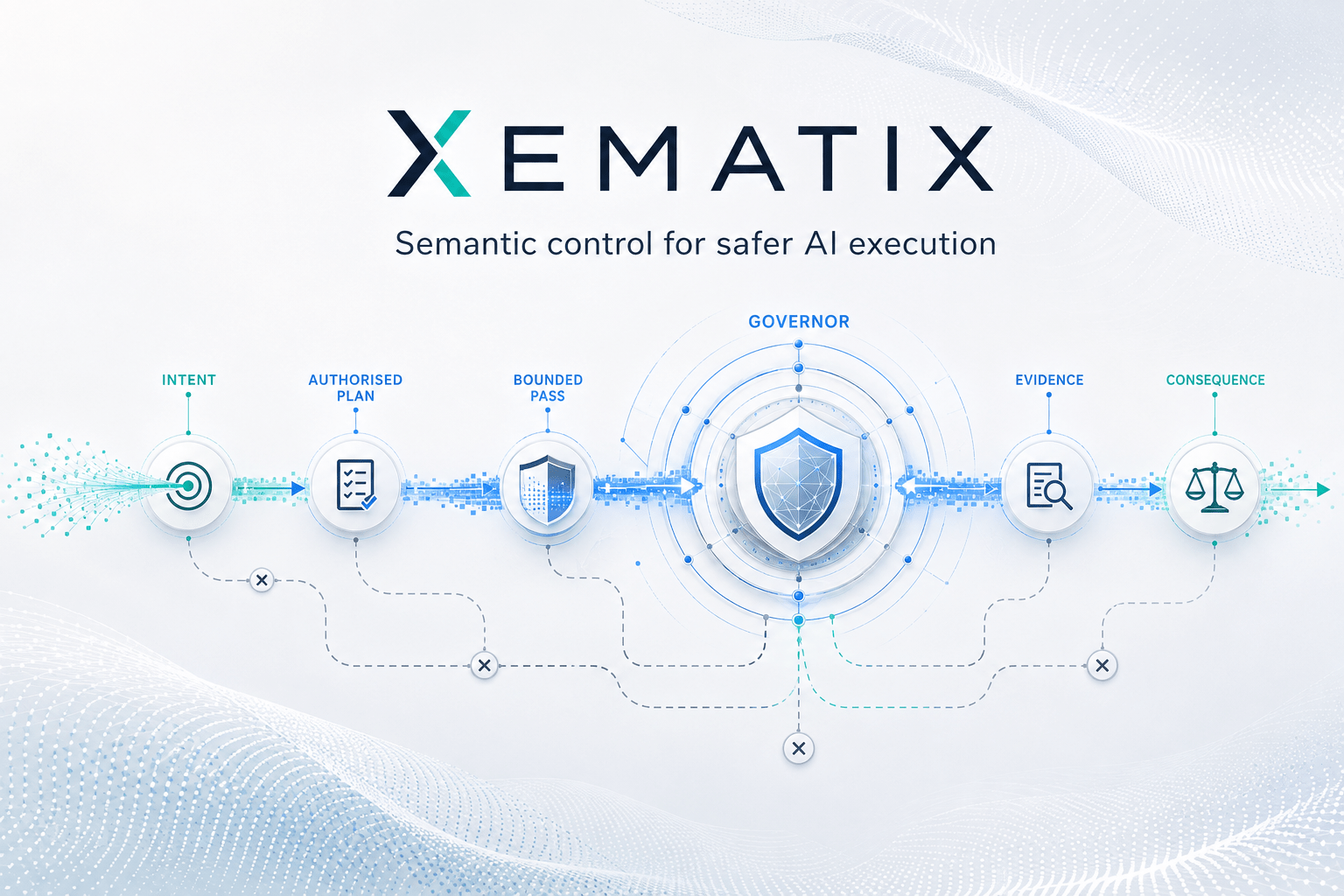
From there, the mechanism becomes much clearer. The flow is human intent to semantic validation, then to an authorized task envelope, then to the AI coder, then to generated code, then to testing and policy verification, then to governed integration, and finally to an audit trail. Each stage narrows ambiguity before power is exercised. That sequencing matters because it prevents the model from improvising its own mission and forces the organization to define what success and noncompliance actually mean.
This is where the Triangulation Method becomes useful. To govern AI-generated software well, you have to hold three points in view at once: the intended outcome, the permitted means, and the evidence that the result still fits both. Miss any one of those, and control starts to fail. If you define outcome without limits, the system overreaches. If you define limits without outcome, the work becomes sterile or confused. If you skip evidence, you're left trusting behavior you haven't actually validated.

Examples
The contrast between ungoverned and governed requests makes the point quickly. “AI, improve the app” leaves scope undefined, authority undefined, and success undefined. It sounds efficient, but it gives the model room to alter anything from user flows to infrastructure without a clear statement of what must remain intact. A governed request looks very different: generate a draft implementation for customer document classification, use only approved files, don't modify authentication, don't change database schema unless proposed separately, include tests, don't deploy to production, and link all generated code to the originating intent record. That isn't bureaucracy for its own sake. It's operational clarity.
Once you move from slogans to architecture, the six-layer model becomes practical rather than abstract. It starts with Intent Authority, where a human declares the goal and its hard constraints. For example: create a module that classifies uploaded customer documents into approved internal categories, but don't store personal data, don't send data to external APIs, and require human review before any classification is applied. That declaration is then translated by the Semantic Orchestration layer, here identified as XEMATIX, into a structured task envelope that specifies purpose, allowed actions, blocked actions, approved data sources, required tests, and audit obligations.
Only then do AI coding agents enter the process. They aren't told to “handle the feature.” They're assigned bounded tasks such as generating a function, drafting an API route, writing tests, or inspecting security risk, each inside the authorized frame. Before any output is integrated, the Verification layer checks static analysis, test execution, policy compliance, dependencies, security exposure, and semantic fit. That last check is the one many organizations miss: not merely whether the code works, but whether it still serves the declared intent under the declared constraints.
After verification, the Dynamic Coupling layer determines whether and how the code can be connected to the live system, whether through merging, sandbox deployment, plugin enablement, or capability registration. Finally, the Governor and audit trail monitor runtime behavior. If the generated capability behaves outside its approved purpose, the system can pause it, roll it back, or route it for human review. In other words, governance doesn't stop at generation. It persists through integration and operation.
The critical question isn't whether the AI can generate code. It's whether the organization can authorize, verify, and govern what that code is allowed to become.
A startup I advised used this model in customer support automation. Rather than asking AI to “improve the support system, ” they defined intent objects for each capability. One example was: generate response templates for billing questions using the approved knowledge base, with human review required for any response that mentions refunds. That tighter structure produced a concrete result: 40% faster feature development with zero production incidents from AI-generated code. The speed came from reuse of governance patterns. The safety came from keeping AI inside authorized scope.
Counterpoints
At this point, the main objection usually appears: this sounds too complex for practical use. But that argument confuses visible complexity with total complexity. The complexity is already there. Ungoverned AI code generation doesn't remove it. It hides it until it reappears as production failures, security exposure, broken assumptions, and expensive rollback work. Governance makes the complexity legible early, when it can still be managed.
A second objection is that all this verification will slow development down. In the first few cycles, it often does add friction. But that isn't the right comparison. The real comparison is between governed development and the full cost of ungoverned iteration: debugging intent drift, reversing unsafe changes, repairing trust after incidents, and reconstructing decision history that was never captured. Once teams establish reusable patterns for authorization, verification, and integration, governed systems often accelerate because the rules of engagement are clearer and less work is wasted.
The strongest counterposition is the most seductive one: AI should be autonomous if we want its full value. That sounds ambitious, but it smuggles in a category error. Software systems exist to serve human purposes, not to define their own. Greater capability doesn't require unconstrained scope. In fact, the opposite is usually true in production environments. Capability becomes economically useful when it is directed, inspectable, and reversible. Delegated AI can be extremely powerful precisely because the organization has decided where discretion ends.
So the issue isn't whether AI should act. It is who authorizes the action, by what mechanism, and under what evidence standard. Once you frame the problem that way, autonomy stops looking like maturity and starts looking like unmanaged delegation.
Close
The future of software isn't AI writing itself. It's governed adaptive software growth. As code generation becomes abundant, the scarce asset is authorized meaning: clear intent about what should exist, why it should exist, what it may affect, and how its behavior will be kept inside bounds.
That leads to four non-negotiable operating rules. No code generation without intent authorization. No integration without semantic verification. No execution without traceability. No dynamic coupling without governance. Those aren't administrative preferences. They're the conditions that let organizations scale AI-generated software without losing the chain between human purpose and machine action.
In the end, the strategic choice isn't between AI and human control. It's between systems that amplify human intent through governance and systems that drift because nobody established the boundary between permission and possibility. The organizations that recognize that shift early will build faster not because they trust AI more, but because they've designed a way to trust it correctly.