Mirror-Key Mode vs Explicit Intent – Which XEMATIX Pattern Fits Your Risk Profile
Most teams don't want more friction. They want faster interaction without giving the system permission to improvise. That's the real choice here: how to move quickly while keeping authority, traceability, and control intact.
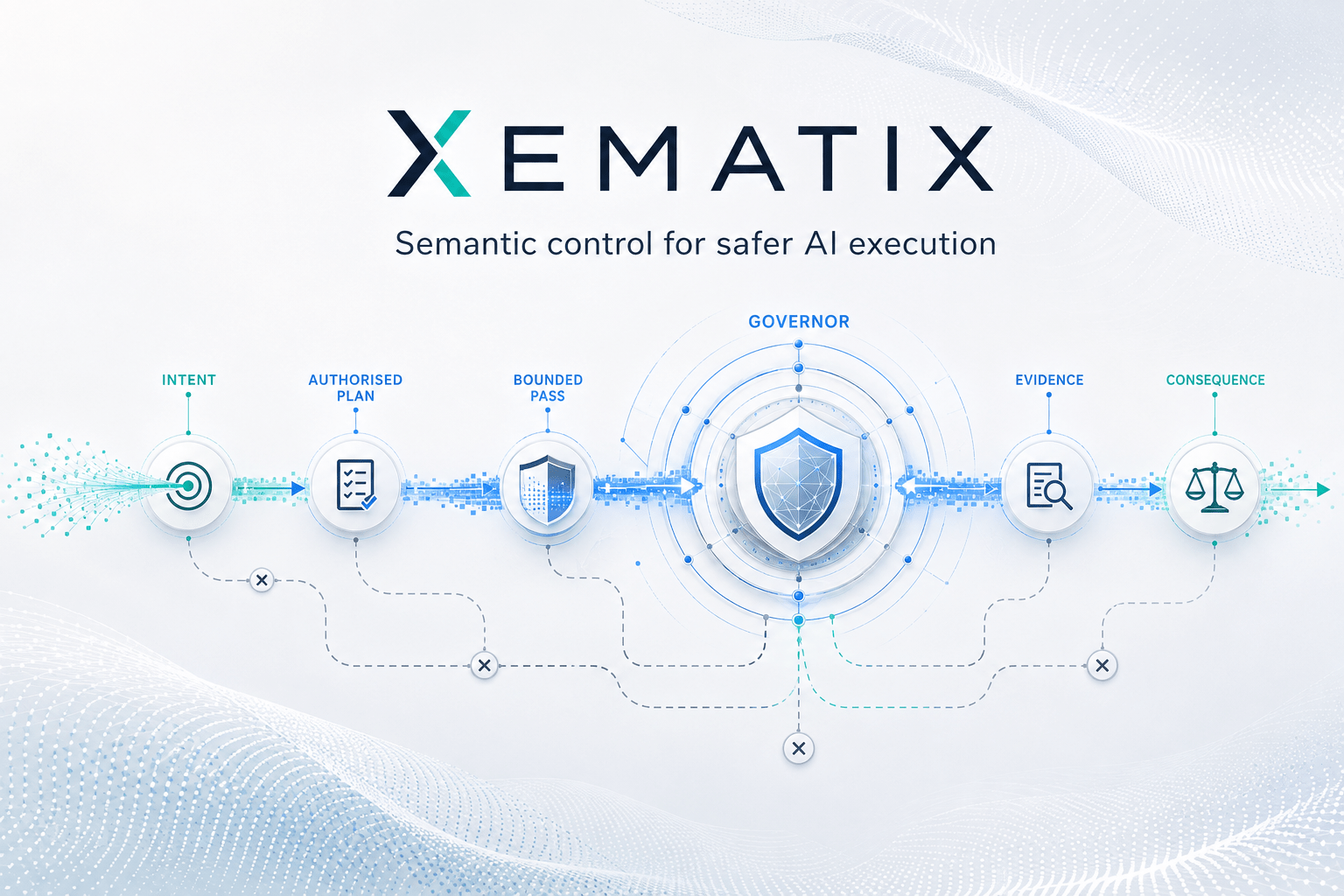
You want the system to understand your shorthand without inventing its own interpretation of what you meant. That tension is real: explicit commands are slow but safe, while conversational AI feels fast but can become unpredictable. Many organizations assume they have to choose between rigid automation and risky agents, but XEMATIX offers a narrower, more governable path through Mirror-Key Mode. In practice, it resolves compressed user signals into pre-governed intent objects without letting the system create authority on its own.
TL;DR
Mirror-Key Mode sits between full explicit declaration and open-ended agent behavior. Instead of guessing what you mean, it expands minimal input into existing, governed intent objects that have already been defined, approved, and bounded. That makes it materially different from agent guessing, and more flexible than simple workflow triggers. In XEMATIX terms, the practical choice is usually among four interaction patterns: Explicit Intent, Mirror-Key Mode, Agent Guessing, and Workflow Triggers. If your environment requires strong governance, Mirror-Key Mode is often the most efficient compliant option once the underlying intent objects have been established.
The core distinction is simple: Mirror-Key Mode resolves authorized shorthand; it doesn't invent new intent.
Options
To choose well, it helps to compare the four patterns by how they handle user input and system authority. Explicit Intent is the most direct and restrictive model. You declare your purpose, constraints, and expected outcomes in full, such as generating a quarterly revenue report for Q3 2024, filtered to enterprise accounts above $50K ARR and formatted as a PDF with an executive summary. The system then captures and validates that declared intent before doing anything else. This is slow by design, but it leaves very little room for ambiguity.
Mirror-Key Mode changes the interaction, not the authority model. Instead of entering the whole request every time, you use shorthand that maps to an existing intent object. A phrase like “Q3 enterprise report” works because it serves as an authorized key to a specific, pre-governed reporting construct. The system can expand the shorthand automatically, but only because the fuller intent already exists and the user is authorized to invoke it. That makes the speed gain real without turning interpretation into invention.
Agent Guessing takes a very different path. Here, a vague request like “help with revenue” leads the system to infer likely goals, choose parameters, and act on assumptions. That may feel helpful in the moment, but under XEMATIX principles it crosses a line: the system is no longer executing governed intent, it's creating it. The convenience is immediate, but the compliance and predictability costs are substantial.
Workflow Triggers are the opposite kind of simplification. Rather than interpret language at all, they bind fixed buttons, forms, or events to predefined actions. Clicking “Generate Q3 Report” launches a known sequence every time. That reliability is useful, especially for tightly bounded work, but it doesn't adapt well when real needs vary even slightly.
A financial services firm I worked with began with explicit commands for compliance reporting. Analysts routinely spent around 10 minutes writing detailed specifications for standard quarterly summaries. After moving those recurring tasks into Mirror-Key Mode, they reduced input time to roughly 30 seconds while keeping audit trails and governance oversight intact. That kind of improvement isn't magic. It's the result of doing the structural work in advance so the shortcut points to something fully governed.
Comparison Criteria
Once the options are clear, the decision usually comes down to three criteria: ambiguity tolerance, governance requirements, and interaction frequency. Those criteria matter because the best pattern isn't the one that feels easiest in a demo. It's the one that holds up under your actual risk profile.
Ambiguity tolerance is the first test. Explicit Intent keeps ambiguity low because the request is fully specified up front. Mirror-Key Mode also controls ambiguity, but in a different way: it limits interpretation to pre-approved paths. Agent Guessing does the opposite by expanding the system's freedom to infer what the user “probably” wanted. If your organization can't absorb interpretation risk, that difference should carry real weight.
Governance requirements come next, and for many teams they decide the issue quickly. Regulated industries, financial operations, and healthcare environments often need clean traceability from user intent to system action. XEMATIX compliance requires intent to be explicit, validated, constrained, and governed before execution. Explicit Intent satisfies that requirement directly. Mirror-Key Mode can satisfy it efficiently, provided the mapping and approval structure already exist. Agent Guessing does not meet that bar because it lets the system author the missing parts.
Interaction frequency is where efficiency becomes more than a theoretical benefit. If a task recurs often, the upfront effort required to create Mirror-Key mappings can pay off quickly. If requests are rare, varied, or exploratory, explicit specification may be the simpler and safer route. In other words, the more often you repeat a governed action, the more attractive bounded shorthand becomes.
Speed only helps when it preserves the chain of authority. Otherwise, it just hides risk behind smoother interaction.
Tradeoffs
Each pattern gains something by giving something up, and those tradeoffs become more visible over time. Explicit Intent gives you certainty by asking more from the user at the start. You spend extra time specifying constraints, but you reduce misinterpretation risk and keep the audit path obvious. That makes it strong for novel, high-stakes, or highly scrutinized work, even if it becomes cumbersome for routine activity.
Mirror-Key Mode shifts the effort earlier in the process. You don't avoid structure; you invest in it before the interaction happens. Teams have to define, govern, and approve intent objects in advance, and they also need clean mappings between shorthand keys and those governed actions. The payoff is substantial efficiency in repeated use. The main risk is poor key design, especially when shorthand could plausibly point to more than one governed object. If the key space isn't disciplined, ambiguity can creep back in through the side door.
Agent Guessing offers the appearance of ease because it reduces user effort at the moment of request. The problem is that it replaces declared authority with system inference. That trade may be acceptable in low-stakes consumer settings, but in governed environments it weakens auditability, predictability, and compliance. The hidden cost isn't just a bad output. It's the fact that the system reached action by filling in intent on its own.
Workflow Triggers are dependable because they reduce variation so aggressively. If the task is simple and repetitive, that can be exactly the right compromise. Still, the same rigidity that makes them safe also makes them narrow. They don't handle variation gracefully, and they don't capture the benefit of compressed human input when users need some room to signal different approved outcomes.
The real decision isn't about finding a perfect universal pattern. It's about aligning the tradeoff to the operating environment. A trading desk, a compliance team, and a marketing operation may all value speed, but they won't tolerate the same kind of uncertainty. In that sense, the faint glimmer in the blackness is not raw convenience. It's governed clarity about where authority begins and ends.
Recommendation
If your work is high-stakes, novel, or tightly regulated, Explicit Intent remains the safest default. It asks more of the user, but it keeps intent declaration and execution tightly coupled. When the cost of misunderstanding is high, that clarity is usually worth the extra time.
If your team handles recurring requests inside a stable governance framework, Mirror-Key Mode is typically the better strategic choice. It combines speed with bounded resolution, which means users can work with shorthand while the system stays inside approved intent structures. This is where the Triangulation Method becomes useful as a practical way to decide: look at the frequency of the task, the strictness of the governance requirement, and the acceptable level of ambiguity. When tasks recur often, governance is non-negotiable, and ambiguity tolerance is low but not zero, Mirror-Key Mode usually emerges as the strongest fit.

Agent Guessing should be avoided wherever governance, auditability, or predictable execution matter. Its convenience depends on allowing the system to bridge intent gaps by inference, and that's precisely the risk many organizations can't accept.
Workflow Triggers remain useful for straightforward, repetitive processes that don't need variation. They are reliable, but they are not a substitute for a governed interaction pattern when users need shorthand access to multiple approved outcomes.
Taken together, the recommendation is defensible rather than fashionable: start with governance requirements, then assess repetition and ambiguity tolerance. For many organizations, that path leads to Mirror-Key Mode as the practical middle option between slow explicit specification and non-compliant inference.
Close
You don't have to choose between rigid control and improvisational systems. XEMATIX makes the choice narrower and more disciplined than that. Mirror-Key Mode offers a middle path that is faster than full explicit specification, safer than agent guessing, and more adaptable than fixed workflow triggers.
What matters is the mechanism behind the speed. When compressed signals resolve only into what has already been authorized, efficiency doesn't come from loosening control. It comes from designing control well enough that shorthand can safely work. That's the difference between a system that invents intent and one that simply unlocks it.