Mirror-Key Mode – How to Build Safe AI Shortcuts Without Breaking XEMATIX Compliance
You want fast AI interaction without opening the door to reckless interpretation. Mirror-Key Mode works when a faint glimmer in the blackness is enough to trigger a governed action path, not because the system guesses, but because it resolves a signal into something you already defined and approved.
You want your AI to respond instantly to a phrase like “Open Sesame” without forcing people to restate the full operational intent every time. At the same time, you can't let it improvise and potentially create harm. The canonical XEMATIX position is firm: execution requires explicit, validated, constrained, and governed intent. There isn't a compliant shortcut around that spine.
Mirror-Key Mode addresses that pressure by shifting effort from runtime to design time. It doesn't let the machine infer what you probably meant. Instead, it expands compressed user signals into pre-existing, governed intent objects that already live inside your CAM and ALO structure. In other words, the signal is short, but the intent behind it isn't. The Triangulation Method matters here because it keeps speed, safety, and auditability aligned rather than trading one off against another.
Mirror-Key Mode is safe only when the system resolves an existing contract. The moment it starts inventing one, you've left compliance behind.
TL;DR
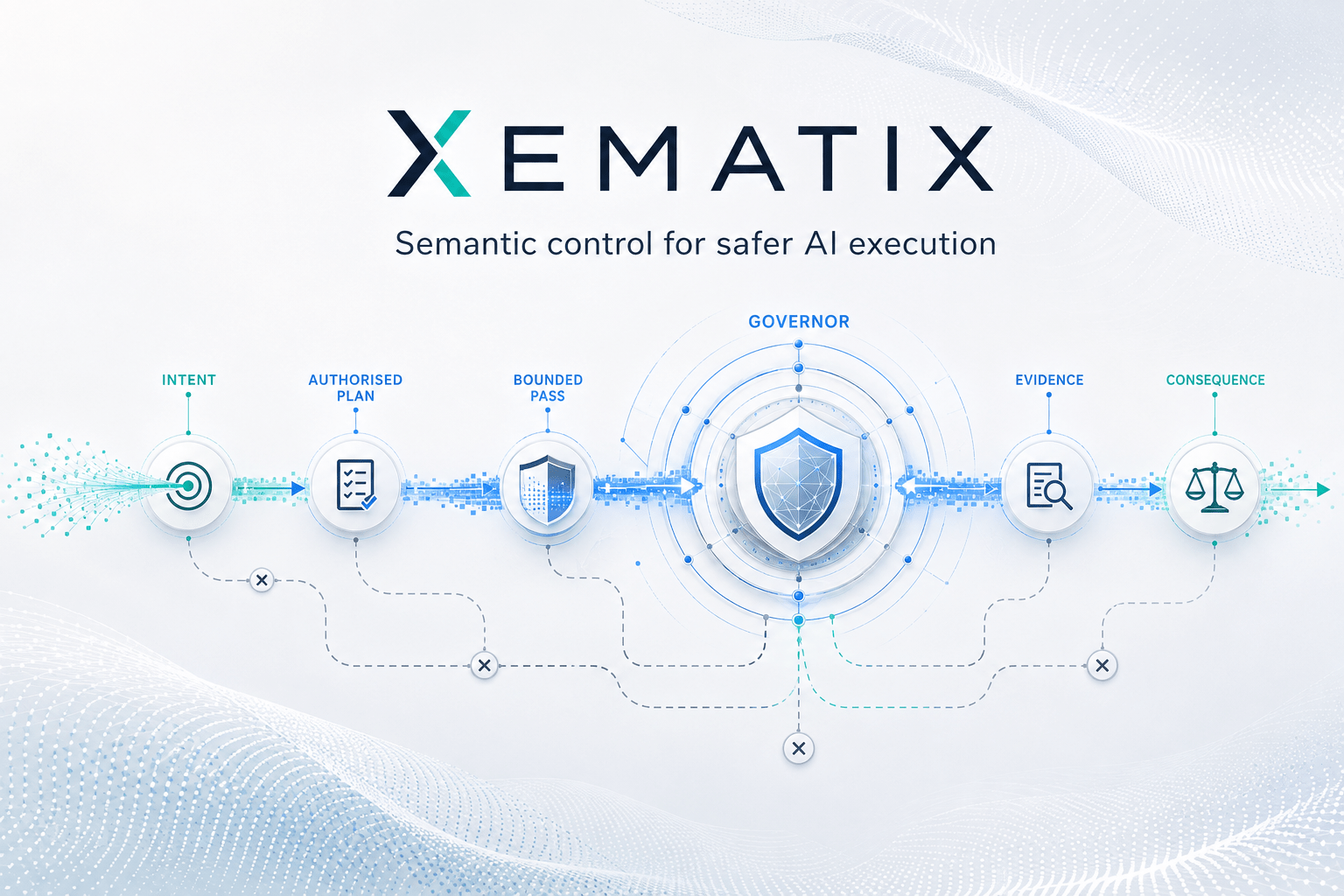
Mirror-Key Mode lets a minimal input such as “deploy staging” resolve into a governed intent object that was already encoded, validated, and approved before anyone typed the key. That makes it fast without making it speculative. To stay compliant, the system still has to pass the full execution path: authenticate the user, verify authorization, recognize the operating conditions, confirm an exact key-to-intent match, validate the expanded object through CAM and ALO, secure Governor approval, and record the full expansion in the ledger. The crucial distinction is simple: authorized intent resolution is allowed because it retrieves an existing governed object, while agent guessing is banned because it creates a new one on the fly.
Prerequisites
Before you implement Mirror-Key Mode, you need the governed object itself. That means the full intent specification must already exist and already be valid within your XEMATIX operating structure. Your CAM has to capture mission alignment, your ALO has to encode operational constraints, and your Governor has to approve the available execution pathway. The mirror-key is only the activation layer. The actual safety comes from the structure underneath it.
Take a mirror-key like “deploy staging.” On the surface, it's brief. Underneath, though, it only works if you've already defined which staging environment is in scope, what deployment criteria apply, who is allowed to invoke it, what rollback behavior is required, and what success conditions count as completion. That is the real implementation burden. Mirror-Key Mode doesn't reduce the need for governance; it compresses access to governance you've already done.
There's also an operational requirement many teams miss at first: you need a reliable way to create, maintain, and retire these intent objects over time. If your governed objects drift out of date while the keys remain available, the shortcut becomes a liability. A mirror-key should point to a living governed object, not a stale assumption.
Steps

Once that foundation is in place, execution becomes straightforward but never casual. The system first has to authenticate the user and verify that the active session is valid. From there, it must confirm that the user is actually authorized to invoke that specific mirror-key under the present conditions, because login access alone doesn't grant execution rights.
After identity and authority are established, the system has to recognize the current operating conditions. A given key may be valid in one environment and blocked in another, or it may resolve differently depending on bounded operational state. Only then should the platform validate that the submitted key maps to exactly one known, governed intent object. If the key produces multiple matches, the user has to disambiguate. If it produces none, the request should fail cleanly.
That resolved object still isn't ready to run until it passes the same CAM and ALO validation that any other governed execution would require. Mirror-Key Mode doesn't exempt the object from current constraints just because it was previously defined. After that, the Governor layer must approve the specific execution pathway in the present situation, confirming that it remains safe, bounded, current, and auditable. Finally, the system has to write the whole chain to the ledger: the original signal, the resolved object, the validation path, and the approved execution plan. That record is what proves a compressed input did not bypass governance.
The key saves typing, not scrutiny. If validation gets thinner because the input is shorter, the design has failed.
Examples
A DevOps team is a clean place to see the pattern. Suppose a developer enters “deploy api-v2 staging.” That phrase is not the intent object itself. Instead, it resolves to a governed specification such as deploying API version 2.1.3 to the staging-east environment with a blue-green pattern, automatic rollback if health checks fail after five minutes, notification to the dev-ops channel on completion, and Governor approval from staging-east before execution. The user experiences a shortcut, but the system executes a full governed object. That's the difference that keeps the shortcut safe.
The same logic applies in more sensitive domains. In a financial services setting, traders might use a symbolic key such as “hedge-delta-neutral” to access a predefined multi-leg options strategy with fixed risk parameters and approval conditions. The key doesn't create a strategy. It retrieves one that already exists as a governed intent object. That distinction matters because financial workflows often tempt teams to blur convenience and interpretation. Mirror-Key Mode stays compliant only when convenience never becomes improvisation.
These examples also show why the method scales. You don't need users to memorize every implementation detail, but you do need the organization to encode those details before execution time. The apparent simplicity at the interface is supported by deliberate complexity in the governed layer beneath it.
Common Mistakes
The most serious failure mode is drifting from authorized intent resolution into agent guessing. If a user enters “backup prod-db” and the system maps that phrase to a pre-encoded object such as DB_BACKUP_PROD_V3, validates current constraints, obtains Governor approval, and then runs the approved sequence, that is compliant. If a user enters “backup the database” and the system decides they probably mean production, assumes a full backup is desired, selects a storage target on its own, and proceeds without a pre-existing governed specification, that is not Mirror-Key Mode. That's speculative execution hiding behind a friendly interface.
A second mistake is treating authentication as if it were enough. It isn't. A valid identity only proves who the user is. It doesn't prove that the user can invoke a given mirror-key in a particular environment, during a particular window, or under current operating conditions. Teams that collapse authentication and authorization often think they're being efficient, but they're really removing one of the safeguards that separates governed execution from misuse.
A third mistake is trying to make mirror-keys feel more intelligent by layering inference on top of them. That's usually where things start to break. If the key requires the system to interpret vague language, fill in missing intent, or choose among unstated objectives, you've crossed the line. Mirror-Key Mode should be direct, bounded, and unambiguous. When the input is too loose, the right behavior is to stop and require clarity rather than let the system improvise.
Close
Mirror-Key Mode isn't a way to make AI read minds more convincingly. It's a way to make governance operate faster at the point of use. The explicit specification doesn't disappear; it moves upstream so the system can expand a short signal into a full governed object that already exists.
That is why the XEMATIX principle remains intact. Execution still depends on explicit, validated, constrained, and governed intent. Mirror-Key Mode simply changes when that intent gets fully expressed. Done correctly, it gives you the speed of symbolic interaction with the safety of pre-validated execution, because the machine resolves instead of inventing, expands instead of assuming, and validates instead of guessing.