Three Market Signals Demanding Immediate XEMATIX Product Acceleration – Not Mission Change
The market isn't asking XEMATIX to become something else. It's asking XEMATIX to productize what governed execution already promised.
That matters because three separate demands now show up as one buying condition: software that can act, prove what it's doing, and stay governable inside real operating workflows.
Opening
The market has shifted beneath us. What used to read as enterprise-only compliance requirements now shows up as baseline expectation for teams shipping containerized software at speed. License provenance, unified operator controls, and execution verification no longer arrive as isolated feature requests. They've converged into a single requirement: if a system participates in live delivery and operational decisions, it must be governable inside the flow of work, not after the fact.
For XEMATIX, that isn't a call to abandon the vision of governed execution and semantic control. It's evidence that the market has caught up to it. The strategic question now isn't whether the direction was right. It's whether the product roadmap will accelerate fast enough to meet procurement-grade expectations.
TL;DR
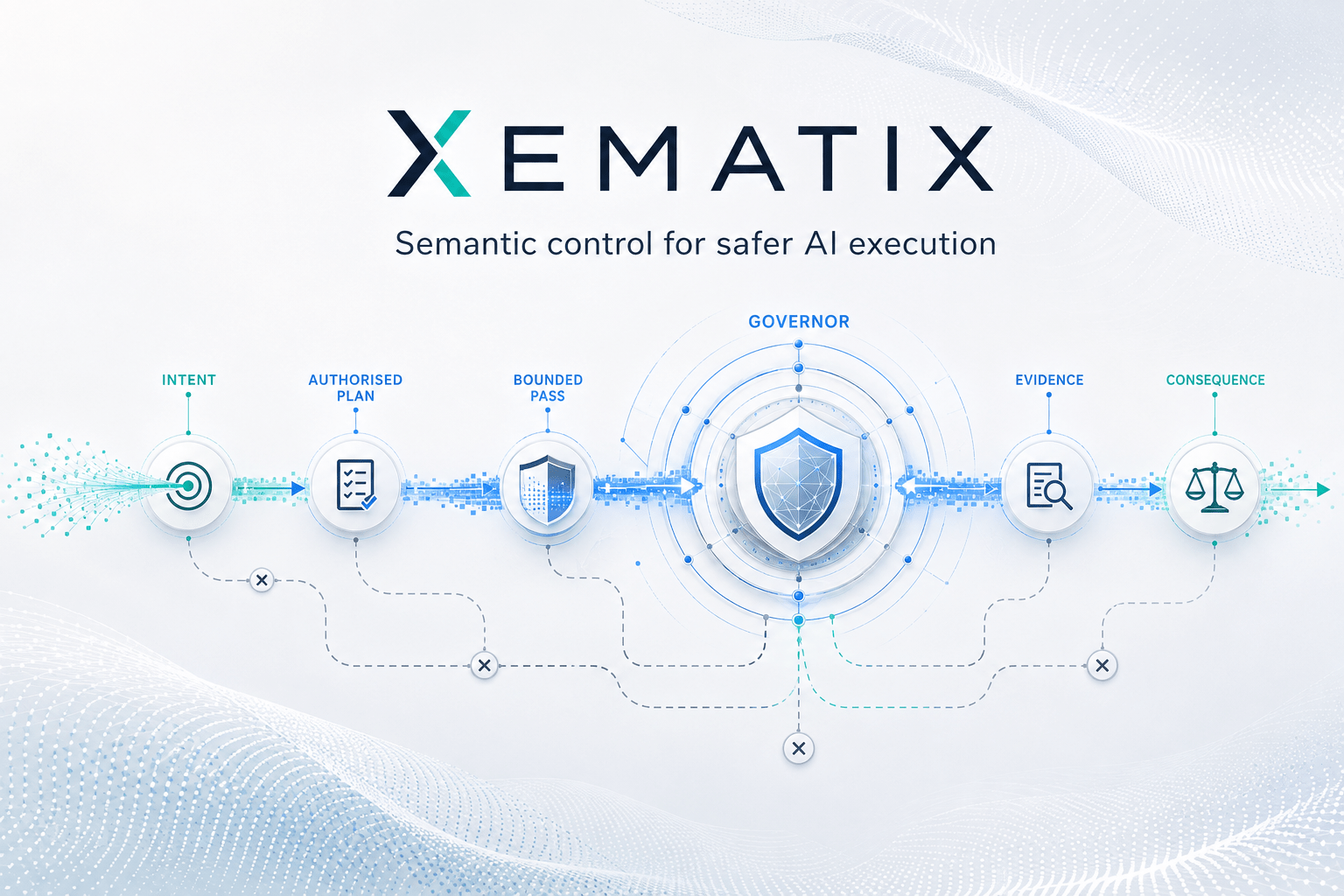
Three signals now demand immediate acceleration of governed execution features. First, license-provenance governance has to live directly inside CI/CD workflows so compliance doesn't slow release velocity. Second, operator controls and autonomous actions have to share one interface pattern so teams can move between automation and approval without changing tools or mental models. Third, any model that executes code or makes sequential decisions in live environments now requires runtime verification, approval gates, and auditable traces before customers will trust it in production.
Taken together, these aren't signs of mission creep. They define the practical shape of the market XEMATIX is already trying to serve.
These signals matter because they change the buying threshold, not just the feature wishlist.
Core Argument
These three signals represent strategic acceleration, not mission change. The governing claim is straightforward: the capabilities XEMATIX has been developing as research proofs now map directly to immediate market pull, and the mechanism is convergence. When compliance, operations, and execution risk all land in the same workflow, customers stop treating governance as a separate layer and start treating it as part of the product itself.
The first pressure point is provenance. In fast CI/CD environments, separate review tracks for license compliance break the release system. Teams don't just want scan results. They need component provenance and license-obligation mapping embedded into developer-facing pipelines and runtime hooks so downstream distribution requirements are handled without adding manual drag. The implication is testable and commercial: where automated compliance checks are procurement-blocking, a product that can't integrate provenance governance into delivery flow risks exclusion before broader value is even considered.
The second pressure point is interface design. Operational teams don't want one system for manual workflows and another for autonomous execution. They want a single control surface that can run automatically under known conditions, pause at defined thresholds, and let an operator approve or intervene without shifting contexts. That's not a design preference. It's the mechanism by which trust gets built in mixed-control environments. If governed execution is meant to survive real use, it has to work across autonomy and intervention as one operational model.
The third pressure point is verification. Once models move from drafting assistance to system action, the margin for error shrinks quickly. A system that executes code, changes environments, or makes sequential operational decisions can't rely on implied trust. It needs runtime checks, stepwise approval where risk warrants it, and decision traces that can be audited afterward. The operational consequence is clear: without verification at execution time, governed execution remains a concept rather than a production capability.
This is where the Triangulation Method becomes useful. A faint signal becomes structure only when it survives multiple tests: repeated customer demand, operational fit, and the constraints of procurement and production risk. These three demands survive that test. They're not separate asks. They're the customer-facing shape of one requirement for governed, verifiable, integrated execution.
A capability becomes strategic when customers need it in order to buy, operators need it in order to use, and governance teams need it in order to approve.
Examples
That argument becomes clearer in real operating conditions. Consider a DevOps team shipping microservices to production daily. They may already run automated dependency scanning, yet the current process still creates a compliance bottleneck because scan results need manual interpretation, license obligations aren't mapped cleanly to distribution requirements, and each release absorbs extra review time. What they need isn't another dashboard. They need provenance governance that runs in-pipeline and produces usable compliance artifacts without slowing engineering velocity.
A platform team evaluating execution automation faces a related problem from the opposite direction. They may want models to handle routine deployments autonomously while pausing for approval on higher-risk changes. But many tools still force an artificial choice between fully manual operation and fully autonomous flow. That gap matters because real teams work by threshold, exception, and controlled escalation. A unified interface that supports both automatic execution and human approval isn't a convenience feature. It's what makes governed adoption possible.
The same logic applies when execution reaches live systems. If a model can take action, customers want more than a record that something happened. They want to know what the system was allowed to do, what checks ran before action, where approval gates were triggered, and how decisions can be reviewed afterward. In that setting, execution verification isn't a layer added for optics. It's the control structure that turns action into accountable action.
Across these cases, the mechanism holds. Teams aren't asking for experimental add-ons. They're asking for capabilities that fit the systems they already run while reducing compliance friction, preserving operator control, and making automation trustworthy enough to deploy.
Counterpoints
The main counterposition is that this work could distract from the core roadmap. That concern sounds disciplined, but it rests on the wrong framing. It assumes provenance mapping, unified interfaces, and execution verification are adjacent expansions rather than the product form of governed execution itself. If XEMATIX already treats governed execution and semantic control as core vision elements, then moving these capabilities from research proofs into integrated product features isn't diversion. It's translation from concept into market-ready form.
A second objection is that partnerships could fill the gap. That logic can work for peripheral functions, but it weakens at the center of the value proposition. License provenance, operator-mediated execution, and runtime verification aren't bolt-on accessories to governed execution. They define whether governed execution is credible in production. If those controls sit outside the core product, then the product no longer owns the mechanism customers are actually evaluating.
The final objection is that demand may be overstated or temporary. But the stronger reading is structural. Containerized delivery, compliance automation, and systems that take action in live environments are not passing fashions. They change the baseline constraints under which software is evaluated and adopted. The testable implication is simple: delaying integration doesn't preserve optionality. It increases retrofit cost, compounds integration debt, and raises the likelihood that customer expectations will outpace the product before the product is ready.
So the decision bridge is tighter than it may first appear. The desire is to stay focused on core strategy. The friction is finite product capacity. The governing belief is that these requests could pull the team off-course. But the mechanism shows the opposite: because market requirements now express the original vision in concrete operational terms, acceleration strengthens strategic coherence rather than weakening it. The decision condition, then, is whether XEMATIX wants governed execution to remain a strong thesis or become a buying-ready capability.
Close
The faint signal has become structure. What once looked like emerging requirements for governed execution now appears as a clear market threshold with direct procurement consequences.
That is why this moment calls for acceleration, not reinvention. XEMATIX doesn't need a new mission. It needs to move existing governed execution capabilities into prioritized product work: provenance inside CI/CD hooks, unified patterns for operator and autonomous control, and execution verification that stands up in live environments.
Seen clearly, the alternative isn't focus. It's delay disguised as discipline. And in a market where governed execution features are becoming non-negotiable, delay carries its own strategic cost.