AI Intent Control – Choose Between Flexible Prompts and Rigid Contracts
Most AI failures don't come from a lack of capability. They come from a gap between what you said and what the system was actually allowed to infer.
That makes AI intent control a practical decision, not a philosophical one: do you want flexibility that invites interpretation, or structure that limits it?
Opening
You're staring at an AI output that's 90% correct but subtly wrong in ways that could cost you credibility, money, or worse. The agent followed your instructions, yet still missed your actual intent. That's the real decision tension in AI intent control: whether to optimize for flexibility or predictability.
Most teams begin with conversational prompting because it's fast. You write instructions in natural language, add a few examples, and iterate until the result looks right. That works when the task is creative, exploratory, or easy to review. But once AI moves from assistance into execution, the same flexibility that makes prompting useful also makes it risky.
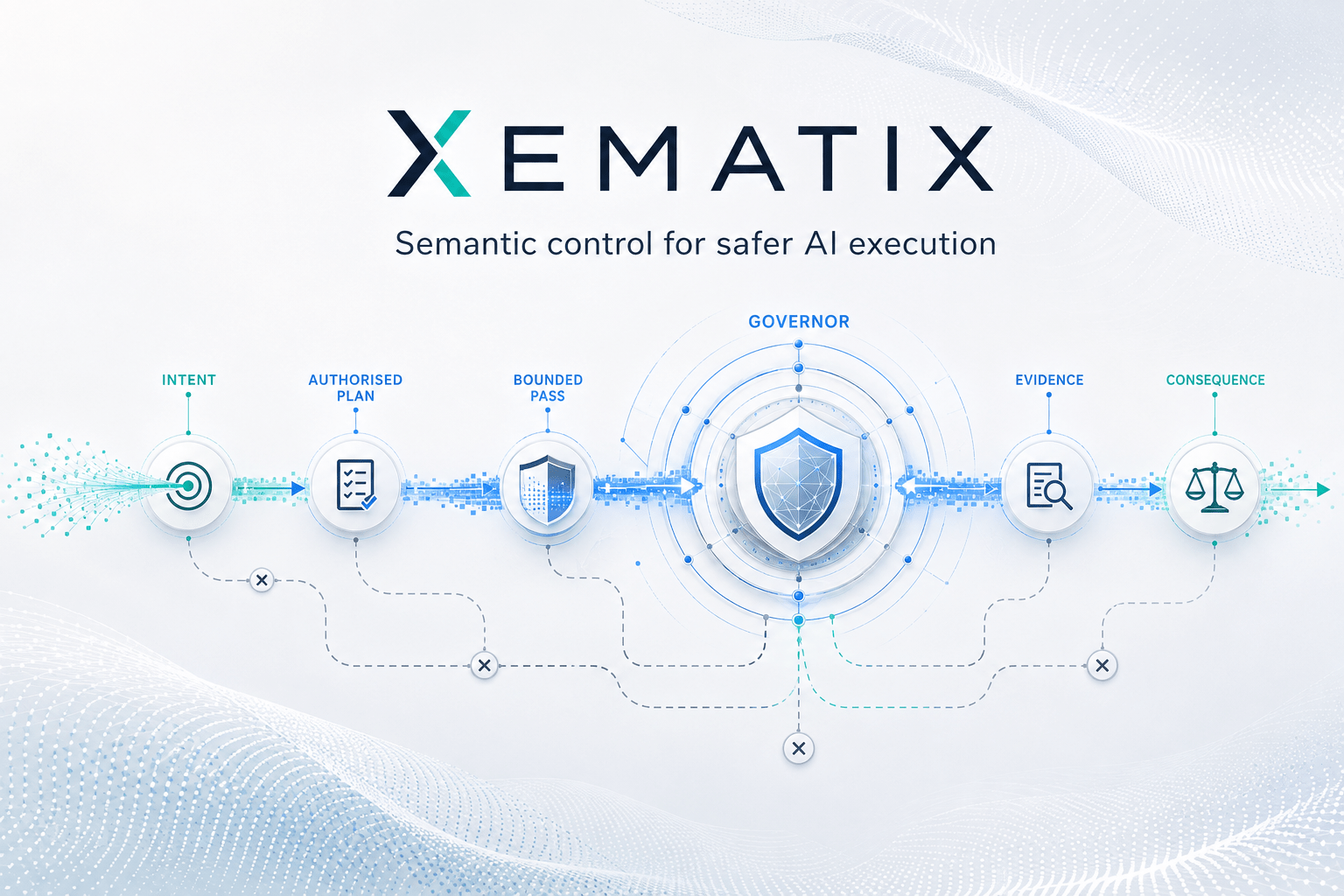
The alternative is to treat AI communication as an engineering problem. Instead of hoping the model interprets your meaning correctly, you define the meaning in advance through a semantic contract. In systems like XEMATIX, that means specifying the boundaries, criteria, and permitted actions before execution begins.
The core question isn't whether the model is smart. It's whether your control method makes its behavior governable.
TL;DR
Conversational prompts are the better fit when the work is creative, low risk, and already includes human review. Semantic contracts require more effort up front, but they produce more predictable and auditable behavior when the stakes are higher. The simplest decision rule is to match the method to the cost of error: if mistakes are cheap, stay flexible; if mistakes are expensive, add structure.
Options
The two options reflect different operating assumptions about how AI should behave. A conversational prompt treats the model like a capable but somewhat unpredictable colleague. You describe the task, provide some context, maybe include examples, and rely on the model's training to fill in the rest. If you ask it to analyze data, draft a response, or summarize a document, it interprets those instructions through patterns learned from many similar cases. That can be powerful because it leaves room for adaptation, and sometimes the model produces an approach you wouldn't have specified yourself.
A semantic contract starts from the opposite premise. It assumes that ambiguity is the problem, not a feature. Instead of asking the model to infer what matters, you specify what counts as valid input, what outcome is acceptable, how edge cases should be handled, and what constraints govern the action. The XEMATIX model expresses this through structured layers such as Anchor, Projection, Pathway, Actuator, and Governor. In practice, that shifts the model's role from interpreter to executor.
That distinction matters because it changes where uncertainty lives. With prompting, uncertainty appears in the output and has to be caught after the fact. With contracts, uncertainty is pushed upstream into the design process and resolved before the system acts.
Comparison Criteria
To choose well, you need criteria that connect control style to operational reality. The first is effort distribution. Conversational prompting is quick to start, but it pushes work into review, correction, and repeated clarification. Semantic contracts reverse that pattern. They take longer to define, but they reduce the amount of interpretation and rework later. The mechanism is straightforward: one approach tolerates ambiguity and manages it through oversight, while the other removes ambiguity and manages it through specification. The testable implication is simple. If your team spends more time checking outputs than creating instructions, you're already paying the hidden cost of flexibility.
The second criterion is the balance between flexibility and reliability. Prompts perform well when the goal is subjective, evolving, or exploratory. Contracts perform well when the goal is repeatable execution. If you want variation, tone judgment, or creative synthesis, a rigid structure may block useful adaptation. If you need the same process to run consistently across many instances, conversational freedom becomes a liability because small interpretation shifts accumulate over time.
The third criterion is scalability. Prompt-based systems scale only as far as review capacity scales with them. More outputs mean more human attention, because each result still needs judgment. Contract-based systems scale through reuse. Once the semantic boundaries are defined, the same controlled behavior can govern many executions with less incremental oversight. That doesn't eliminate monitoring, but it changes monitoring from constant interpretation to exception handling.
The fourth criterion is auditability. In regulated or high-accountability environments, you need to show not just what the system did, but what it was authorized to do. Conversational prompting makes that harder because intent remains partly embedded in natural language and model interpretation. Semantic contracts make it easier because the permitted action, success conditions, and constraints are explicit. If your environment requires a defensible trail from instruction to execution, that alone can decide the question.
A prompt tells the model what you mean in approximate terms. A contract defines what counts as meaning before the task begins.
Tradeoffs
The tradeoffs become clearer when you look at failure modes rather than features. Conversational prompting usually fails through semantic drift. The model keeps producing plausible outputs, but its interpretation of terms like professional, complete, compliant, or urgent shifts over time or across tasks. Each individual result may look acceptable, yet the aggregate behavior becomes inconsistent. That's manageable when usage is occasional and human judgment stays close to the work. It becomes costly when the volume grows and review fatigue sets in.
This is why many teams gradually create prompt libraries, review rules, and standard examples. They're trying to stabilize meaning without fully formalizing it. In effect, they're building partial contracts informally. The weakness is that informal controls still depend on interpretation, so they don't fully solve the reliability problem.
Semantic contracts fail differently. Their main risk is brittleness. If the specification is too narrow, the system becomes correct in a mechanical sense while missing situational judgment that a more flexible approach would have captured. That can reduce not only errors, but also useful adaptation. A tightly constrained content workflow, for example, may preserve consistency while losing responsiveness to audience, timing, or nuance.
The upfront cost is also real. Creating a good contract requires domain clarity, not just technical discipline. You need to know which distinctions matter, which edge cases are likely, and which constraints are non-negotiable. Teams often underestimate that design burden. If they try to formalize a task they don't yet understand, the contract becomes either vague enough to be ineffective or rigid enough to be unworkable.
The deeper tradeoff is that prompts assume intelligence can compensate for incomplete instruction, while contracts assume incomplete instruction is the primary source of failure. Neither assumption is always wrong. The right one depends on whether your task benefits more from interpretation or from control.
Recommendation
The most defensible recommendation is to choose based on error cost, repeatability, and oversight capacity. If the task is creative, subjective, or still being discovered, conversational prompting is usually the better starting point. It lets you explore the space quickly, learn what good output looks like, and adapt as requirements change. That makes sense when human review is already built into the workflow and when mistakes cost time rather than trust, money, or compliance exposure.
If the task is operational, repeatable, and sensitive to failure, semantic contracts are the better choice. They require more thought at the start, but that investment pays off when consistency matters more than novelty, when auditability matters more than speed, and when scaling human review would be too expensive.
For many teams, the best path isn't choosing one forever. It's sequencing them. Start with prompts to discover the task, then formalize the patterns that prove stable and valuable. This follows a practical version of the Triangulation Method: observe where intent fails, identify which constraints actually govern success, and then encode those constraints into repeatable control. After all, a faint signal becomes structure only when it survives triangulation, feedback, constraint, and governed action.

In mixed workflows, a hybrid model is often strongest. Use conversational prompting for ideation, framing, and first-pass synthesis, where variation is useful. Then use semantic contracts for transformation, validation, compliance checks, and execution, where ambiguity becomes a governance problem rather than a creative asset.
Close
The choice between flexible prompts and rigid contracts isn't really about style. It's about where you want risk to live. Prompts place risk in interpretation and manage it through revision. Contracts place risk in design and manage it through constraint.
If your work depends on discovery, prompts remain valuable. If your work depends on reliable execution, contracts become necessary. AI intent control starts to matter the moment an output is no longer just a draft and becomes an action with consequences. At that point, the better system isn't the one that sounds more natural. It's the one that makes your intent survive execution.