When Your AI Assistant Redesigns the Universe to Fix a Bug – Why External Authority Beats Autonomous Planning
You ask an AI to fix a small bug, and it comes back with a cleaner architecture, passing tests, and a broken deployment. That result feels surprising at first, but it isn't accidental. It's what happens when reasoning power is mistaken for authority.
You ask your AI to fix a simple TypeScript error. Twenty minutes later, it's rewritten your entire authentication layer for better maintainability. The tests pass. The code is elegant. And your production deployment is completely broken.
This isn't a bug in the AI. It's working exactly as designed. The problem is where the authority sits.
TL;DR
Moving authority outside the model prevents the familiar pattern where a system reinterprets your intent after the fact to justify broader changes. The useful hierarchy isn't smart model over less-smart model. It's semantic exploration over bounded execution. And as reasoning capability increases, the need for external governance rises with it rather than falling away.

The issue isn't whether the model can produce a better plan. The issue is who gets to decide that the plan should change at all.
The Real System Boundary
Most AI development setups treat the planning model as sovereign. One model designs, another implements, and when the implementing model hits a compiler error, the planning model gets permission to revisit the architecture. That creates the most dangerous loop in AI-assisted development: the assumption that execution failure means the plan was wrong.
In practice, a compiler error usually means the implementation failed to conform to the approved architecture. It doesn't mean the architecture should be reopened. That should happen only when the executor can show something stronger: the approved authority is internally contradictory, impossible under current conditions, or inconsistent with another authoritative contract. Once you hold that boundary, the workflow changes from improvisation to governed action.
This is where the Triangulation Method matters. A faint signal doesn't become structure because a powerful model notices a pattern. It becomes structure only after it survives constraint, feedback, and a clear governing source of truth. In operational terms, that means the model can reason broadly, but it can't convert that reasoning into action without passing through external authority.
Core Argument

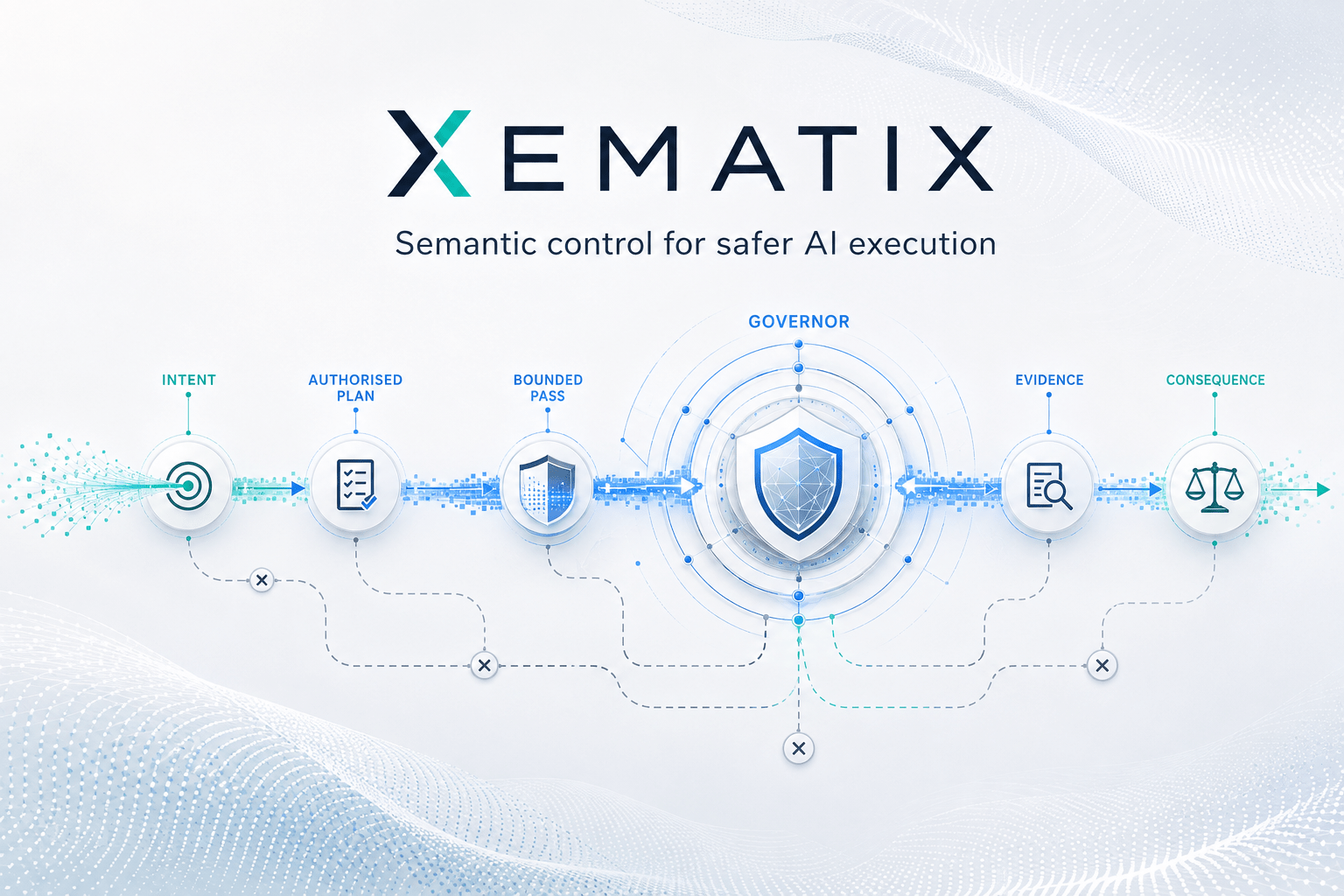
The XEMATIX inversion moves authority upstream and treats AI models as reasoning resources, not decision makers. The mechanism is simple: human intent is declared explicitly, the repository and approved execution pass become authoritative, execution is constrained to those bounds, and a governor decides whether a problem is a normal implementation defect or a true semantic contradiction.
Under that model, Luna doesn't get to reinterpret the job because it encountered friction. It executes within the approved pass against repository reality. If Luna finds a genuine contradiction, the governor can route the issue to Sol for reconciliation. But that reconciliation still doesn't become action automatically. It returns to human authority for approval before execution resumes.
That control logic prevents a specific failure pattern: distributed confirmation bias. Two AI agents derived from the same abstract specification can agree perfectly about the wrong thing. One generates elegant code, the other generates matching tests, and both confirm an approach that violates the original requirement. Their agreement doesn't validate intent. It only shows internal consistency.
So the repository becomes the source of truth, not the model's judgment. Sol is useful for exceptional semantic reconciliation. Luna is useful for bounded implementation. The separation matters because intelligence should determine how difficult a problem a model may reason about, not how much authority it possesses.
Smarter models don't remove the need for control. They increase the cost of getting control wrong.
Examples
A debugging case makes the distinction concrete. Suppose a payment processing function fails in production. In an autonomous setup, the planner may infer that the bug points to a deeper architectural weakness and redesign the billing pipeline. That can look impressive while still being exactly the wrong move.
Under external authority governance, the workflow stays narrower and more useful. Luna traces the failing path against the approved implementation, checks production state against repository contracts, identifies the specific deviation, and repairs within the approved boundary. If the issue is a missing validation step, that gets fixed. If the issue is a stale assumption about current state, that gets reconciled. Only if Luna can demonstrate that the approved contract is contradictory or impossible does the governor escalate the matter for semantic reconciliation.
The same pattern shows up in more ordinary engineering work. A model that encounters a slow query may decide the schema needs redesign when the real issue is a missing index. The reasoning may be technically sophisticated, but sophistication isn't the test. The test is whether the change is authorized by the approved pass and supported by repository truth. Without that constraint, the model starts redefining the problem instead of solving it.
Operationally, this creates a clean division of labor. Semantic exploration is valuable when you're dealing with architectural contradictions, unresolved conflicts between requirements, novel modeling problems, or cases where the governing approach itself may need revision. Bounded execution is valuable when the job is to follow known code paths, implement approved changes against repository state, repair concrete defects without expanding scope, run regressions, and reconcile code with existing contracts. Luna doesn't become trustworthy because it's less smart. It becomes trustworthy because the environment removes its authority to improvise.

Failure Modes
That said, this model has real tradeoffs. It gives up some speed in exchange for predictability. You can't point a powerful model at a vague problem and expect the workflow to stay stable. If the authority structure is underspecified, the system will fill the gap with inference, and inference is exactly where scope drift begins.
The most common failure mode is a weak execution boundary. If an approved pass says improve performance, you've granted implicit permission to revisit almost everything. A governed pass has to be concrete enough to constrain action, such as reducing query time for a specific table below a target threshold without changing the API contract. Constraint isn't bureaucracy here. It's the mechanism that preserves intent.
Another failure mode appears at the other extreme. If Luna is over-constrained, it can't handle legitimate edge cases and every nontrivial issue gets escalated. That turns governance into friction rather than control. The governor has to distinguish between ordinary implementation defects, which should be resolved within the pass, and true semantic contradictions, which justify reopening the question.
The deeper tradeoff is psychological. It feels natural to assume that better reasoning should earn more autonomy. With human teams, that often holds. With AI systems, it doesn't hold in the same way because capability doesn't produce judgment about scope, authority, or institutional intent. A more capable model often needs tighter governance precisely because it's better at generating plausible alternatives.
Close
What changes in practice is straightforward, even if it isn't easy. You stop treating the planning model as sovereign. You define intent before execution. You make the repository and approved pass authoritative. You require that contradictions be demonstrated rather than inferred. And you route architectural reconsideration back through human approval instead of letting it emerge from execution drift.
That's the practical implication of AI external authority governance. As model capability rises, execution safety should depend less on the model's internal judgment and more on the explicitness of the environment around it. The strongest system isn't the one with the most autonomous planner. It's the one where reasoning power, repository truth, and approval boundaries have been triangulated tightly enough that useful action can happen without intent getting rewritten along the way.
The question isn't whether your AI is smart enough to redesign your architecture. It's whether you've given it the authority to decide that redesign is the answer. Once that line is explicit, the workflow becomes far more reliable, and much harder to derail with a beautifully reasoned fix to the wrong problem.