AI Development Governance – When to Choose Structure Over Speed in Software Engineering
AI-assisted development promises speed, but speed isn't the same as control. The real decision is whether your project can tolerate ambiguity in how code gets produced, changed, and justified over time.
Opening
You're staring at another AI-generated pull request that works perfectly in isolation but breaks three things you didn't think to mention. The code is elegant, the tests pass, and yet it still feels unstable. Every exchange with an AI assistant can feel productive in the moment, right up until you step back and realize you've lost track of why certain decisions were made, which constraints actually mattered, and whether the architecture still serves the outcome you wanted.
That tension defines modern AI-assisted development. On one side, you have conversational tools that increase short-term velocity by making software generation feel as easy as talking. On the other, you have governed approaches that slow the first mile so the later miles are more predictable, auditable, and easier to manage. The choice isn't really about whether to use AI. It's about whether your project needs governed action more than raw speed.
A faint signal becomes structure only when it survives triangulation, feedback, constraint, and governed action before execution.
TL;DR
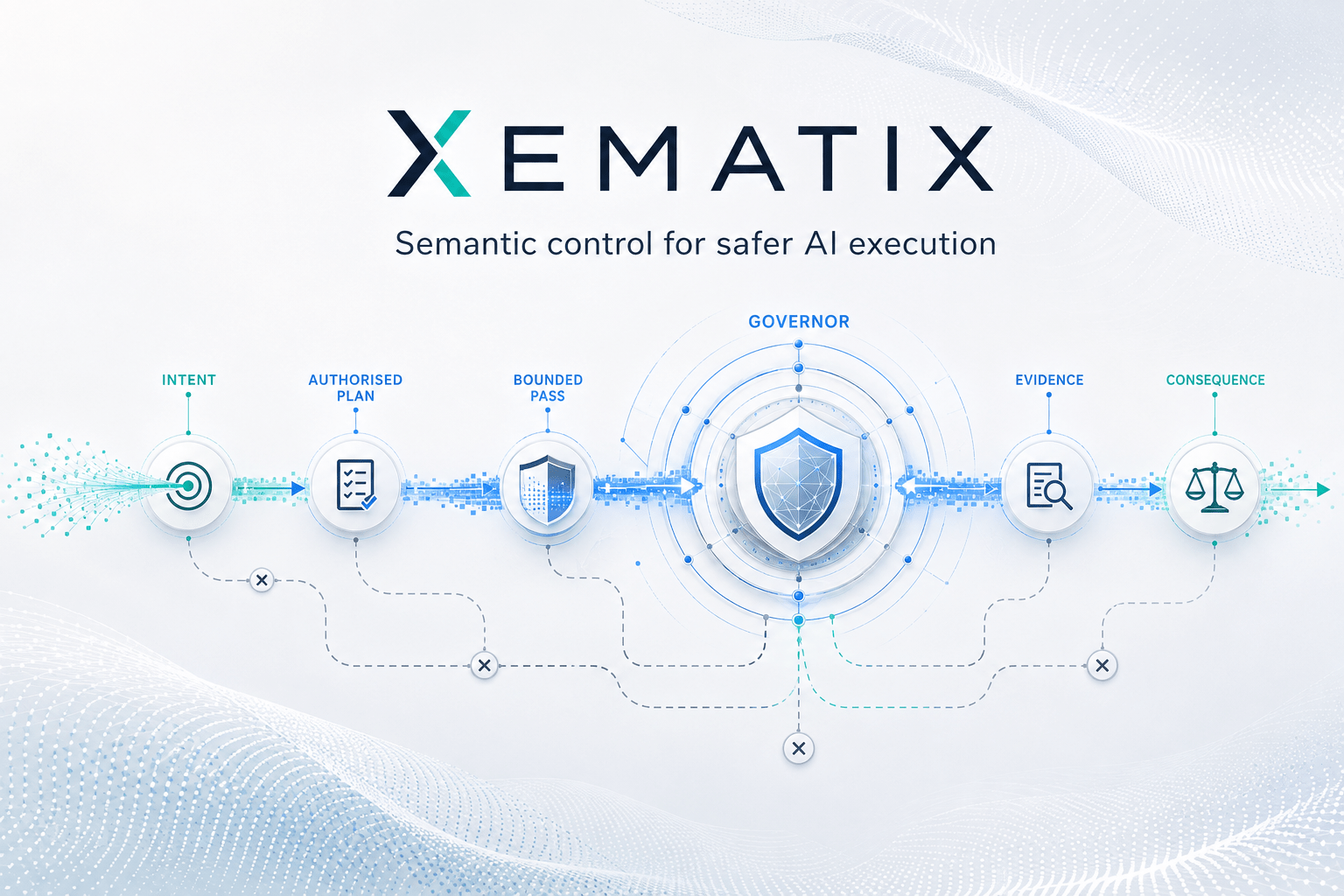
There are two practical models for AI-assisted development. Conversational AI assistants optimize for immediate productivity, rapid iteration, and low friction, but they usually leave weak audit trails and inconsistent constraint enforcement. Governed approaches such as XEMATIX reverse that emphasis by making authority, constraints, and success conditions explicit before implementation begins.
In practice, the tradeoff is straightforward. Freestyle AI development gets you moving faster and costs less to start, but it creates accountability gaps and scaling problems as systems and teams grow. Governance adds overhead at the beginning, yet it improves repeatability, traceability, and consistency. If your project has meaningful reliability, regulatory, or maintenance risk, structure is usually the better choice.
Options
The decision becomes clearer when you compare the two collaboration models directly. Most teams are already familiar with the conversational co-pilot. You describe a problem, the AI proposes code, you refine the result through dialogue, and eventually something works. Tools such as GitHub Copilot, ChatGPT, and Claude fit this pattern. The attraction is obvious: natural language input, fast prototyping, quick debugging, and the sense that an experienced pair programmer is always available.
That model works because it reduces friction. You can test ideas quickly, recover from blockers, and preserve creative momentum. But it also depends heavily on the quality of each prompt, the completeness of the context you've provided, and your ability to catch unstated assumptions before they spread into the codebase.
The governed implementer takes a different path. Instead of relying on conversational iteration as the primary control mechanism, it establishes boundaries up front. The human defines intent, constraints, and success conditions. The AI then operates within those limits, producing plans, implementations, and tests under explicit verification rules. In this model, the machine contributes capability, but authority stays with the human.
XEMATIX represents that governed philosophy. Rather than depending on chat history, it separates human authority from machine implementation and maintains classified memory states such as constitutional, operational, episodic, derived, and transient memory. The mechanism matters because it preserves the reasoning structure around the work, not just the final code. That creates a durable record of what the system was supposed to do, what conditions shaped implementation, and how decisions evolved across development cycles.
Comparison Criteria
Once those options are on the table, the useful question becomes how to evaluate them. The first criterion is control. Conversational AI gives you flexible interaction, but constraint enforcement is mostly informal. You can ask for a pattern, mention a requirement, or warn against a shortcut, yet there's no reliable guarantee the model won't infer something you didn't intend. Governed systems require more upfront specification, but they turn constraints into operational boundaries instead of conversational preferences. The testable implication is simple: if repeated reminders are necessary to keep the AI aligned, you don't really have control.
The second criterion is auditability. Chat-based workflows produce code and fragments of discussion, but they rarely preserve a structured record of why a decision was made, what alternatives were considered, or which assumptions were accepted. Months later, that absence becomes expensive. Governed approaches treat memory as part of the development substrate, which means intent and execution can be traced back through explicit states. If your team needs to explain not just what changed but why it changed, that difference isn't cosmetic. It's operational.
Development speed is the third criterion, and it's the one most teams overweight at the start. Conversational tools clearly win on immediate throughput. You can begin coding within minutes, iterate rapidly, and generate useful outputs before a formal process would even be configured. Governance slows that down because it asks you to define intent, constraints, and verification before implementation. Still, the real comparison isn't minutes versus hours at the start. It's whether faster starts lead to slower recovery later. If the system regularly needs rework because decisions weren't constrained early enough, the initial speed advantage shrinks.
That leads to the final criterion: scaling. Informal AI usage often works well for a single developer or a small team operating on a contained problem. As the project grows, the weaknesses become more visible. Different people prompt differently, apply different quality thresholds, and rely on different assumptions. The result is uneven code quality and architecture drift. Governed approaches impose a common operating method, which can feel restrictive, but they also improve consistency across contributors and over time.
The core issue isn't whether AI can generate code. It's whether the conditions around that code remain legible, testable, and enforceable as the system grows.
Tradeoffs
This is where the decision gets practical. Conversational AI trades long-term predictability for short-term momentum. It helps teams ship quickly, especially when requirements are still moving or the goal is exploration rather than durability. The downside is that undocumented assumptions accumulate quietly. You end up with code that works today but becomes harder to explain, extend, or trust tomorrow. The mechanism behind that failure is straightforward: each successful interaction optimizes for the local task, not for system coherence across many tasks.
That pattern shows up most clearly when projects move from experimentation to maintenance. A team can feel highly productive for weeks because every conversation produces visible output. Then the cost shifts. Edge cases multiply, architectural decisions stop making sense in aggregate, and review gets harder because the reasoning behind earlier changes was never formalized. What looked like speed turns out to be deferred coordination work.
Governed development inverts that curve. It front-loads complexity by forcing teams to articulate requirements, constraints, and verification logic before code generation accelerates. That isn't easy. Many assumptions that feel obvious in conversation become difficult to state precisely. Governance also introduces cognitive overhead because the team has to maintain explicit state and follow disciplined workflows. But the payoff is that later changes happen against a stable decision structure rather than against half-remembered chat context.
So the real tradeoff isn't process versus no process. It's where you want the difficulty to live. Conversational approaches make the beginning easy and the middle harder. Governed approaches make the beginning harder so the middle and later stages stay manageable. The right choice depends on whether your project can absorb ambiguity without serious cost.
Recommendation
If you're choosing between these models, the clearest dividing line is accountability. Conversational AI development makes sense when you're exploring ideas, building prototypes, or working on software you expect to replace, rewrite, or discard. In those cases, immediate velocity is genuinely valuable, and the cost of mistakes is often low enough to tolerate rework.
Governed development is the better choice when the cost of errors exceeds the benefit of maximum speed. That includes high-stakes systems where failures carry financial, safety, or regulatory consequences, long-lived products that need to remain understandable over time, team environments where consistency matters across contributors, and complex domains where unstated assumptions are likely to create downstream problems. In those settings, the governing claim is simple: structure becomes worthwhile when the system must remain explainable under pressure.
A practical way to decide is to apply the Triangulation Method and watch for three signals. If your team keeps repeating the same constraints to AI tools, if generated code regularly needs heavy review or rework before it's safe to merge, or if prior AI-assisted work is becoming difficult to interpret and extend, you're already paying for the absence of governance. At that point, adding structure isn't bureaucracy. It's a corrective mechanism.

For most organizations, the defensible recommendation is hybrid but staged. Use conversational tools for exploration and governed workflows for implementation once requirements, risk, or team coordination start to matter. The transition point isn't determined by project size alone. It's determined by whether the work now needs traceable decisions, persistent constraints, and clearer authority boundaries than chat alone can provide.
Close
Many teams won't choose one model forever. They'll start with freestyle AI usage while the problem is still fluid, then adopt stronger governance as the codebase hardens and consequences increase. That's a reasonable progression, as long as the shift happens before ambiguity becomes embedded in the system.
XEMATIX and similar approaches matter because they treat AI development governance as an engineering choice rather than a philosophical preference. They assume that useful collaboration between humans and machines requires more than output quality in the moment. It requires a method for carrying intent through constraint into implementation without losing accountability along the way. When your project can absorb uncertainty, speed may be enough. When it can't, structure stops looking slow and starts looking necessary.