Intent-Driven Architecture – Why Software Should Decompose by Purpose, Not Interface
Most enterprise software doesn't fail because teams are careless. It fails because the architecture asks one interface to absorb too many purposes.
That design choice seems efficient at first, but it steadily turns software into a larger target for complexity, dependency, and procedural drag. Intent-driven architecture takes the opposite position: decompose by purpose, then govern how those purposes cooperate.
Opening
Every enterprise software suite eventually starts to resemble a digital landfill. What begins as a focused application accumulates features, workflows, permissions, and integrations until the interface becomes the work. Teams spend more time navigating menus than making decisions, while vendors gain leverage from the fact that basic changes now require touching a bloated, tightly coupled system.
The problem isn't mainly execution. It's architectural. For decades, software has been organized around interfaces instead of purposes, which means unrelated jobs get bundled into the same operational surface simply because they live in the same application. XEMATIX Intent Fabric argues for a different decomposition: software should be broken into purpose-built components that cooperate through governed intent envelopes rather than forced into one expanding interface boundary.
TL;DR
The strategic claim is straightforward. Software works better when capabilities are separated by purpose, not collected behind a single application shell. In that model, small components handle bounded jobs and communicate through governed intent envelopes that carry meaning, authority, constraints, and expected outcomes. That changes integration from a field-mapping exercise into a governed exchange about what is being requested, who is allowed to request it, what rules apply, and what counts as success. It also shifts the human role upward. Instead of learning procedural software operation, people express intended outcomes while the system routes execution across specialized components.
Core Argument
That shift matters because the traditional enterprise model concentrates too much responsibility inside one application boundary. A CRM, for example, doesn't stay a customer system for long. It becomes a document system, a workflow system, a reporting system, a permissions system, and often a payment and communication system too. Each added capability may solve a local need, but together they create a structure that is harder to change, harder to govern, and more expensive to replace.
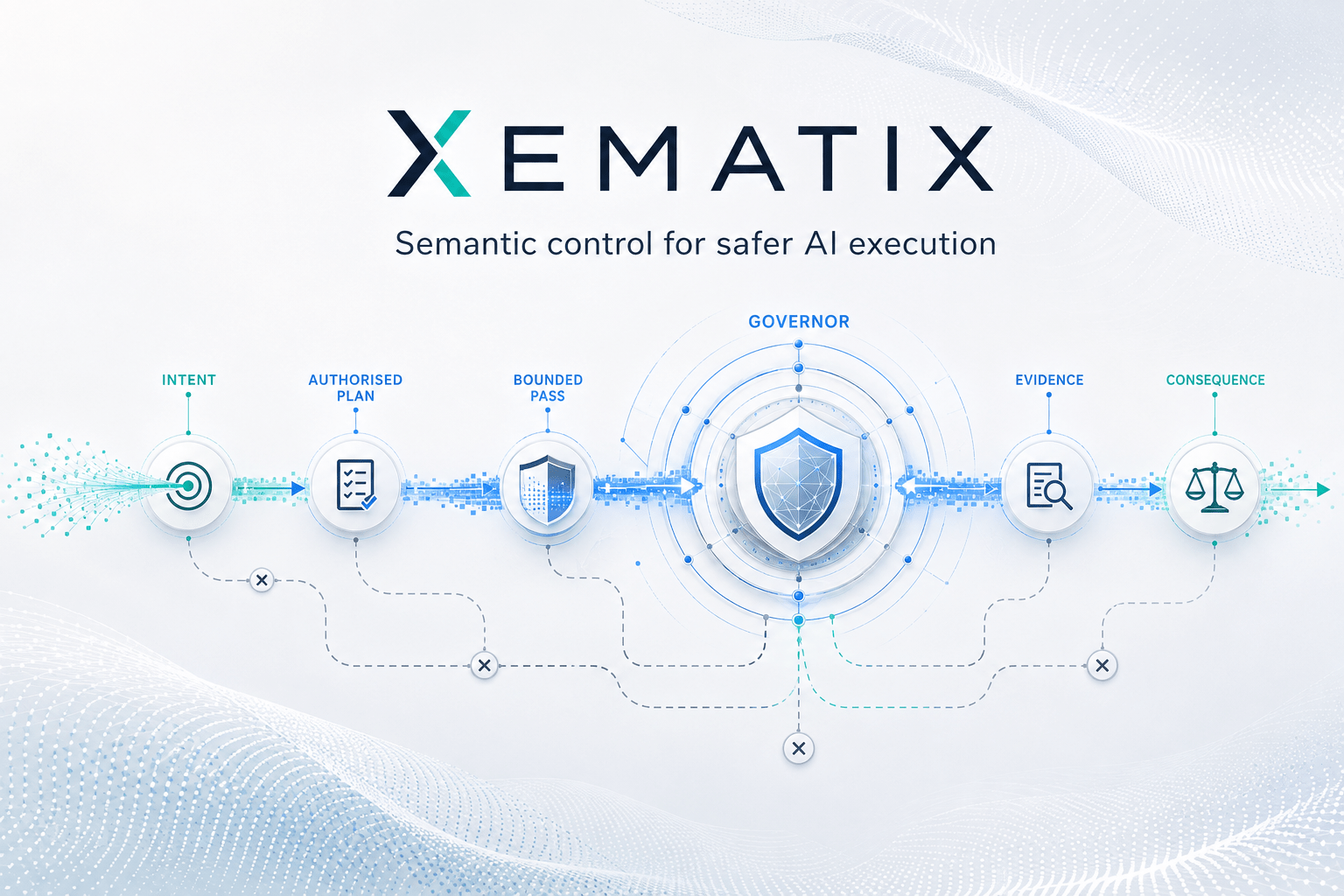
Intent-driven architecture reverses that pattern. Rather than asking one application to host every capability, it separates work into purpose-built components and coordinates them through governed intent envelopes. The envelope is the contract. It defines what the human is trying to accomplish, who authorized the request, which constraints apply, what evidence matters, what success looks like, and where the result and rationale must return. That is the mechanism that turns a faint request into governed action: the intent survives triangulation through authority, feedback, and constraint before execution begins.
The key design move is simple: stop integrating screens and start governing purpose.
Once the contract becomes semantic, the integration point changes as well. Systems no longer exchange only fields and endpoints. They exchange purpose, authority, constraints, and outcome expectations. That difference is operational, not rhetorical. If a request arrives without the right authority, required evidence, or policy conditions, the receiving component can refuse, escalate, or route it without pretending that a valid payload equals a valid action.
A valuation request makes the distinction clear. In a conventional environment, a user logs into a valuation application, navigates screens, gathers inputs from identity systems and document stores, and manually shepherds the process forward. In an intent-driven environment, the user expresses the outcome directly: validate the machine's current replacement value using approved evidence, apply valuation policy, identify unresolved uncertainty, and prepare the result for expert review. XEMATIX then structures that request into governed envelopes and routes them to the appropriate components for evidence collection, identity verification, valuation, and review. Each component operates within a bounded responsibility, and each action remains tied to the governing contract that authorized it.
Examples
That architecture becomes easier to understand when you view it through operational decomposition. In insurance claims, a single claims platform often tries to manage identity checks, evidence review, policy interpretation, exception handling, and claimant communication inside one system. An intent-driven design separates those jobs. One component confirms claimant credentials and policy status. Another assesses photos, documents, and third-party reports. Another applies coverage rules and calculates settlements. Another routes edge cases to human reviewers. Another generates and delivers status updates.
The important point isn't that these are separate services. It's that each receives a governed request that specifies exactly what it may do and what it must not do. The identity verifier can confirm credentials but can't approve a claim. The policy component can apply coverage rules but can't override a fraud flag. Because authority and constraint are carried with the request, responsibility stays bounded even when multiple components contribute to one outcome.
That boundedness has a direct strategic consequence: replaceability improves without forcing wholesale redesign. If a new fraud detection capability appears, it can join the environment through the same intent contract instead of requiring every adjacent system to be reworked around a new interface assumption. The architecture remains modular because the stable element is the governed purpose, not one vendor's implementation details.
A financial services firm used this approach in loan origination by deploying specialized components for credit scoring, income verification, document processing, and compliance checking instead of relying on a monolithic loan management system. Loan officers expressed the outcome they needed, such as evaluating an application for a standard mortgage product, rather than stepping through dozens of screens. Processing time dropped 40 percent, and audit trails became more comprehensive because each action was tied to an explicit request, policy condition, and result.
When the contract carries purpose and constraint, modularity stops being a diagram and starts becoming an operating reality.
Counterpoints
The strongest objection is also the most predictable: this sounds like microservices with extra steps. That comparison is useful up to a point, because both approaches break large systems into smaller units. But the governing claim of intent-driven architecture is different. Microservices usually decompose code and infrastructure. Intent-driven architecture decomposes operational purpose and governs the contract that coordinates it.
An API endpoint such as POST /validate-identity can move data effectively, but it typically says very little about why the request exists, who is authorized to make it, which policy controls apply, what fallback path is allowed, or what evidence must be preserved. An intent envelope carries those conditions as part of the request itself. That makes the receiving component accountable to more than syntax. It must respond to the full contract, not just a well-formed payload.
The testable implication is clear. If two components accept the same semantic contract, they should be replaceable with less disruption than components tied to proprietary screen logic or narrow endpoint assumptions. That is why this model aims at semantic interoperability rather than simple connectivity. The system is held together by governed meaning, not merely by compatible transport.
A second objection is more serious: doesn't this just move lock-in to the protocol layer? In one sense, yes. Intent-driven architecture requires governance standards, contract discipline, and protocol compliance. You don't escape coordination costs; you relocate them to the level where they can be inspected and governed.
That is still a better trade if the protocol remains open, explicit, and separable from any one vendor's interface stack. Traditional lock-in traps organizations inside proprietary workflows, training burdens, and application boundaries that are painful to unwind. Protocol-level dependence is different because it anchors the organization in a governed way of expressing intent and authority rather than in a single vendor's bundled implementation. The switching question becomes narrower and more manageable: can a replacement component understand and fulfill the contract under the same constraints?
This is where the Triangulation Method matters. A new architectural signal only becomes durable structure if it survives three tests at once: it must express the business purpose clearly, operate under explicit governance, and produce results that can be reviewed and improved through feedback. Intent-driven architecture passes that test when the envelopes are not just transport wrappers but enforceable contracts for action.

Close
The case for intent-driven architecture is strategic, not cosmetic. Decomposing software by purpose makes systems smaller at the point of responsibility, more interoperable at the point of coordination, and more replaceable at the point of change. It also improves the human experience by moving attention away from procedural navigation and back toward domain judgment.
That doesn't mean the shift is trivial. It requires organizations to stop asking only how systems connect and start asking what governed intent is actually being executed, under which constraints, with what proof, and toward which outcome. But that is exactly the right level of rigor for enterprise software that needs to remain adaptable without becoming incoherent.
XEMATIX Intent Fabric formalizes this position. Purpose-built components cooperate through governed intent envelopes, each one responsible for a bounded outcome, constrained by explicit authority, and required to return evidence with the result. If that model holds, then the future of enterprise software won't belong to the largest interface. It will belong to the architecture that can preserve purpose under change.