Most data and AI failures don't begin with bad models or weak infrastructure. They begin when the same business term means different things in different systems, and no one notices until the outputs conflict.
That's why semantics has become an operating concern, not a documentation exercise. Once shared meaning affects budgets, forecasts, and model behavior, it belongs in the control plane.
Opening
Your data science team calls them “active customers.” Your marketing automation platform calls them “engaged users.” Your AI model calls them “high-propensity prospects.” Each definition seems reasonable in isolation, but when they diverge, and they usually do, the cost compounds quickly. A recommendation engine trained on one definition feeds a dashboard built on another, which triggers campaigns targeting a third population entirely.
The immediate waste is easy to spot: rework, conflicting reports, brittle pipelines, and meetings spent arguing over numbers. The larger cost is slower and more damaging. Trust erodes. When business leaders can't rely on consistent definitions across tools, they stop trusting the outputs altogether. A major AI investment then becomes a sophisticated way to automate inconsistency.
That friction is what turns semantics into an executive issue. Once shared meaning determines whether systems produce defensible results, it stops being a local engineering concern and becomes a governed capability.
The problem isn't that teams lack definitions. It's that the enterprise lacks a way to enforce one meaning across many tools.
TL;DR
Semantics has moved from technical implementation to strategic control. In practice, that means shared business meaning can't live only in tribal knowledge, tool-specific logic, or static documentation. It has to be governed as an operational asset that survives handoffs between analytics, applications, and AI systems.
The mechanism is a semantic control layer. Rather than asking teams to keep definitions aligned through process alone, you define business concepts once at the business-logic level and translate them into consistent implementations across the stack. That changes procurement as well. The useful question is no longer whether a platform contains metadata features, but whether it can enforce unified business meaning wherever business logic is executed.
Core Argument: From Technical Task to Enterprise Control
Traditional semantics tries to make individual tools work correctly. Enterprise semantics tries to make many tools work together reliably. That sounds like a subtle distinction, but it changes ownership, architecture, and operating discipline.
In the traditional model, semantics lives close to implementation. Engineers define schemas, map fields, and write transformation logic so each system can function. The work is necessary, but it's local. One team solves for one platform at a time, and nothing guarantees that “customer, ” “revenue, ” or “active” means the same thing across the CRM, warehouse, dashboard, and ML pipeline. That approach can hold as long as tools operate independently. It starts to fail when outputs are chained together and one system's definition becomes another system's input.
Enterprise semantics moves the control point up a level. Instead of treating business meaning as something every team reinterprets during implementation, it treats core concepts as governed assets with authoritative definitions. You define the concept once in business terms, then the platform enforces that meaning wherever the concept appears. The governing claim is simple: if business concepts drive decisions across systems, their meaning has to be controlled centrally even when the systems themselves remain distributed.
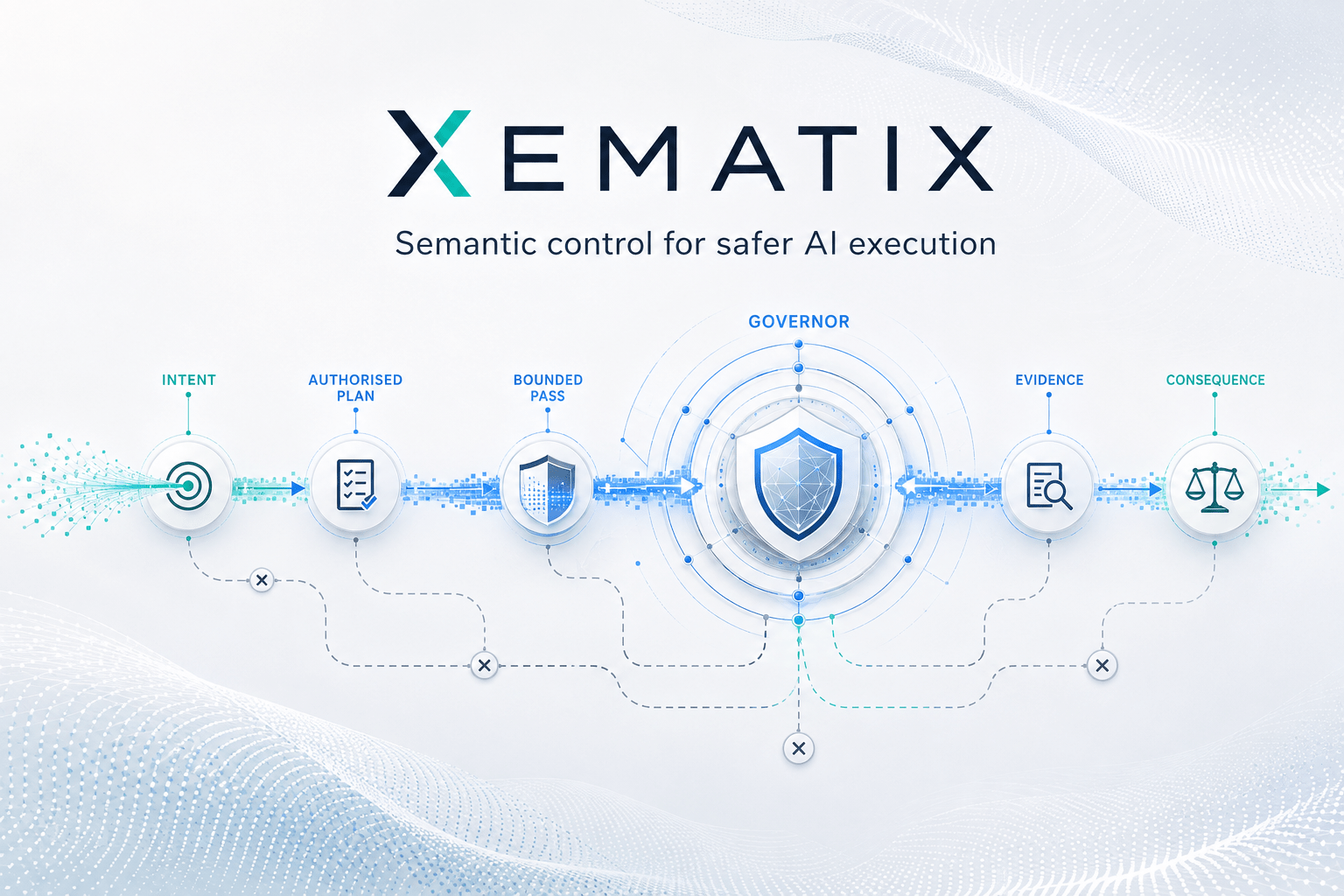
The mechanism behind that claim is a control layer between business intent and technical execution. This layer doesn't replace databases, applications, or models. It translates governed business logic into the form each connected tool requires while preserving the same meaning. If an executive asks for active customers, the answer shouldn't depend on which interface, model, or workflow happens to process the request. It should resolve to one governed concept expressed consistently everywhere.
This is where the Triangulation Method matters. A business term becomes operationally trustworthy only when it survives four pressures: triangulation across functions, feedback from real use, constraint from governance, and governed action in production systems. A faint signal such as “we all know what an active customer is” becomes durable structure only when finance, marketing, analytics, and product can converge on one definition, test it against outcomes, constrain exceptions, and enforce it across tools.

CAM-based control layers are useful here because they provide a place to do that work deliberately. They let organizations define concepts at the right level of abstraction, connect those concepts to executable logic, and maintain control as requirements change. The testable implication is straightforward: once meaning is governed in a control layer, conflicting outputs caused by tool-specific definitions should decline. The operational consequence is just as clear: semantic consistency becomes something you can engineer, monitor, and budget for.
Examples
Consider “Active Customer.” In a fragmented environment, analytics may define it as a purchase within 90 days, marketing may use engagement within 30 days, and model training may treat any transaction within 180 days as sufficient. None of those choices is irrational on its own. The problem is that each one creates a different population, so the organization ends up measuring, targeting, and predicting against different realities while using the same label.
With a semantic control layer, the concept is defined once at the business-logic level, for example: a customer who has completed a transaction within 90 days or has engaged with marketing content within 30 days and has not requested account closure. That definition becomes the governed object. From there, the control layer translates it into the technical form each environment needs. A dashboard gets the correct SQL logic. A marketing platform gets the right API-resolvable segment. An ML pipeline receives a feature definition aligned with the same business concept.
What changes in practice is less dramatic than many teams expect, which is part of the appeal. Analysts still use dashboards. Marketers still run campaigns. Data scientists still build models. The difference is that they no longer recreate core definitions independently inside their own tools. The workflow becomes more stable because business meaning is set upstream and propagated deliberately rather than rediscovered downstream through implementation.
That also changes change management. If the business decides that recent support-ticket activity should count toward active status, you don't open separate workstreams across every tool owner and hope the updates stay synchronized. You update the governed concept once, review the rule under the relevant controls, and let the control layer distribute the new logic consistently. The mechanism reduces coordination drag because the enterprise no longer relies on manual alignment as its primary control.
A catalog can tell you definitions differ. A control layer changes the conditions that allow them to differ in production.
Failure Modes
This shift brings understandable skepticism, and some of that skepticism is healthy. The first objection is that this sounds like another Master Data Management program with a new label. That concern exists for a reason: many organizations have invested heavily in centralized governance efforts that introduced process overhead without fixing day-to-day inconsistency.
The distinction is in what gets centralized. Traditional MDM often tries to centralize data itself inside a monolithic model. A semantic control layer centralizes business logic, not all underlying data or all tool usage. The systems remain distributed. Teams keep their platforms and workflows. What changes is that shared business concepts are no longer reauthored independently in every environment. The governed layer is narrow by design, which makes it more practical to adopt and easier to connect to existing operations.
A second failure mode is scope. If an organization attempts to govern every term across every domain at once, the program usually stalls before proving value. The better operating pattern is to start where inconsistent meaning already creates material downstream cost. That usually means a small set of high-consequence concepts such as customer, revenue, qualified lead, churn risk, or product availability. Under the Triangulation Method, those concepts are the right starting point because they can be validated across functions, tested against real outcomes, constrained through policy, and tied directly to execution.
A third objection is that better documentation should be enough. It usually isn't. Documentation records intent. Control changes behavior. That difference matters because most semantic breakdowns happen after documentation exists, when teams implement local variations for speed, convenience, or legacy compatibility. If the enterprise can't detect and prevent those variations from spreading into production logic, it still doesn't have semantic control.
There is a real tradeoff. Adding a control layer increases architectural complexity and requires stronger discipline around concept ownership, versioning, and exception handling. But complexity already exists in most enterprises; it's just hidden inside duplicated logic and inconsistent outputs. A control layer makes that complexity explicit and governable. The decision condition, then, isn't whether control adds overhead. It's whether the business cost of unmanaged meaning is high enough that explicit control is the cheaper option. For organizations making consequential decisions through data products and AI systems, it often is.
Close
This is why enterprise semantics control has become a budget line item for CAIOs and senior platform leaders. The issue isn't whether semantics matters in theory. It's whether your operating model can preserve shared meaning as data moves through dashboards, applications, models, and decisions.
That reframes procurement. Processing speed, storage scale, and integration breadth still matter, but they don't answer the more important question: can the platform enforce consistent business meaning across the stack? A platform that can't do that may still perform well technically while producing outputs the business can't defend consistently.
The practical test is simple. Ask where core business concepts are defined, how those definitions are translated into tool-specific logic, what controls govern changes, and how the organization detects drift between intended meaning and implemented meaning. If the answers depend on documentation, heroic coordination, or manual cleanup, the control layer is still missing.
When shared meaning is governed, data and AI investments become more reliable because their outputs rest on the same business logic. That doesn't remove every disagreement, but it does change the nature of the disagreement. Teams stop arguing about what a term means in each tool and start making deliberate decisions about the business rules that should govern the enterprise. That's the point where semantics stops being a background engineering task and becomes a durable operating capability.