Why Deterministic AI Architecture Beats Probabilistic-First – The Case for Building Structure Before Intelligence
Most AI programs begin with model capability and treat governance as cleanup. That sequence feels faster at first, but it usually pushes the hardest questions downstream.
The stronger approach is less glamorous and more durable: build the structure first, then let AI operate inside it. In high-stakes workflows, that order changes what can be automated, what must be governed, and what humans are actually responsible for.
There are two paths to bringing AI into consequential workflows. Most organizations choose the obvious one: start with the intelligence, then add governance around it. Worthify chose the harder path: build the deterministic foundation first, then let AI orchestrate within known boundaries.
That difference isn't philosophical. It's operational. One approach finds simplicity by deleting workflow that never needed to exist. The other surrounds ambiguous processes with validation layers because the underlying semantics were never properly bounded.
TL;DR
Deterministic-first architecture exposes where real decisions actually live, which makes it possible to remove human ceremony instead of adding more review around it. In that model, reports stop being AI-generated artifacts and become renderings of governed state, where evidence lineage, calculations, and authority are structurally known before prose appears. The practical test is simple: good architecture should reduce human action while clarifying human authority.

The Fork in the Road
The probabilistic-first path usually starts with an appealing sequence: AI reads everything, values the machine, and an expert approves the report. It looks elegant until you ask the questions that matter in any defensible system. What evidence did it actually use? Which analysis attempt produced the recommendation? Which machine identity was in scope? Was that photo admitted? Which component state was current? What changed after the recommendation was made?
Those aren't edge cases. They're the system boundary. If you start with probabilistic outputs, you eventually have to retrofit governance around unbounded meaning. The result is predictable: more human validation wrapped around a process whose structure was never explicit enough to govern cleanly.
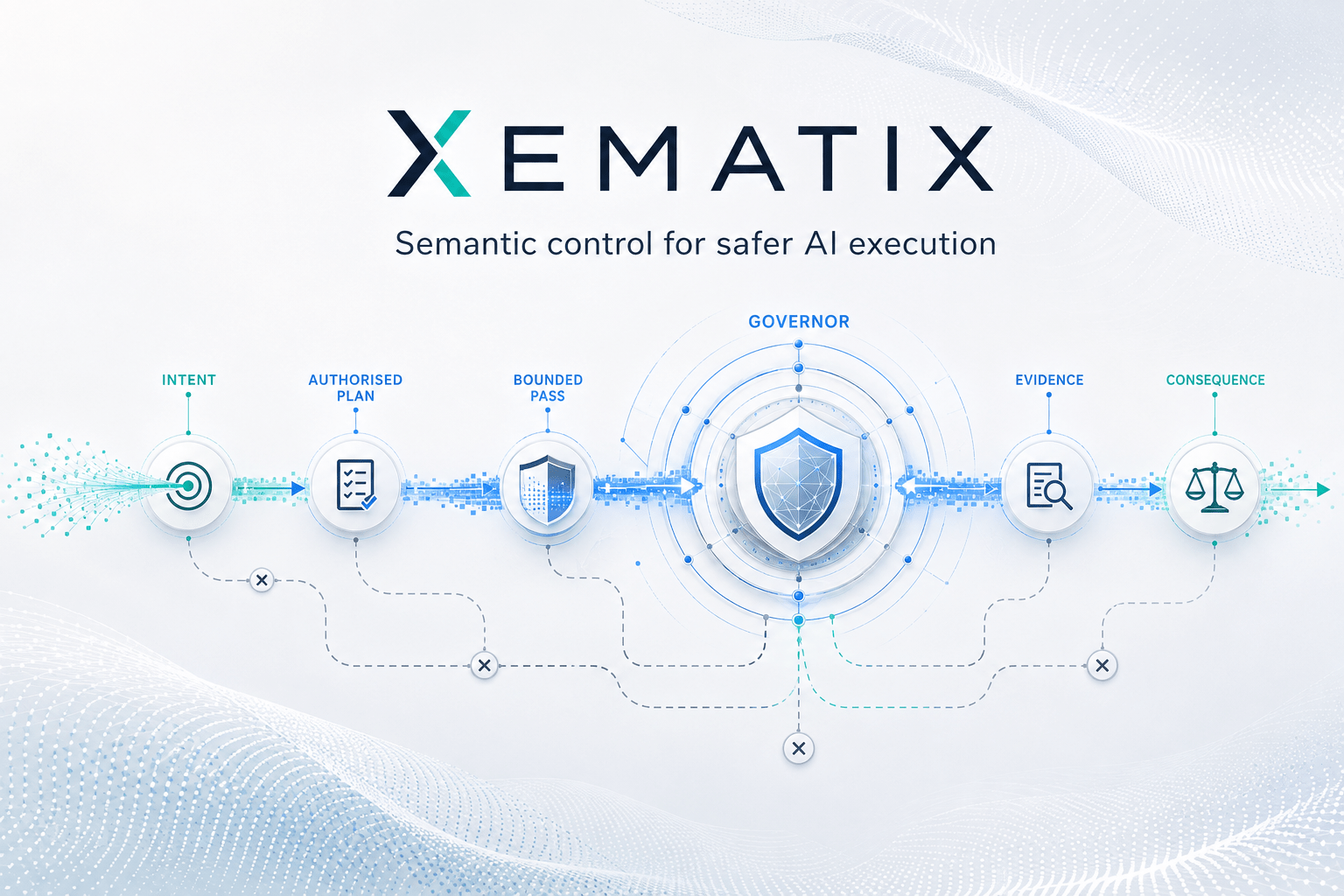
Worthify built in the opposite order. Deterministic authority came first, then explicit state, then explicit decisions, then AI orchestration, and only then compressed human interaction. That meant putting the machinery in place early: custody protocols, evidence lineage, identity authority, package fingerprints, deterministic calculations, currentness rules, role boundaries, append-only decisions, and snapshots. At the time, some of that structure felt heavier than the eventual user experience. But that heaviness served a purpose. It revealed where the actual decisions were and separated them from workflow residue.
If you can't name what counts as evidence, state, and authority before AI acts, you're not governing AI. You're governing uncertainty after the fact.
What Good Looks Like Operationally

The real test of architecture isn't whether it feels elegant on a diagram. It's whether it can delete workflow in practice. Worthify can remove most human ceremony because the structure knows which decisions matter and which actions were only there to compensate for ambiguity.
Consider report approval. In a probabilistic-first design, approval is often a black-box gesture over uncertain inputs and partially hidden reasoning. In Worthify's deterministic foundation, approval has structural meaning. The expert is authorizing a specific set of admitted evidence, calculations, exceptions, and conclusions that already exist in governed state.
That changes the status of the report itself. It is no longer accurate to say that AI generated a valuation report. The report is better understood as a rendering of a governed, signed state. AI may have assembled much of that state and proposed the conclusion, but the evidence, lineage, calculations, and authority are all known before the prose is produced.
This distinction has an operational consequence, not just a linguistic one. If a client challenges a valuation six months later, the organization isn't forced to defend a model's opaque reasoning. It can point to a deterministic audit trail that shows exactly what was known, when it was known, what rules applied, and who exercised authority.
Where Deterministic Structure Can Go Wrong
That doesn't make deterministic-first architecture automatically virtuous. The strongest counterposition is real: bottom-up engineering can harden into architecture for its own sake. Teams are very capable of building intricate systems that formalize everything except the one decision that actually matters.
So the question isn't whether deterministic structure sounds rigorous. The question is whether it produces a simpler governed experience. Worthify provides a useful answer because the architecture is now enabling workflow deletion. If the deterministic substrate required more gates, more screens, and more approvals, its value would be doubtful. Instead, it is allowing more machine work, fewer human actions, and clearer human authority.
That leads to the governing claim of the article. Determinism shouldn't make the experience feel more rigid. It should make the experience simpler because uncertainty has somewhere explicit to go. When constraints are structural rather than improvised, AI can operate more freely without making the process less defensible.
The proof of good AI architecture isn't that it controls every action. It's that it makes unnecessary actions disappear.
The Real System Boundary
Most discussions of AI governance focus too late in the process. They ask how to validate outputs when the more important question is how to bound inputs, operations, and meaning before outputs ever appear. Worthify reverses that sequence. The probabilistic capability operates inside deterministic constraints that define what it is allowed to know, what it is allowed to act on, and what its work is allowed to mean.
That's the mechanism that matters. Evidence admission follows custody rules. Calculations follow deterministic logic. State changes follow append-only protocols. Identity and role boundaries define who can authorize what. Within those constraints, AI can do a great deal of orchestration. But it doesn't get to define the rules that make its outputs governable.
This creates a cleaner division of authority between human and machine. The expert isn't validating hidden reasoning after the fact. The expert is exercising governance over a process whose structure is already explicit. Likewise, the AI isn't inventing meaning from opaque logic. It is assembling governed state inside a framework that already specifies what valid work looks like.

A Concrete Example That Forces Clarity
A manufacturing equipment valuation makes the difference visible. Imagine a critical component showing unexpected wear. In a probabilistic-first system, AI may identify the issue and suggest an adjustment factor, but the expert then has to validate both the detection and the adjustment logic. Did the model apply the same standard to comparable sales? Was the adjustment method defensible? Did the recommendation depend on evidence that shouldn't have been admitted?
In Worthify's deterministic approach, those questions are handled much earlier and much more cleanly. Wear detection follows explicit evidence protocols. The component state is captured with custody lineage. The adjustment calculation follows deterministic rules applied to governed data. By the time the expert reviews the case, the work has already survived triangulation through evidence, calculation, and authority. The expert isn't being asked to rescue an ambiguous recommendation. They are authorizing or rejecting a structured conclusion whose boundaries are already known.
That difference becomes even more important over time. If the client questions the adjustment months later, the organization can show what evidence was admitted, which rules were applied, what state was current, and what authority the expert exercised. AI's role remains visible but contained: orchestration within known constraints, not reasoning within hidden logic.
Making Probabilistic Capability Safely Disappear
The end state isn't better AI theater. It's a workflow where probabilistic capability becomes quiet infrastructure because deterministic structure contains its failure modes. That is the strategic advantage of deterministic AI architecture. It doesn't reduce intelligence. It makes intelligence usable in environments where authority, lineage, and defensibility matter.
This requires a different build order and, just as important, a different belief about what AI is for. The goal isn't smart AI with governance layered on top. The goal is governance structure with AI orchestration inside it. Intelligence serves the structure, not the reverse.
When that works, the benefits compound in ways that matter operationally. Experts spend their time on judgment that carries authority rather than validation that exists only because the system is ambiguous. Clients receive results that are more understandable and more defensible. The organization gets automation without surrendering clarity.
In the end, the stronger architecture is the one that survives constraint and then gets out of the way. That is why deterministic AI architecture beats a probabilistic-first design in high-stakes workflows. It doesn't just produce outputs. It produces governed action.