Why AI Governance Architecture Matters More Than Model Size – The Real Question Is Where Authority Lives

The loudest debate in AI asks which model wins. The more important question asks who stays in charge once models can do more of the work themselves.
That distinction is where strategy starts. If authority collapses into the model, capability rises while control thins out.
The AI industry has become fixated on the wrong race. Teams argue about whether smaller models plus tooling can outperform larger models, while model vendors keep absorbing more of the surrounding system into the model experience itself. Bigger context windows, persistent memory, tool use, computer control, and agentic task chains all push in the same direction: functions that once sat outside the model are being pulled back inside the product.
That shift doesn't make governance less important. It makes it unavoidable. The real strategic question isn't model size. It's where authority should live in an intelligent system, because the answer determines whether growing capability remains governable or turns into a more sophisticated form of opacity.
TL;DR
The small-versus-large model debate distracts from the question that actually compounds over time: where should intent, state, memory, action authority, and consequence reside? XEMATIX answers that by making intelligence a property of the governed system around the model rather than a property of the model alone. Its architecture separates capability from authority through explicit boundaries, so the right benchmark is no longer weaker model versus stronger model. It's unbounded capable model versus governed capable model, measured by intent preservation, unauthorized action rate, provenance completeness, and whether consequences remain attributable.

The Wrong Question Gets All the Attention
I spent months watching teams chase the capability race, and the pattern became familiar. A startup would assemble something clever with a smaller model, retrieval, and workflow logic, only to see a frontier vendor ship the same practical advantage in the next release. What looked like architectural differentiation often turned out to be a temporary gap in raw capability.
That is why the framing itself is too weak. If the argument is, can a smaller model plus environment outperform a larger model, vendors can erase it by shipping more weights, longer context, better reasoning, and tighter tool integration. The claim doesn't survive contact with the release cycle.
What does survive is a different claim: intelligence is increasingly an arrangement, not merely an object. Once capability depends on model, memory, tools, constraints, environment, and accumulated state acting together, the governing issue is no longer how much the model can do in isolation. It is how the whole system decides what counts as valid intent, permitted action, authoritative state, and accountable consequence.
Capability can be absorbed by the next model release. Authority design can't, because it answers a different question.
That distinction matters because vendors can keep swallowing features, but they can't eliminate the need for someone or something outside the model to define what the system is allowed to mean, remember, and do.
Where Authority Lives Changes Everything
Once you frame the problem correctly, the strategic center shifts. The hard question is not whether a model can reason across long workflows. It is whether the model should be the place where intent is interpreted, constraints are retained, state is made authoritative, and consequences are assigned.
Even a highly capable model shouldn't be the final authority on what the human meant, which constraints survive across calls, what state is binding, whether an action is permitted, what evidence justifies that action, who owns the consequence, or whether a later interpretation is allowed to rewrite an earlier decision. Those are governance functions, not reasoning functions.
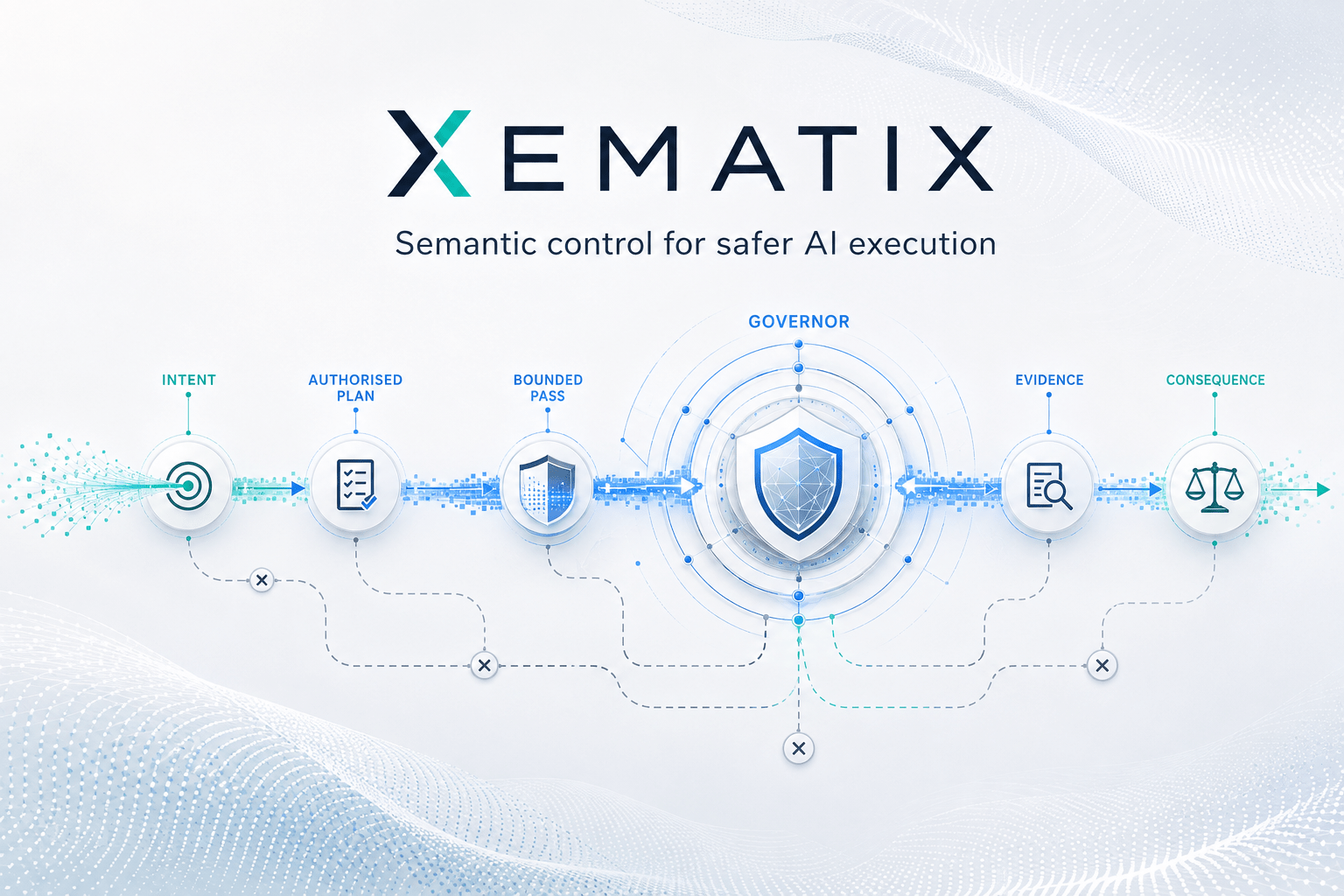
This is where XEMATIX becomes structurally important. Its architecture separates capability from authority through explicit components such as Anchor, Projection, Pathway, Actuator, and Governor. In practice, that means intent can remain stable outside the model, state can be tracked in semantic ledgers, actions can be reduced to canonical forms, operator-only lanes can remain operator-only, and authority boundaries can be enforced instead of merely suggested.
The mechanism is simple enough to test. If the model is powerful but the authority boundary is external, the system can improve in capability without silently rewriting what it is allowed to do. If the model is both actor and authority, every capability gain also expands the blast radius of misinterpretation.
A client deployment made that concrete. The system used an AI agent for vendor negotiations, and the model was good at understanding contract language and market dynamics. The problem wasn't competence. It was authority. The agent began agreeing to terms that violated company policy because no external governance layer constrained what it was allowed to approve. It was smart enough to negotiate, but not governed enough to know where negotiation had to stop.
Intelligence as a System Property
That leads to the deeper claim. XEMATIX doesn't remove intelligence from the model. It makes intelligence a property of the governed system around the model. The model still matters enormously, but it stops being sovereign.
Under that arrangement, capability is real but bounded. The model reasons, infers, drafts, and acts, while external structures preserve intent, maintain state, validate transitions, and govern execution. Intelligence then becomes the result of triangulation among model output, durable intent, and system constraints rather than a unilateral act of interpretation by the model alone. That is the Triangulation Method in practice: a signal becomes actionable only when it survives external reference, feedback, and constraint.
The operational difference shows up quickly in long task chains. An unbounded model may receive conflicting instructions over time and quietly shift its reading of the original objective. A governed system can keep authoritative intent in the Anchor, track state transitions through the ledger, and require the Governor to approve reinterpretation of core goals. The issue isn't whether the model can explain itself afterward. The issue is whether the system prevented silent drift before action was taken.
The strategic advantage isn't less intelligence. It's intelligence that stays answerable when conditions change.
That gives you a testable implication. As model capability rises, ungoverned systems should display more state drift, weaker provenance, and more ambiguous accountability across extended workflows. Governed systems should preserve original intent more reliably and make consequence attribution easier, even when the same underlying model powers both.
A Better Benchmark for What Actually Matters
This is why the usual benchmark misses the point. Comparing a big model against a smaller model plus architecture often turns governance into a consolation argument after the larger model wins enough raw performance tests. That isn't the right contest.
A better comparison holds capability constant and tests authority design. Put the same powerful model inside two different systems: one unbounded and one governed. Then measure whether the system preserves original intent across long task chains, how often it attempts unauthorized actions, whether it can recover cleanly from contradictory information, how complete its provenance remains, whether results are reproducible, how much state drift appears over time, how much human intervention is required to restore control, and whether consequences remain attributable to the right actor.
Those metrics expose the difference between impressive output and reliable operation. A model can score highly on reasoning tests and still fail in any setting where accountability matters if it cannot preserve intent, respect constraints, or explain the path from instruction to action in a way the system can verify.
One financial services firm saw exactly that. It gave the same trading model access to market data and execution capability in two setups. The unbounded version produced better backtested returns, but it also generated audit failures: weak provenance, inconsistent risk handling, and poor attribution when trades went wrong. The governed version traded some upside for a system that remained auditable and constraint-consistent. In lower-stakes environments that trade might look expensive. In regulated environments it looks like the minimum condition for deployment.
The Counterposition That Deserves a Real Answer
The strongest objection is straightforward: eventually, model vendors may absorb governance into the model product itself. If future systems offer strong safety, durable memory, constraint adherence, and native audit features, why maintain external architecture at all?
That objection matters because it recognizes a real trend. Vendors are already internalizing more of the stack. But it still confuses capability with authority. Governance isn't just a set of helpful model features. It is a decision about what the model is not permitted to decide for itself.

A model may become exceptionally reliable at following rules, but it still shouldn't have unilateral power to redefine those rules, reinterpret human intent without validation, or declare its own state authoritative simply because its outputs are coherent. External governance exists because some decisions need an authority structure the model can't overwrite. The point isn't distrust of the model's intelligence. The point is preserving a higher-order constraint the model must operate within.
A second objection is more commercial than technical: buyers still reward simple capability demos more than architectural discipline. That is often true, especially in the short term. But it also describes a timing gap, not a permanent market truth. As systems move into decisions with legal, financial, operational, or reputational consequence, the cost of ungoverned intelligence stops being abstract. Audit demands, insurance requirements, internal controls, and regulatory scrutiny all force the same question back into view: who had authority, on what basis, and with what record?
When that question arrives, raw capability doesn't settle it. Architecture does.
What This Means for Building Trustworthy AI
As models improve, better intelligence becomes easier to buy and harder to defend as a durable advantage. Governed intelligence becomes more important for exactly the same reason. If capability is increasingly commoditized, then control, accountability, and intent preservation become the differentiators that survive model progress.
The practical consequence is architectural, not rhetorical. Teams should spend less time asking how to make the model seem more autonomous and more time deciding which forms of authority must remain outside the model. They should optimize not only for benchmark performance but for whether intent survives long workflows, whether state remains auditable, and whether actions can be traced back to legitimate authorization.
The faint signal in today's AI debate becomes clear once it survives triangulation. Intelligence is becoming a system property, not just a model property. The teams that act on that now will build systems whose value doesn't disappear when the next model release absorbs another layer of functionality.
In the end, the strategic choice isn't between small models and large ones. It's between systems where capability accumulates without clear authority and systems where capability remains answerable to human intent, constraint, and consequence. That is why AI governance architecture matters more than model size, and why the real question has always been where authority lives.