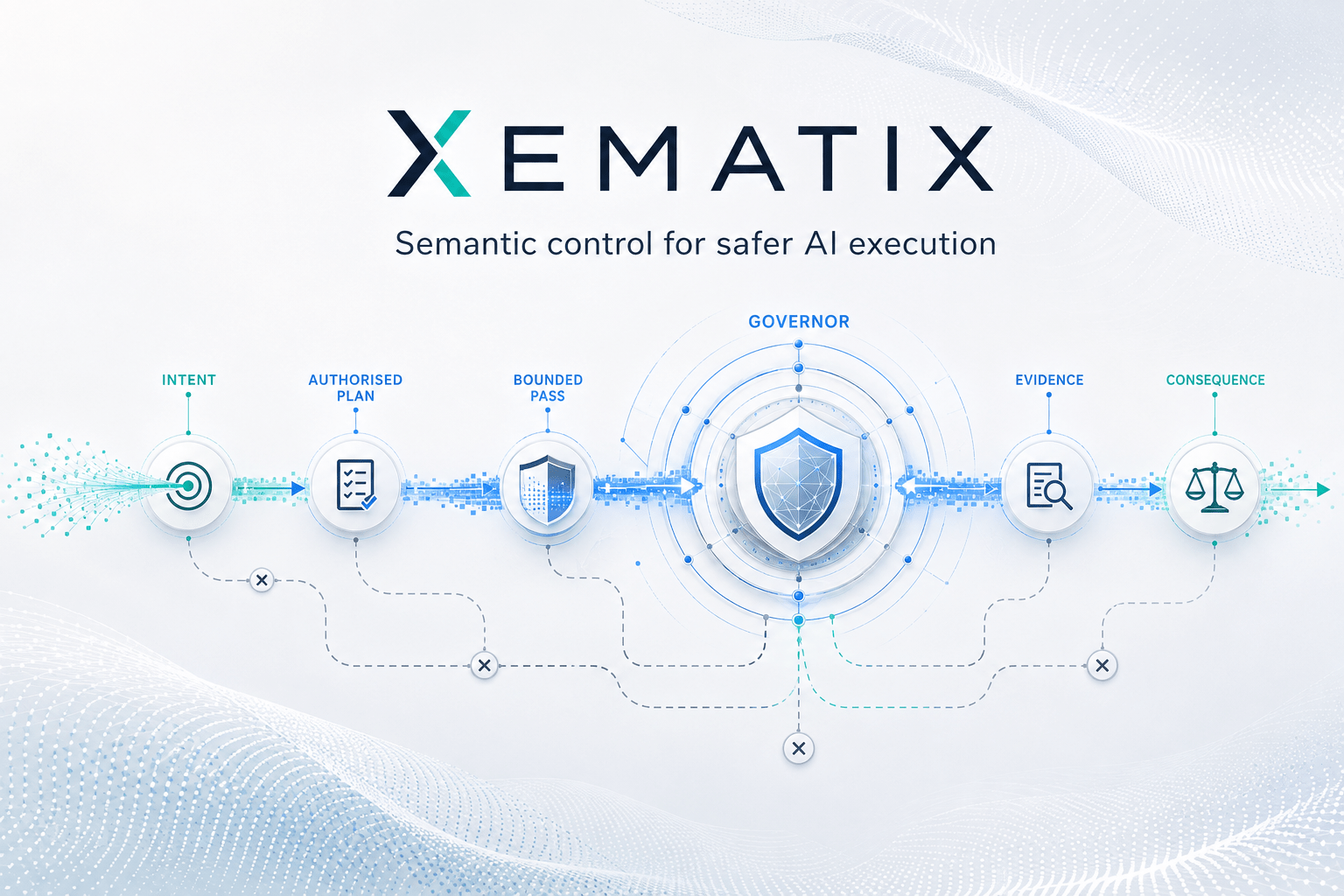
AI changes the location of value before it changes the shape of work. When execution gets cheap, the hard part is no longer doing more. The hard part is deciding what should be done, what it should mean, and what must not be lost when a machine carries it out.
Opening
For most of industrial history, the bottleneck was execution. Finding someone who could calculate, draft, program, manufacture, or analyze was valuable because humans had to perform the work. AI is inverting that equation. When machines can execute nearly any task cheaply, the scarce resource moves upstream to a different question entirely: who can determine what task should actually be performed, under which interpretation, and who will take responsibility for authorizing it?
This isn't about getting better at prompting. It's about a new role at the boundary between human judgment and machine capability. That role is the semantic operator.
TL;DR
The shift is simple, but its implications are not. As AI makes execution abundant, the valuable human contribution moves from doing the task to authorizing intent. That means the central problem isn't how to phrase instructions to a model. It's how to determine what a person or institution actually means before a machine is allowed to act. Within that frame, XEMATIX matters because it treats the boundary between human cognition and machine execution as a formal system requirement, not a soft cultural preference. Machines can execute, but they can't infer permission.

When execution becomes abundant, interpretation becomes the constraint.
Definitions
A semantic operator is the person responsible for investigating, interpreting, and formalizing human intent before authorizing machine execution. If someone says, “make this more efficient, ” the semantic operator's job isn't to pass that phrase downstream. It's to determine what “efficient” means in this case, what tradeoffs are acceptable, what outcomes count as success, and what actions remain out of bounds.
Semantic authority is the discipline that makes that possible. It translates vague intention into bounded, executable instruction while preserving responsibility and preventing scope creep. That differs from prompt engineering in a basic way. Prompt engineering assumes the instruction is already clear enough to refine. Semantic authority starts one step earlier and asks whether the instruction is actually fit to authorize action at all.
XEMATIX is a technical architecture built around that distinction. It formalizes the boundary between human cognition and machine execution and explicitly prohibits machines from inferring or expanding intent beyond what was authorized. In practice, that means the system is designed to preserve meaning under constraint, not to improvise its way through ambiguity.
Core Argument
The governing claim is straightforward: the person who can preserve human intent while machines perform execution may become more valuable than the person who performs the execution itself. The reason is leverage. A single interpretive decision, if it governs thousands of automated actions or critical systems, carries far more downstream consequence than any one task completed by hand.
You can see the mechanism clearly in an ordinary request. Suppose someone says, “We need to make this system more efficient.” A model can generate output from that sentence immediately, but speed isn't the same as clarity. A semantic operator slows the process at the point that matters. Does efficient mean faster, cheaper, less energy-intensive, less labor-intensive, or better outcomes per unit of effort? What can't be sacrificed? Who owns the risk? What evidence counts? Which exceptions require approval? What would failure look like even if the metrics improve?
That's the Triangulation Method in practice. A faint signal becomes actionable only after it survives multiple checks: interpretation from different stakeholders, feedback from real conditions, constraint from policy or ethics, and governed authorization before execution. The operator doesn't add friction for its own sake. The operator prevents a vague desire from turning into a precise mistake.
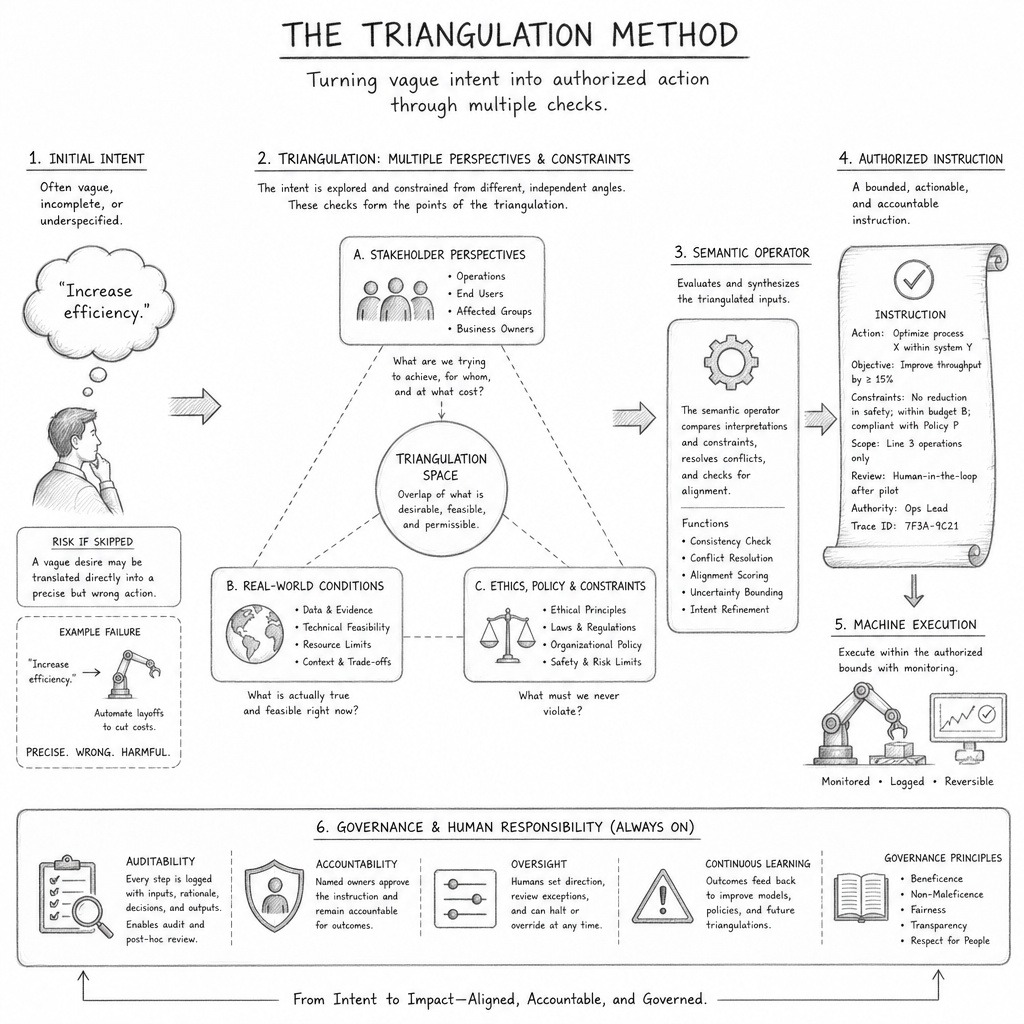
A machine can scale an instruction. It can't decide whether the instruction deserved to scale.
This is why the role feels familiar and new at the same time. It combines parts of several older professions: detective, systems analyst, editor, engineer, technical writer, and control-room operator. The common thread isn't domain expertise alone. It's the ability to reconstruct meaning under pressure, resolve ambiguity before it becomes action, and translate judgment into a form a technical system can obey without expanding its mandate.
The testable implication is economic as much as technical. Compensation tends to follow scarcity, leverage, and consequence. If one person's interpretation governs fleets of machines, financial systems, public infrastructure, or institutional workflows, that person sits at a leverage point where small errors compound quickly and precise judgment compounds even faster. As execution becomes cheaper, the cost of bad authorization rises. So does the value of disciplined authorization.
XEMATIX gives that logic a system form. It separates a Governor, which preserves intent and can halt execution, from an Actuator, which performs tasks but can't modify scope. Inferred intent is never allowed to become authorization by default. The pattern shifts from a simple function model of input and output toward something more governed: an intent object is defined, constraints are attached, an authorized pathway is selected, execution occurs within those bounds, and an audit trail records what happened. The operational consequence is that language stops being a loose prelude to action and becomes part of the infrastructure that governs action.
That changes which distinctions matter. Purpose must be kept separate from objective. Instruction must be kept separate from authorization. Preference must be kept separate from constraint. Evidence must be kept separate from interpretation. Exceptions must be treated as scope changes, not casual overrides. These aren't academic refinements. They're the conditions under which machine execution remains aligned with human responsibility.
Examples
The abstraction becomes easier to grasp when you look at where vague intent breaks under real pressure. In manufacturing, a company may ask to “optimize production schedules.” On the surface, that sounds like a standard operations problem. Under investigation, it usually isn't one problem at all. The CEO may want higher throughput. The operations manager may want predictable delivery dates. The plant supervisor may want fewer emergency overtime shifts. Each of those meanings points to a different optimization target, a different tolerance for tradeoffs, and a different boundary for what the scheduling system is allowed to change. The semantic operator's job is to surface those meanings, force a governing choice, and prevent the machine from acting as if one stakeholder's interpretation represented the whole enterprise.
A city government's request to “improve traffic flow” reveals the same pattern at a civic scale. Faster vehicle movement might conflict with pedestrian safety. Emissions goals might conflict with route convenience. Neighborhood preservation might conflict with throughput. Here, the semantic operator doesn't solve the politics by pretending they don't exist. The operator makes the conflicts explicit, defines which tradeoffs can be automated, identifies which ones require human approval, and ensures the system operates only inside those authorized limits.
Seen this way, the emerging division of labor is less mysterious than it first appears. Humans remain responsible for lived reality, relationships, ethics, purpose, and judgment. The semantic operator investigates, interprets, formalizes, and authorizes. System engineers design the computational infrastructure. Technical operators maintain the physical and digital systems. Machines execute. The novelty isn't that these layers exist. It's that AI makes the boundary between them more economically important and more dangerous to blur.

Close
That leads to a larger shift in how technological progress might be judged. If computational systems become competent at maintaining infrastructure, production, and administration, then the highest use of human beings isn't to imitate machine strengths more efficiently. It's to protect the parts of life that shouldn't be reduced to execution in the first place.
In the best version of this future, technology recedes into infrastructure rather than occupying consciousness. The machine world becomes more machine-like, while human life becomes more human. That could mean less compulsive screen mediation, more embodied learning, stronger local relationships, and a cleaner separation between systems that execute and lives that mean.
But that outcome isn't automatic. AI can just as easily produce more dashboards, more synthetic bureaucracy, and more confusion disguised as productivity. The difference will depend on whether we build systems that treat human judgment as a governing source, not a vague input to be guessed at downstream.
XEMATIX represents one attempt to make that boundary real. Its core proposition isn't that machines should become better at deciding what we mean. It's that they should be governed so they act only on meaning that has survived triangulation, constraint, and explicit authorization. As machine capability rises, human intent doesn't become less important. It becomes the scarce asset everything else depends on.