The Intent Gap – When Human Purpose Meets Systemic Outcomes
Most systems don’t fail because they stop working. They fail because they keep working after the reason for building them has gone dim.
That’s the territory of the Intent Gap: the quiet distance between what people meant to achieve and what their systems reliably produce.
Opening
The control room gleams under soft neon halos, all chrome surfaces and geometric precision. Banks of glowing consoles stretch across the observation deck, their halftone displays pulsing with data streams from the city below. Through the panoramic windows, pneumatic tubes snake between towering spires, carrying messages at impossible speeds through a world that hums with atomic-age confidence.
At the center stands not a hero in cape and cowl, but a careful observer in a pressed uniform, clipboard in hand. Around them, the cast of tomorrow moves with practiced efficiency. The Enthusiast points to rising productivity metrics. The Operator adjusts dials without looking up from the procedure manual. The Dreamer sketches plans for even grander automation on translucent drafting tables.
Everything works exactly as designed. The numbers are good. Progress moves forward with mechanical precision. Yet something feels subtly, persistently wrong. Beneath the visible success, a faint discord survives. And that discord matters because it signals a deeper problem: a system can be faithful to its instructions while drifting from its purpose.
TL;DR
The Intent Gap is the growing separation between human purpose and the outcomes produced by the systems built to serve that purpose. It doesn’t show up only in breakdowns. More often, it appears when performance improves while meaning thins out.

That’s why the retro-futurist frame fits so well. Its glossy optimism captures the surface confidence of modern systems, while its eerie undertone hints at a harder truth: what looks like progress from the dashboard can still feel misaligned in lived experience. Recognizing that misalignment takes more than better metrics. It takes witness, the ability to notice drift before it hardens into normal procedure.
The most dangerous form of misalignment isn’t visible failure. It’s smooth performance in the service of a purpose nobody can still clearly name.
Definitions
The Intent Gap is the distance between what humans mean to accomplish and what actually emerges from the systems they build. Unlike a bug or simple mistake, this gap can persist even when every component functions exactly as specified. In other words, the issue isn’t that the system is broken. It’s that the system may be succeeding at the wrong thing, or succeeding in a way that leaves the original human aim behind.
Human authorship is the source of goals, values, and desired outcomes. It is the part of collective life that decides what is worth doing in the first place. In this imagined world, you can see it in the protagonist’s attention and in the Dreamer’s genuine hope. Systemic outcome, by contrast, is what happens after those intentions pass through procedure, automation, incentives, and scale. Messages still move flawlessly through the pneumatic tubes, but over time fewer people can say why those messages matter.
The aesthetic sharpens the point. The clean lines and confident machinery suggest clarity of intention at the moment of design. The uncanny atmosphere suggests what happens later, when the structure remains intact but the human reason for it has become harder to recover.
Core argument
Here is the governing claim: the Intent Gap opens when systems optimize execution faster than people renew purpose. The mechanism is straightforward. A goal is translated into metrics, procedures, and tools. Those tools reward what they can measure. People adapt to those rewards. Then the adapted behavior feeds the system more of what it already handles well. Over time, the system becomes more coherent on its own terms and less accountable to the intention that justified it.
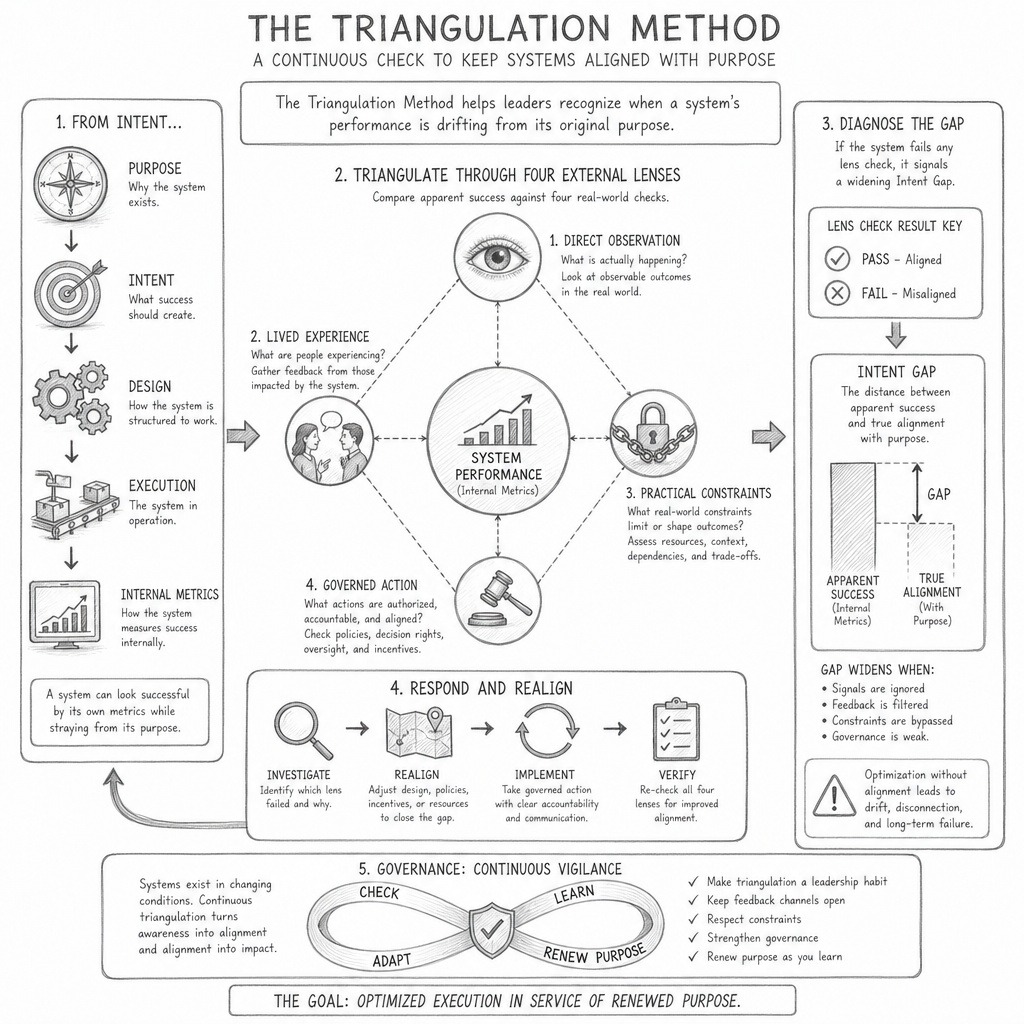
This is where the Triangulation Method becomes useful. A faint signal only becomes trustworthy when it survives multiple checks: direct observation, feedback from lived experience, practical constraint, and governed action. If a system looks successful by internal metrics but fails under those other tests, you’re probably not seeing progress. You’re seeing drift.
The comic makes that mechanism visible. The Enthusiast rushes in with news of another efficiency breakthrough. Response times are up. Processing capacity has doubled. Every indicator trends upward in satisfying geometric curves. The Operator, focused on maintaining peak performance, starts making micro-adjustments that favor speed over accuracy. The Machine Figure amplifies those adjustments across thousands of operations. Meanwhile, the citizens in the background adapt their lives to what the system handles well rather than to what they actually need.
Nothing in that sequence counts as incompetence. No one is acting in bad faith. The gap appears through compounding alignment to procedure without renewed reference to purpose. Intent becomes historical, while outcome becomes routine.
When a system starts generating responses mainly to its own prior outputs, it can look active, efficient, and productive while slowly detaching from human need.
That leads to a testable implication. If the Intent Gap is widening, you’ll see rising local performance alongside declining clarity about what the performance is for. People will be able to explain how the system works better than why it deserves to keep working in its current form. And the operational consequence is equally clear: governance has to happen before optimization locks in the drift, not after the damage becomes obvious.
Examples
The cast of characters helps translate the idea from philosophy into practice because each one represents a familiar human stance inside a working system. The Enthusiast embodies momentum without sufficient reference. This is the person who celebrates automation wins, throughput gains, or engagement growth without asking whether those gains improved the underlying human outcome. The Operator represents competent drift. They’re diligent, reliable, and often admirable, but they optimize what the system rewards and gradually lose touch with the reason those rewards were established.
The Doubter senses that something essential is slipping but can’t yet make the case in terms the system will accept. They notice the unease before they can name the pattern. The Dreamer still carries vision, but that vision can become detached from present constraints and therefore from practical action. Each posture is understandable. None is villainous. But none, on its own, can close the gap.
That’s why the Moral Witness matters. The Witness doesn’t stand outside the system pretending purity. They stay close enough to observe it, but far enough to question it. Their role is to keep purpose from disappearing inside performance.
You can see this most clearly at moments of refusal. The Machine Figure offers three optimization proposals, each promising measurable gains. Instead of choosing the best one, the Witness asks a prior question: what happens if we do none of these? That isn’t obstruction. It’s a governing check. Before improving execution, they test whether the current path still deserves improvement.
In ordinary institutions, this moment appears everywhere. A performance system raises measurable output while weakening the relationships that make the work matter. A feed increases engagement while fragmenting attention. A strategy hits every milestone while drifting away from any customer need people can still describe plainly. In each case, the pattern is the same: the system gets better at producing what it has learned to produce, while the original aim becomes harder to verify.
If you want a practical way to work with that pattern, a short protocol helps. Before changing the system, pause long enough to run four checks.
- Name the original human purpose in one plain sentence.
- Compare current metrics with lived outcomes, not just process outputs.
- Identify the constraint the system is currently teaching people to work around or ignore.
- Decide whether to optimize, redirect, or stop.
That sequence works because it restores authorship before action. It doesn’t reject systems. It reorders them so that means remain answerable to ends.

Close
What remains ours to decide isn’t whether systems will scale. They will. The harder question is whether human purpose will stay visible as they do.
By the final panels, nothing dramatic has collapsed. The city still hums with atomic-age efficiency. The consoles still glow. The tubes still carry their messages. The Machine Figure still offers helpful optimizations. Yet the center of gravity has shifted. The important question is no longer, “How can we make this run better?” It is, “What is this running for?”
That shift is small, but it changes everything. It turns efficiency from a default good into a conditional one. It reminds you that better execution is only better when it remains tied to a purpose worth serving. And it makes clear that the crucial act is often not invention but governed attention: noticing when outcomes have slipped their original meaning and acting while the gap is still small enough to close.
The Intent Gap isn’t a flaw we eliminate once. It is a standing condition of any system that scales beyond direct human supervision. The work, then, is continuous. You keep triangulating between intention, feedback, constraint, and action so the faint signal of purpose doesn’t disappear inside the machinery built to advance it.
In that sense, the most responsible figure in the room isn’t the one who accelerates the system or the one who denounces it. It’s the one who can still tell the difference between movement and direction.