The Model Is Not the System – Why Governed AI Development Environments Outperform Raw Model Capability
The tempting move in AI-assisted development is to buy more model capability and expect better outcomes. In practice, the more durable improvement often comes from a different place: reducing how much the model has to infer on its own.
After months of using increasingly capable AI coding assistants, I noticed something unexpected. The biggest improvement in my workflow didn't come from upgrading to a stronger model. It came from reducing how much the model was required to decide.
That observation cuts against a common assumption in AI-assisted software development: that better results require better models. Working within .xematix, a governed AI development environment, I found that a capable but less powerful model often produced more coherent, predictable work than a frontier model operating with complete freedom. For senior architects, that isn't a minor tooling preference. It's a choice between two development philosophies with very different operational consequences.
TL;DR
You can improve AI-assisted development in two ways. The first is model-centric: choose the most capable model you can afford and rely on it to infer architecture, constraints, and intent from conversation. The second is system-centric: build an AI development environment that makes the correct path explicit through durable rules, boundaries, and evaluation.

For bounded work inside an established architecture, the second path usually wins. A governed environment narrows the model's decision surface, which improves reliability, lowers oversight cost, and reduces architectural drift. Frontier capability still matters, but it's most valuable when the problem itself is unsettled and the team genuinely needs exploration rather than controlled execution.
The practical question isn't which model is smartest. It's which environment makes correct behavior easiest to produce.
Options: Model-Centric or System-Centric
The difference becomes clear when you look at where architectural intelligence lives. In model-centric development, the model has to reconstruct the system again and again from prompts and recent conversation. It must infer repository structure, design patterns, previous decisions, prohibited changes, testing expectations, and workflow state. Even a strong model can struggle here, not because it lacks reasoning ability, but because it has too many plausible directions available at once.
I've seen this play out in teams where the assistant kept introducing unnecessary abstractions. The model was technically sophisticated enough to see many valid solutions, but that sophistication became part of the problem. Every unresolved design choice opened another branch to explore. When the environment doesn't constrain the search space, model capability often amplifies variance rather than reducing it.
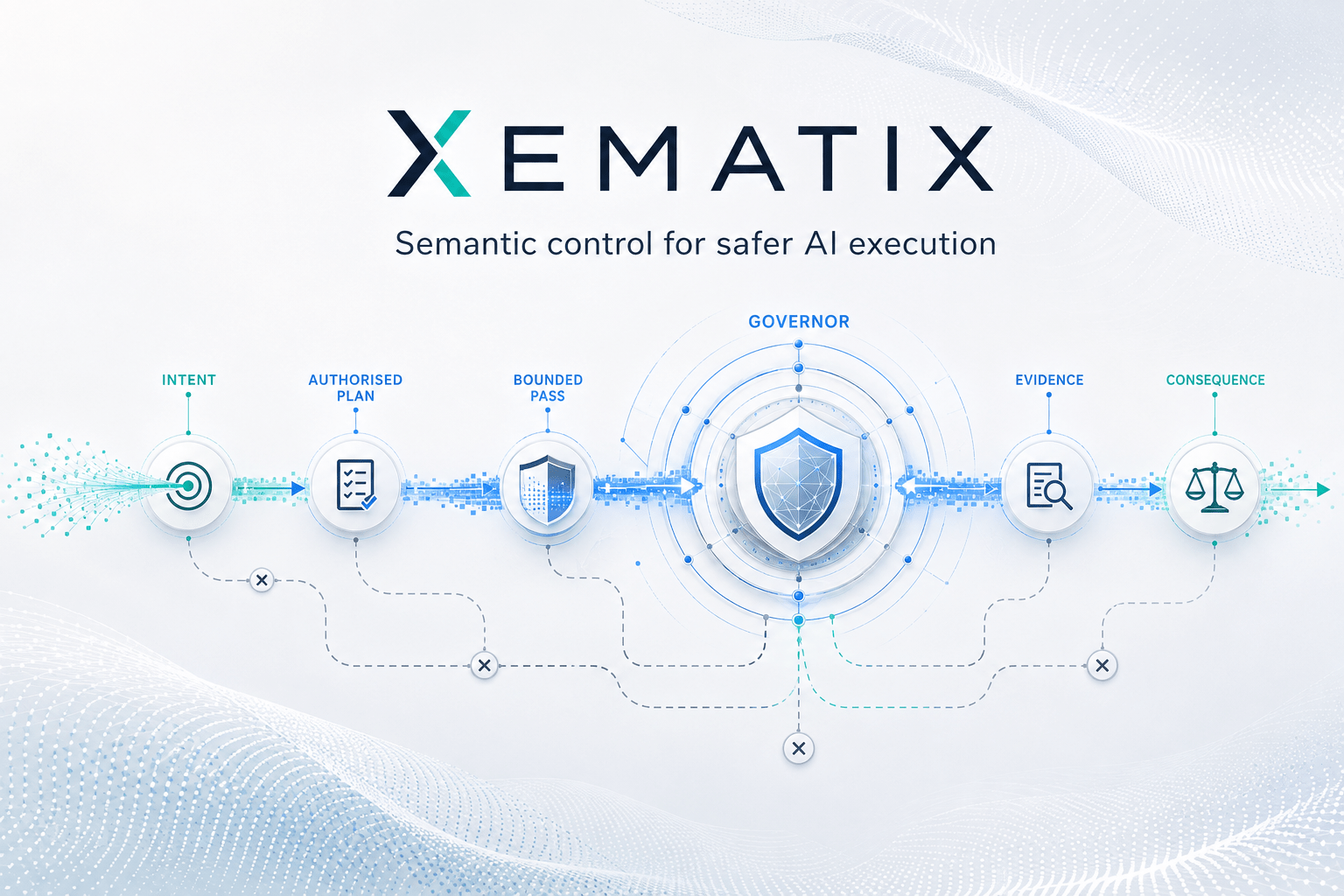
System-centric development takes the opposite approach. It moves authority out of the conversation and into persistent, machine-readable governance. In .xematix, for example, the Anchor defines system invariants, the Projection specifies expected outcomes, and the Governor evaluates whether proposed changes violate established constraints. The model still reasons, but it reasons inside a structure that survives across sessions, tools, and model swaps.
This is where the Triangulation Method becomes useful as a way to think about the decision. A signal becomes dependable only when it survives multiple checks: explicit constraints, environmental feedback, and governed evaluation. In that setup, the environment does more of the remembering, and the model does less speculative reconstruction.

Comparison Criteria
If you're deciding between these approaches, four criteria matter most: reliability, cost, maintainability, and model independence. Reliability comes first because consistency is the real test of an engineering system. Model-centric development can look impressive in isolated sessions, but its variance rises with the number of decisions left implicit. A stronger model can produce a more sophisticated wrong answer if the environment doesn't clearly bound the task.
Cost is the next filter, and it's broader than API spend. Human review time, rework, and repeated context reconstruction all count. In model-centric workflows, teams often burn tokens and attention re-establishing architectural facts that could have been encoded once and reused deterministically. That doesn't just raise compute cost. It creates a tax on every session.
Maintainability matters because temporary conversation isn't durable system memory. When critical architectural knowledge lives in chat history rather than in governed infrastructure, teams accumulate a form of debt: not code debt exactly, but conversational architecture debt. The system starts working only when the right person asks the right model the right way, and that fragility becomes expensive over time.
Model independence is the final criterion, and it's easy to underestimate until the model landscape shifts. A system-centric AI development environment treats the model as a replaceable reasoning component operating against stable contracts. That makes it easier to change vendors, tune cost-performance tradeoffs, or adopt smaller models without destabilizing the development process.
Raw capability matters most when the environment is vague. Once the environment becomes explicit, governance often outperforms brute force.
Tradeoffs

The appeal of model-centric development is obvious. It feels fast at the start. You describe what you want, the model interprets your intent, and the friction is low. For exploratory work, that flexibility is real value. If the architecture is still emerging, premature constraint can narrow the solution space too early and hide useful options.
Still, that convenience degrades as the system matures. I watched one startup's velocity slow as its codebase grew because their assistant began producing increasingly elaborate solutions to simple problems. The model wasn't malfunctioning. It was optimizing across a wider possibility space than the team intended, treating ambiguity as an invitation to redesign. In other words, capability without constraint turned local tasks into architectural negotiations.
System-centric development asks more of you upfront. You have to define boundaries, document authority, and make acceptance criteria explicit before the model begins work. That effort can feel heavy compared with simply opening a chat window and asking for code. But the mechanism is straightforward: when the environment carries forward prior decisions, the model no longer has to rediscover them, and the team no longer has to repeatedly police them.
The economic effect can be substantial. One team found they were spending about 40% more on API calls because the model kept reasoning through architectural decisions that had already been made. Once that knowledge moved into the environment itself, both compute cost and oversight effort dropped. The gain wasn't mystical model improvement. It was governed reduction of unnecessary choice.
Recommendation
The decision turns on whether you're asking the model to explore or to execute. If you're working inside an established codebase with known patterns, bounded tasks, and clear acceptance criteria, a governed AI development environment is usually the better investment. It produces more consistent outcomes across sessions, protects architectural intent, and improves your ability to use less expensive models without losing quality.
If, on the other hand, you're working in a genuinely novel problem space, the model-centric approach still has an important role. When the architecture itself is being discovered, flexibility matters more than repeatability. In that phase, you want the model to range more widely because the constraints aren't mature enough to encode yet.
A practical test helps separate those cases. Ask: what is the minimum model capability required for reliable execution in this environment? If a smaller or cheaper model performs well once the environment is explicit, that tells you the system has gained intelligence. The governing claim is simple: better environments compress the need for exceptional model judgment.
From an architectural standpoint, that is the defensible default. Use model-centric workflows for discovery. Use system-centric workflows for delivery. As soon as the work becomes repeatable, move authority into the environment.
Close
That leaves an uncomfortable but useful question: how much of the intelligence you currently buy from a coding model is really compensating for ambiguity in your development environment?
If the answer is a lot, then continually upgrading models treats the symptom, not the cause. The stronger move is to make the surrounding system more explicit through feedback, constraint, and governed action. The model can reason, but it shouldn't have to carry the entire architecture in its head.
In the end, the model isn't the system. The system is the structure that preserves intent, survives model changes, and turns a faint signal into dependable engineering outcomes. That's why governed AI development environments so often outperform raw model capability where it counts most: not in isolated demos, but in real software delivery.