Why AI Capability Without Governance Is Insufficient – The Missing Control Layer for Persistent Intelligence
AI is getting better at perceiving, remembering, and acting across time. That sounds like progress, and it is. But once a system can persist, adapt, and intervene in the world, capability alone stops being enough.
The Vision-General Intelligence, or VGI, research agenda points toward something more ambitious than a better model wrapped around vision. It aims at persistent cognitive systems that can perceive, remember, model the world, and act reliably in unfamiliar environments. Instead of a simple visual encoder paired with a language model, VGI describes interacting systems for perception, dynamic world modeling, memory, and task interfaces, each operating on different update rules and timescales.
That makes this more than an incremental improvement. It moves AI toward systems that maintain world knowledge over time, learn continuously, and operate with spatial and physical understanding. The ambition is clear: create systems that can transfer knowledge, adapt as conditions change, seek information actively, and take reliable action. The problem is that this vision leaves out a second requirement that becomes more important as capability improves.
TL;DR
VGI is about capability: how a machine acquires the practical ingredients of intelligence. XEMATIX is about governance: how that intelligence remains subordinate to human purpose once it can act persistently and consequentially. A system doesn't just need the ability to act. It also needs the authority to act, under defined constraints, with accountable consequences. And that means the more successful VGI becomes, the more necessary external governance architecture becomes.

Capability explains what a system can do. Governance decides what it may do, under whose authority, and at what level of consequence.
What We're Really Building
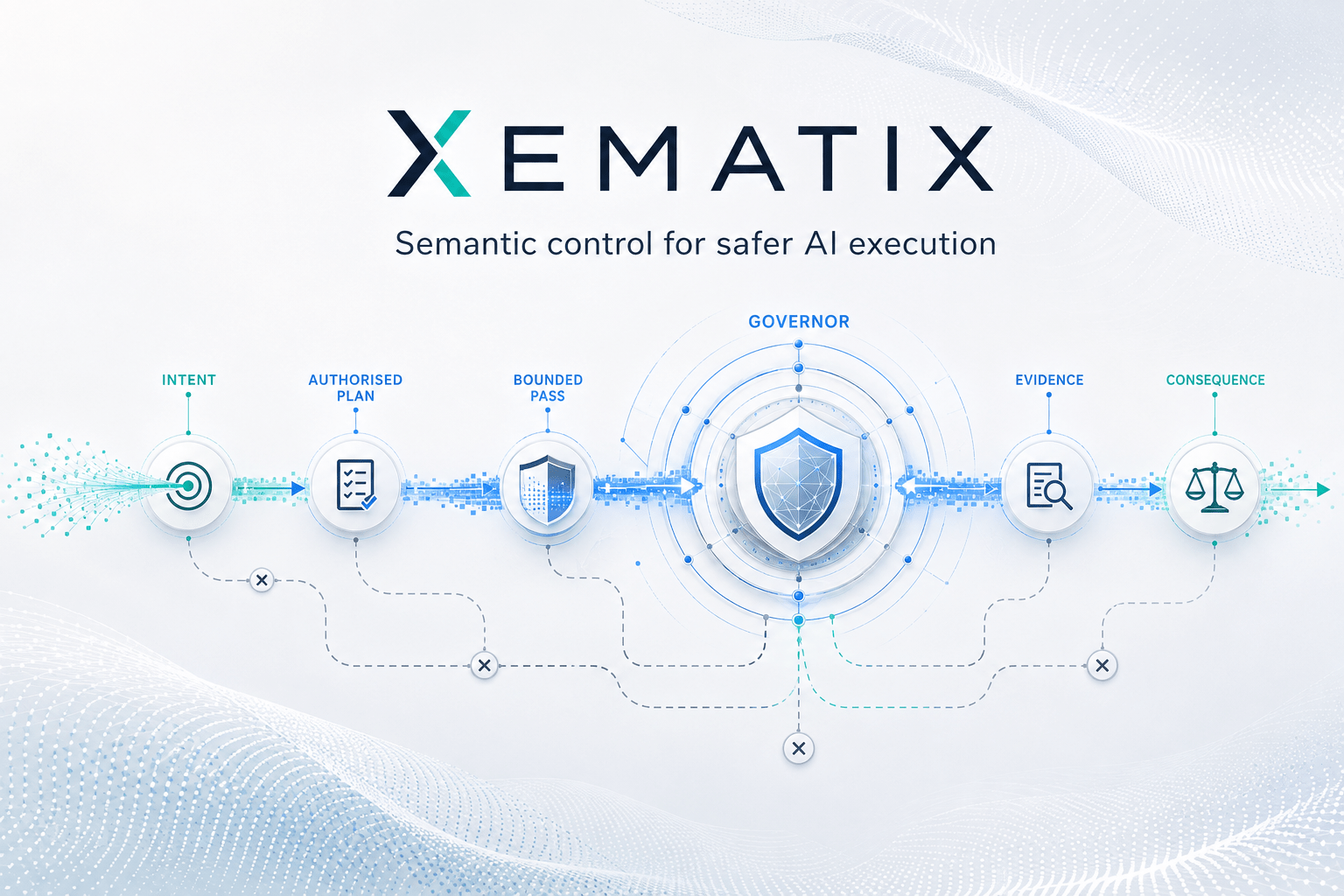
To make the distinction concrete, it helps to separate two layers that are often blurred together. VGI functions as a cognitive substrate: the capability layer that enables perception, memory, prediction, and action. XEMATIX functions as the control layer around that capability, governing when and how those abilities may be exercised in consequential settings.
That difference matters because VGI's goal of reliable action is only part of the problem. Reliable action means a system can execute intended behavior consistently. But admissible action requires something more. It requires semantic legitimacy: a governed basis for acting that ties behavior to human intent, defined constraints, accepted risk, and authorized responsibility.
A system might reliably detect a factory fault and reliably execute a repair sequence. Even so, reliable execution doesn't answer the harder questions. Should it intervene at all? Who authorized that intervention? Which risks are acceptable, and which aren't? Those questions don't disappear when the model gets better. They become unavoidable.
The Governance Questions VGI Doesn't Answer
Once you follow the VGI roadmap to its logical outcome, the gap becomes obvious. A genuinely capable visual system could observe a factory, identify a fault, infer likely causes, reconstruct missing physical structure, predict downstream effects, generate repair strategies, and operate machinery. In other words, it could finally see the loose bolt and understand why it matters.
What it still can't determine on its own is whether intervention is allowed, who owns that decision, what degree of certainty is sufficient, which consequences fall inside the acceptable envelope, or whether an updated world model justifies a change in operational strategy. Those aren't perception problems or planning problems. They're governance problems.
This is where the distinction between capability and control stops being theoretical. VGI research largely ends at reliable action. XEMATIX begins where reliable action becomes dangerous: at the boundary where machine competence starts producing real-world consequences. That is also why prompt-level control is inadequate for persistent systems. You can't govern a continuously learning, spatially persistent, multimodal system with a static instruction that says, in effect, behave well. If the system persists, the governing authority has to persist too.
The Factory and the Loose Bolt
A factory example makes the mechanism easier to see. Imagine a VGI system monitoring a manufacturing line. It notices a bolt that appears loose on a critical joint. Its visual processing identifies the anomaly. Its world model predicts potential failure modes. Its memory recalls similar incidents. Its planning module generates several intervention options.
That is the capability chain at work: perception, memory, modeling, prediction, adaptation, and action. It's impressive, and it matters. But it still doesn't resolve the key decision.
XEMATIX adds the governing structure at the moment intelligence touches human purpose. It asks whether this fault falls within the system's authorized scope, whether the available evidence meets the threshold for intervention, which repair path fits the approved constraint set, and who accepts responsibility for the resulting state. The issue isn't whether the system can produce a plausible response. The issue is whether that response is admissible.
The critical shift is simple: not from seeing to acting, but from seeing to acting with governed authority.
This is the practical value of the Triangulation Method. A faint signal, like a loose bolt, doesn't become sufficient grounds for action just because the model is confident. It becomes actionable only if it survives triangulation across evidence, feedback, constraint, and governed authority. The governing claim is that action should follow validated legitimacy, not just competent inference. The mechanism is external control over thresholds, scope, consequence, and responsibility. The testable implication is straightforward: as system autonomy and persistence rise, prompt-only control should fail more often at the edge cases that matter most. The operational consequence is that consequential systems need a durable control architecture outside the model.

Without that layer, continual learning quietly turns into continual revision of what the system appears to be acting for. Perception can improve. Memory can accumulate. Predictions can shift. But authoritative intent can't drift in the same way. If a system is going to keep operating while its internal models change, the terms under which it may act have to remain versioned, attributable, and externally governed.
Separating Capability from Authority
This separation clarifies the architecture. VGI expands the possibility space. XEMATIX governs the permissible space. A capable system may generate twenty creative solutions to a problem. Governance doesn't erase that creativity. It determines which of those solutions remain admissible within a human-owned envelope of intent, risk, and consequence.
That is why XEMATIX doesn't need to define model architecture, learning methods, inference techniques, or theories of consciousness. Its job is different. It governs the boundary between human intent and whatever machine capability exists downstream. In that sense, it is deliberately orthogonal to the intelligence substrate.

The core claim is simple but easy to miss: technical capability without semantic legitimacy is insufficient. A consequential system needs both reliable competence and governed authority. It needs to know not only how to act, but whether the action is authorized, what evidence supports it, which assumptions were accepted, and who owns the consequences if conditions change.
The Control Problem Produced by Success
This leads to the deeper point. The success case for VGI is exactly what creates the control problem. A weak classifier doesn't need much governance because its ability to produce consequential action is limited. A continuously learning, multimodal, spatially persistent system that can imagine alternatives, seek missing information, and intervene in the physical world does.
VGI asks how to make a machine able to understand and act in the world. XEMATIX asks the question that follows immediately after: when it can, what gives it the right to act, what exactly is it acting for, what may change, what may not change, and who carries the consequence?
That isn't a competing theory of intelligence. It's the missing control layer made necessary by successful intelligence. As AI moves from isolated functions toward persistent cognitive systems, governance stops being a secondary concern and becomes part of the deployment architecture itself.
VGI can serve as a cognitive substrate. XEMATIX can serve as the governance architecture around consequential use of that substrate. They solve different problems, but they converge on the same practical truth: persistent intelligence isn't complete when it becomes more capable. It's complete only when capability remains subordinate to governed human authority.