Competitive Intelligence Tools – Competitor Tracking vs Position Intelligence
Most intelligence tools tell you what a competitor did. Fewer help you see what is forming around your business before it becomes obvious.
That distinction matters because the better tool isn't the one with more alerts. It's the one that matches the question you're actually trying to answer.
Opening
Every Monday morning, thousands of founders open their inbox to the same kind of update: Competitor X changed pricing. Competitor Y launched a feature. Competitor Z hired a VP of Sales.
That information feels useful because it's concrete, timely, and easy to interpret. But it answers only one question: what did my competitors do this week?
A different question is often more important: what changed in the world around my position?
That shift from competitor awareness to position awareness is the real dividing line in competitive intelligence tools today. It changes not just what you learn, but how you make decisions.
The core choice isn't between more data and less data. It's between tracking named rivals and tracking the conditions that shape your position.
TL;DR
There are now two clear approaches in the market. Competitor-centric tools such as RivalEdge, Briefed, and Signal monitor a defined list of rivals and report their changes on a regular cadence. They're simple, direct, and often immediately useful when your problem is tactical response.

Position-centric intelligence, represented here by CyberKinesis, starts from a broader premise. Instead of treating competitors as the boundary of relevance, it treats your strategic position as the boundary. That means competitors still matter, but so do regulatory shifts, adjacent technologies, customer behavior changes, and market movements that haven't yet shown up as a competitor action.
If you need to respond to direct rivals in a stable market, competitor-centric monitoring is usually the better fit. If you're more concerned about being surprised by developments outside the competitor set, position-centric intelligence is the stronger choice.
Options
The market has crystallized around two distinct architectures, and the difference begins with the first question each system asks.
Competitor-centric monitoring starts with a list of companies. You name three to ten rivals, and the tool watches those organizations for meaningful changes. RivalEdge summarizes pricing, launches, and hiring. Briefed tracks websites, advertising, and reviews. Signal compresses the week into short Monday briefings on what competitors shipped. The promise is straightforward: you get a clean view of the companies you already know you care about.
Position-centric intelligence starts somewhere else. It asks what your position is, which means your business, capabilities, strategy, constraints, concerns, and the subjects you need to stay ahead of. Competitors are part of that picture, but they don't define its limits. From there, the system watches for anything materially relevant to that position, including technology shifts, regulatory movement, changing customer expectations, and developments in adjacent markets.
CyberKinesis illustrates that second model. Rather than asking only what Competitor X did, it asks what changed in the environment around what you're trying to accomplish. That creates a different kind of intelligence product: less like a watchlist, more like an evolving view of your operating situation.
Comparison Criteria
To choose well, it helps to compare these approaches on the dimensions that actually affect decisions.
The first is scope. Competitor-centric tools define the monitoring boundary by company name. If a development doesn't originate from a tracked rival, it may never appear. Position-centric tools define the boundary by strategic relevance. That widens the field considerably, but it also makes the output more aligned with how disruption usually arrives. Important changes often begin outside the obvious competitor set and only later show up in head-to-head competition.
The second is the core unit of intelligence. Competitor tools are built to report events. A company launched a feature. A rival changed pricing. Another hired a sales leader. Position-centric systems are built to detect developments. Instead of isolated facts, they connect multiple signals into an emerging pattern, such as rising customer preference for integration over standalone functionality or growing pressure on premium pricing from policy and switching-cost changes.
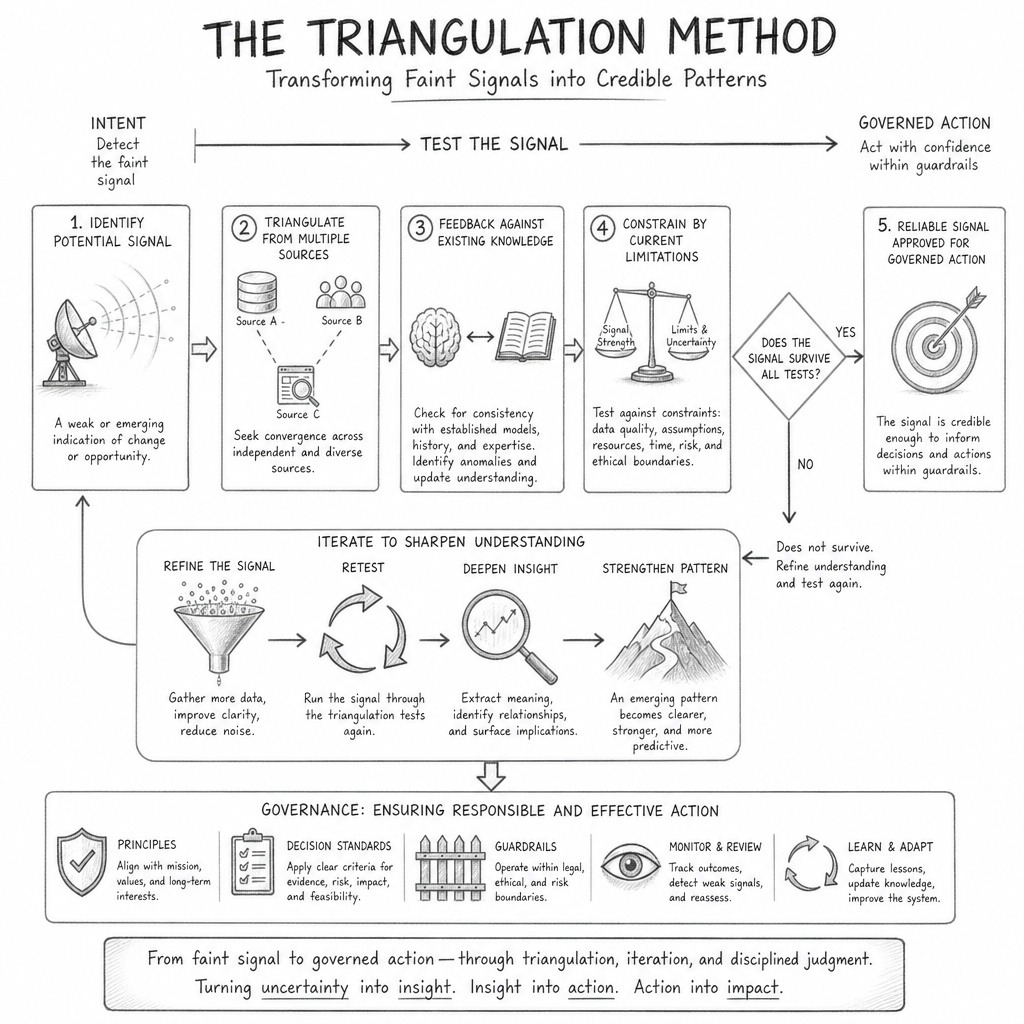
The third is how value accumulates over time. Competitor monitoring often resets each cycle. This week's report is useful, but mostly independent from last week's report. Position intelligence works differently because continuity is part of the product. Observations compound. Patterns sharpen. A faint signal becomes more credible only after it survives triangulation, feedback, constraint, and governed action.
That difference changes the quality of the conclusion. A founder using RivalEdge might learn that a competitor dropped prices by 15 percent. A founder using position-centric intelligence might learn that pricing pressure has been building across several segments, that regulatory changes are lowering switching costs, and that their premium posture is becoming harder to defend. One system reports an event. The other clarifies a strategic condition.
Competitor tracking tells you what happened at a company. Position intelligence tells you what may be taking shape around your business.
Tradeoffs

That doesn't make one approach universally better. Each solves a different problem, and each has a real cost.
Competitor-centric monitoring is strongest when tactical clarity matters most. If a direct rival changes packaging, pricing, messaging, or product scope, you can see it quickly and decide whether to respond. The setup is simple, the outputs are concrete, and the action path is usually obvious. For teams that already understand their market and need disciplined awareness of direct competition, this is efficient and often sufficient.
Its weakness is that it can produce a false sense of coverage. You may know a great deal about competitors while still missing the forces that are changing the category itself. A technology shift, a regulatory discussion, or a customer expectation change may matter more than anything your named rivals did that week. By the time those forces appear in competitor behavior, the window for early response may already have narrowed.
Position-centric intelligence addresses that blind spot by widening the aperture and preserving continuity over time. It is better suited to environments where the important signal is weak at first and scattered across different domains. Because it connects technology, regulation, adjacent markets, and customer behavior, it can help you see structure forming before it becomes consensus.
The tradeoff is complexity. Defining your position takes real strategic thought. The output may be less instantly actionable because it often points to developing situations rather than finished moves. And the payoff tends to compound over months, not arrive as an immediate weekly win. If you want simple alerts with obvious next steps, this can feel slower, even when it is more strategically valuable.
That is why the right choice depends less on industry labels than on decision conditions. A consultant tracking AI regulation needs a position-centric view because the important movement spans technical progress, policy formation, and client demand. A SaaS founder in a stable category with clear rivals may get most of the value they need from focused competitor monitoring.
Recommendation
The cleanest way to decide is to match the tool to the type of uncertainty you face.
Choose competitor-centric monitoring when your market has a small set of clear rivals, when competitor moves directly shape pricing or product decisions, and when your main need is fast, actionable awareness. It also fits better when your strategic position is already stable and you're optimizing execution within a known landscape. In that setting, broader monitoring can add complexity without adding proportional value.
Choose position-centric intelligence when your risk comes from outside the obvious competitor set, when your advantage depends on seeing around corners, or when your operating environment spans multiple domains that don't fit neatly into a standard competitor watchlist. It is especially strong when strategic foresight matters more than tactical reaction and when you're willing to invest upfront to define what your position actually is.
In practice, founders in fast-moving markets such as AI, fintech, and healthcare technology often benefit more from the position-centric model because the real threat rarely arrives first as a direct competitor move. It emerges through a mix of policy, technical capability, capital flows, buyer expectations, and adjacent entrants. By contrast, established businesses in more stable markets often get better return on attention from competitor-centric tools because the key questions are narrower and the tactical path is clearer.
Independent consultants and fractional executives also lean toward position-centric intelligence for a simple reason: their work depends on understanding where the market is moving, not just on reporting what a handful of companies did.
Close
The decision comes down to the question behind the purchase.
If your real concern is what your competitors did this week, competitor-centric monitoring is the right tool. It gives you clear signals, minimal setup friction, and direct tactical usefulness.
If your real concern is what is changing around the position you're trying to defend or build, then competitor tracking is too narrow. You need an intelligence system that treats your strategic situation, not just your rivals, as the center of attention.
Most market shifts don't announce themselves as competitor news. They begin as faint signals in regulation, technology, customer behavior, or adjacent markets. The more volatile your environment, the more that distinction matters. Competitor-centric tools help you react. Position-centric intelligence helps you see what is developing early enough to choose with intent.