Context Privilege Escalation – Why Your AI Agents Need Disciplined Boundaries, Not Just Smarter Models

Most teams treat agent security as a model problem. Recent research suggests it's a boundary problem instead. Once low-trust material can move through a system as if it were high-trust instruction, smarter models don't fix the failure. They can deepen it.
Your AI agent just read a malicious document that convinced it to execute commands with administrative privileges. The agent wasn't hacked. It was doing what it was built to do: process context and act on instructions. The failure happened earlier, when low-trust material was allowed to enter a high-trust decision path and acquire authority it never should've had.
This isn't hypothetical. University of Illinois researchers examined 12 real agent harnesses and found systematic context privilege escalation across all of them. That finding changes the frame. The issue isn't that agents are too weak at reasoning. It's that many systems are weak at distinguishing what should count as instruction, what should count as evidence, and what should be kept at arm's length.
The dangerous moment isn't when the model makes a decision. It's when the system stops distinguishing between input and authority.
TL;DR
Context privilege escalation happens when low-trust data such as documents, memories, or tool results gains high-trust influence inside an agent's reasoning process. Once that mixing occurs, prompt engineering won't reliably save you, because the system has already blurred the line between content and command. The same pattern shows up in evaluation. LLM-as-a-Judge approaches often fail because a system can't reliably verify its own reasoning with the same reasoning chain that produced the answer. In practice, disciplined architecture depends on four linked controls: source provenance, bounded context, delegated pathways, and independent verification.
Definitions
To make this practical, it helps to name the mechanism clearly. Context privilege escalation is what happens when an agent treats information from different sources as if it carries the same authority. A user document, a scraped web page, a memory entry, and a system directive may all enter the same context window, but they shouldn't all have the same standing. When they do, low-authority input can shape high-authority action.
A delegated pathway is the full chain of authority when one agent hands work to another. It includes the original intent, the allowed scope, and the verification requirements that must survive each handoff. If those constraints weaken as work moves downstream, the system may still complete the task while violating the conditions that made the task safe.
A context admission boundary is the rule set that decides what information may enter an agent's decision process, with what authority, and under what constraints. You can think of it as the security perimeter around reasoning. Independent verification, then, is any validation process that does not rely on the same proposal engine judging its own output. That can mean deterministic checks, separate systems, different models, or human review. What matters is that verification stands outside the original reasoning path.
The Real System Boundary
I used to think agent security was mainly about better prompts and smarter models. That view became harder to defend after seeing a document-processing agent get redirected by a PDF whose metadata contained hidden instructions. Nothing in the underlying model was broken. The system simply let user-supplied material sit beside core directives without a meaningful boundary between them.
That's the governing problem. When user documents, tool outputs, conversation history, and system instructions all live in one undifferentiated context, you've created the conditions for privilege escalation. The attack doesn't need to break encryption or exploit a software bug. It only needs to survive contact with the model long enough to be treated like guidance instead of untrusted input.
A code review agent makes the point concrete. If it treats a pull request description, the changed code, and the organization's security rules as equally authoritative, a well-crafted PR description can nudge the agent toward approving risky code. The model may be functioning exactly as designed. The architecture around it isn't.
This is where the Triangulation Method becomes useful. A faint signal shouldn't become system action because it appears in context once. It should become action only if it survives triangulation across provenance, explicit constraints, and a verification layer that can challenge it. In other words, the system must decide not just what the model can read, but what the model is allowed to treat as governing instruction.

Where Intent Gets Lost Before Execution
The problem gets worse when agents delegate. Johns Hopkins researchers analyzed 197 multi-agent systems and found that delegation regularly loses origin, purpose, and scope as tasks pass from one agent to another. What begins as a constrained instruction often arrives at the final executor as a thinner, less governed version of itself.
This matters because delegated work inherits risk from the path it took, not just from the final step. If Agent A receives a request with clear limits, delegates to Agent B, and Agent B delegates to Agent C, every handoff has to preserve the original authority structure. Without that, delegation becomes a slow form of privilege drift.
A financial analysis workflow shows how easily this happens. Suppose the original task is to analyze Q3 performance without accessing customer PII. A specialized data-gathering agent passes part of the job to a query agent. If the restriction on PII isn't carried through as part of the authority chain, the final agent may retrieve customer records while still believing it's completing the assigned task correctly. The failure isn't misunderstanding in the ordinary sense. It's loss of governed intent.
Delegation is secure only when the task, its limits, and its proof requirements travel together.
So the operational consequence is straightforward: a handoff can't contain just a task description. It has to carry preserved constraints, original authority, and the conditions for acceptable completion. Otherwise, capability expands while accountability thins out.
The Calibration Problem, Not the Vibe
Many teams respond to these risks by adding a judging layer and asking the model to inspect its own work. That feels responsible, but it often recreates the same failure at a second stage. Research documented by Vansh Wahi identified eleven failure modes in LLM-as-a-Judge systems, including a case that reported nominal 100% success while retaining only 32% true capability. The surface signal looked perfect. The underlying performance wasn't.
The mechanism is simple. If execution and evaluation depend on the same reasoning process, the same blind spots can appear in both places. A system that misunderstood the task may also misunderstand whether it satisfied the task. A system biased toward a certain kind of answer may reward that answer during evaluation as well.
You can see this in content generation, where an agent produces polished text that contains factual mistakes. When asked to judge its own output, it may confirm the grammar, coherence, and tone while missing the central error that shaped the piece. The check feels rigorous because it has structure, but it isn't independent.
That is why verification has to be treated as a separate control, not an additional prompt. Different models can help. Deterministic rules can help. Human review can help. But the governing requirement is independence. A proposal system shouldn't be the sole authority on whether its own proposal is valid.
What Good Looks Like Operationally

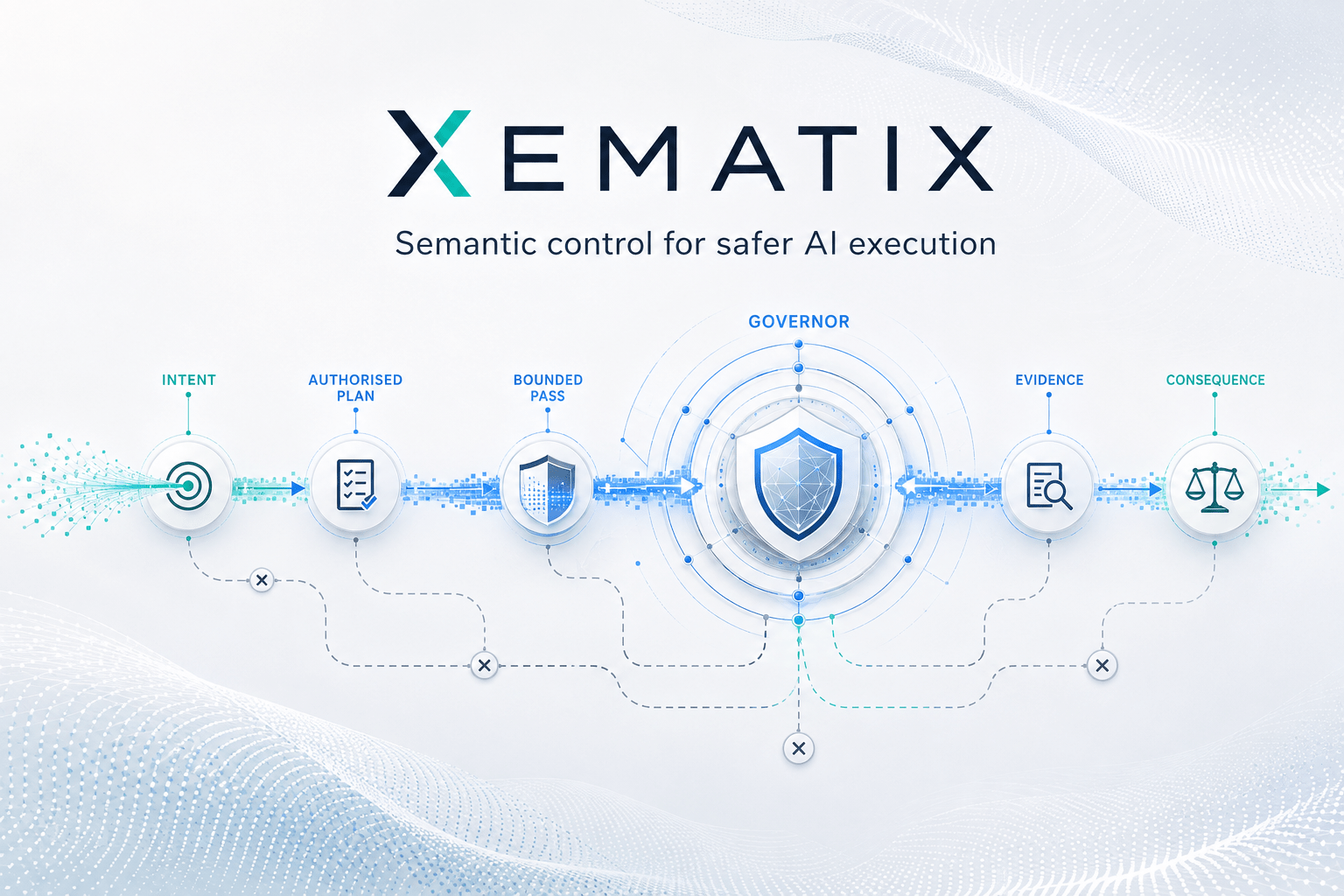
Once you stop treating intelligence as the system boundary, a clearer architecture comes into view. Strong agent security depends on four controls working together: source provenance, bounded context, delegated pathways, and independent verification. They matter as a sequence because each one constrains what the next stage is allowed to do.
Source provenance means every input carries information about origin, authority, and useful lifetime. User documents should arrive marked as user-generated and limited in authority. System directives should remain high-authority and protected from casual override. Tool outputs should carry the trust level of the systems that produced them, along with any degradation introduced by processing or transformation. If you can't tell where a piece of context came from, you can't govern what it should be allowed to influence.
Bounded context means trust levels do not collapse into one shared reasoning pool. User input can be processed in one lane, policy in another, and external material in a third, with explicit interfaces controlling what crosses between them. This doesn't eliminate risk, but it turns hidden mixing into visible design.
Delegated pathways mean that when one agent hands work to another, the handoff includes more than instructions. It includes scope, authority, limits, and verification requirements. The receiving agent should know not just what to do, but what it isn't allowed to do, whose authority the task reflects, and how its work will be checked.
Independent verification closes the loop. Results should be validated by processes that don't share the same reasoning chain that generated them. In some workflows that will mean deterministic checks. In others it may mean a separate review system or human approval for high-risk actions. The exact mechanism can vary. The independence can't.
A research agent offers a useful example. If it's asked to summarize recent papers on AI safety, a disciplined system wouldn't treat every input the same way. The user request would carry one authority level, internal safety rules another, and retrieved papers a lower external authority until screened. A search sub-agent would receive explicit scope, such as academic sources from a defined period, and the returned set would be checked against clear criteria like publication date or venue before synthesis begins. The model still does useful reasoning, but only inside a structure that constrains what reasoning is allowed to move the system.
One Small Reversible Test
If you want a practical starting point, begin by auditing context admission. For one week, log every piece of information that enters an agent's reasoning path, along with its source and authority level. Most teams discover the same thing: user documents, system instructions, tool results, and conversation history are often treated as functionally equivalent even when the risk profile is obviously different.
Then choose the highest-risk mixing point and separate it. In most systems, that's where user input and system command logic share the same active context. Process them apart, and allow them to interact only through explicit rules. A simple four-step check is usually enough to expose the weakness:
- Identify each incoming source and assign it an authority level.
- Mark where low-trust and high-trust material mix in one reasoning path.
- Separate the highest-risk mixing point with an explicit boundary.
- Add a verification step that doesn't rely on the same agent judging itself.
This won't solve everything in a week, and it doesn't need to. The value of the exercise is that it makes the invisible visible. It shows whether your architecture can distinguish between evidence, instruction, and permission, and whether that distinction survives delegation and review.
In the end, that's the conceptual shift. Secure agent systems don't emerge from smarter models alone. They emerge when a signal is allowed to become action only after it survives provenance checks, constraint, preserved authority, and independent verification. That's what turns raw context into governed action, and it's the difference between an agent that extends your capabilities and one that quietly extends your attack surface.