Your Strategy Is an Electric Motor, Not a Gas Engine – Why Deterministic Planning Fails
Most strategic plans don't fail because leaders aren't disciplined enough. They fail because the planning model doesn't match the system being managed.
When the domain is shaped by shifting behavior, feedback, and distributions rather than fixed sequences, deterministic planning creates false confidence instead of control.
Opening
I watched a seasoned executive spend three months building a detailed AI implementation plan. Every milestone was mapped, every dependency tracked, every risk catalogued. The plan was beautiful, and within two weeks of launch it was already obsolete. The technology moved faster than the timeline, user behavior shifted in unexpected directions, and market conditions changed the competitive frame entirely.
He was treating an electric motor like a gas engine.
That category error explains more strategic failure than most leaders want to admit. They apply deterministic, mechanical thinking to systems that are fundamentally probabilistic. They plan as if they're assembling a combustion engine when they're actually trying to steer a field of interacting forces.
TL;DR
The distinction is simple, but it changes how strategy should work. Deterministic systems resemble gas engines: fixed sequences, repeatable inputs, and outputs you can predict with confidence. That's why they fit domains like accounting, manufacturing, and compliance, where consistency matters more than adaptation. Probabilistic systems are different. They behave more like electric motors, where performance comes from managing fields, distributions, and statistical regularities rather than tracing one fixed sequence from cause to effect. That's the reality of markets, innovation, AI adoption, and most forms of human behavior.

The strategic mistake is using gas-engine logic in electric-motor environments. Leaders ask for rigid milestones in systems that can only be managed through ranges, feedback, and governed adjustment. The result isn't rigor. It's misplaced precision.
In deterministic systems, the question is what will happen next. In probabilistic systems, the better question is what becomes more likely if we act here.
Core Argument
The gas engine metaphor matters because it captures the logic behind conventional planning. A gas engine works through a rigid sequence: intake, compression, combustion, exhaust. Each cycle follows the same order. If you know the starting state and the condition of the components, you can make a strong prediction about what happens next. That makes deterministic planning highly effective in environments where the system itself is stable and the sources of variation are tightly controlled.
An electric motor works differently. It doesn't depend on visible mechanical stages in the same way. It converts energy by managing electromagnetic fields, and its performance emerges from distributed interactions rather than one obvious chain of events. You don't need to trace every particle to control the system. You need to understand the governing variables, build feedback into operation, and constrain the system so useful patterns persist.
That's closer to how strategy actually works in complex domains. Customer demand isn't a fixed sequence. Competitive response isn't linear. New technology doesn't diffuse according to a tidy project chart. Outcomes emerge from many small interactions across a system, and the signal only becomes reliable when it survives triangulation, feedback, constraint, and governed action. In other words, the job of leadership isn't to predict every event. It's to shape the conditions under which favorable outcomes become more probable.
This is the mechanism many planning processes miss. In probabilistic environments, a plan doesn't fail because people ignored it. It fails because the world keeps updating while the plan stays static. The more uncertainty, interaction, and adaptation in the domain, the more quickly a deterministic plan turns from coordination tool into liability. It encourages teams to defend assumptions that should be retested.
That doesn't mean rigor disappears. It means rigor moves. Instead of demanding certainty where none exists, you define a governing claim, test it against reality, and adjust based on what survives contact with the system. The operational consequence is clear: if your domain is probabilistic, strategy must be built around ranges, signal detection, response rules, and resource flexibility rather than one locked sequence of milestones.
Examples
Netflix is a useful example because it didn't win by predicting one exact future state and then executing a fixed master plan toward it. It moved by reading distributions: broadband adoption, viewing behavior, device penetration, content demand, and the economics of delivery at scale. The company made a series of linked bets, measured aggregate behavior, and kept adjusting as the signal strengthened. That is what managing a probabilistic system looks like. You don't need certainty about each user or each quarter. You need enough feedback to tell whether the field is moving in your favor.
Blockbuster approached the same market with the logic of a deterministic operating machine. It relied on store footprints, fixed inventory cycles, and a revenue model shaped around late fees and physical constraints. That logic had internal coherence, but it was optimized for stability at the very moment the environment was becoming statistical, networked, and fluid. One company kept steering into the changing field. The other kept refining a mechanism whose assumptions were decaying.
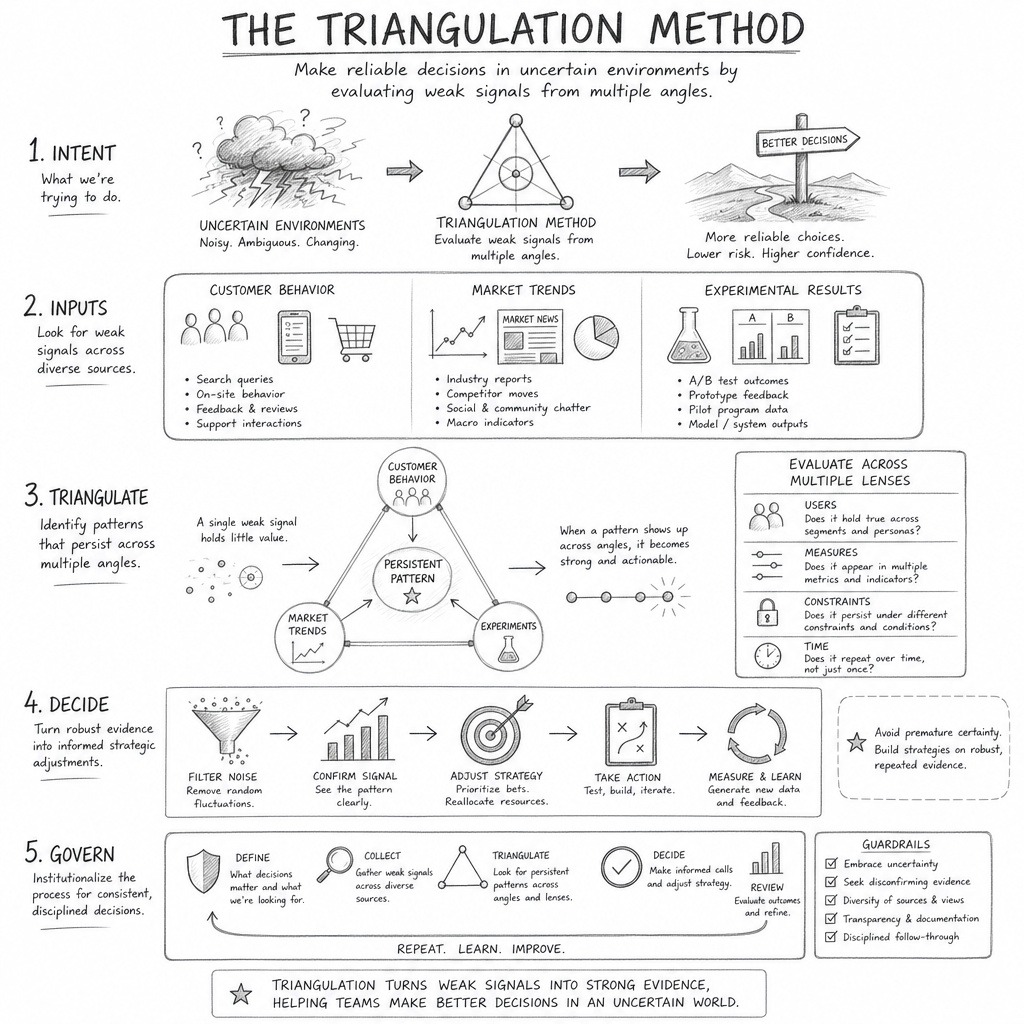
The same pattern appears in product development. Teams that perform well in uncertain markets usually don't confuse a roadmap with proof. They watch conversion trends, usage distributions, retention behavior, and adoption patterns. They run multiple bounded experiments, compare signals across them, and promote only what holds up under repeated feedback. That is the Triangulation Method in practice: one weak signal means little, but a pattern that survives across measures, users, and constraints becomes actionable.
By contrast, weaker teams often demand false resolution too early. They build elaborate Gantt charts around exploratory work, insist on precise ROI forecasts before learning has occurred, and treat early customer reactions as if they were final specifications. In a deterministic domain that discipline can help. In a probabilistic one it usually suppresses learning, delays adjustment, and hardens fragile assumptions into official plans.

The point isn't to remove planning. It's to move planning to the level where control is real: hypotheses, thresholds, feedback loops, and governed reallocation.
Counterpoints
Deterministic thinking still has an essential role. If you're closing the books, running payroll, executing a safety protocol, or maintaining compliance controls, you want repeatability, auditable steps, and minimal variance. In those domains, a gas-engine model is exactly right. The sequence matters, and deviation creates unnecessary risk.
So the argument isn't that deterministic management is outdated. The argument is that leaders often fail to distinguish between domains that reward specification and domains that reward adaptation. The testable implication is straightforward. If identical actions repeatedly produce different outcomes because the environment is responding, learning, and shifting, you're not in a deterministic system anymore. You're in a probabilistic one, and your management model has to change with it.
A common objection is that probabilistic management sounds vague or permissive, as if giving up on detailed prediction means surrendering discipline. It doesn't. Electric motors are precise, but their precision comes from governing fields rather than forcing a visible mechanical chain. Strategy works the same way in complex environments. You can improve the odds, tighten response times, allocate capital with discipline, and build stronger decision rules without pretending that each step will produce one guaranteed result.
What matters is matching method to system. Deterministic domains need specifications, controls, and exact sequence management. Probabilistic domains need explicit assumptions, live feedback, bounded experimentation, and clear thresholds for changing course. Once that distinction is made, planning becomes more useful because it stops claiming a level of certainty the system can't support.
Close
The real shift is from mechanic to field director. Instead of trying to script every move, you create conditions in which better outcomes become more likely. Instead of tracking only whether tasks were completed, you watch whether the underlying distribution is moving. Instead of treating deviation as failure, you distinguish between noise, signal, and the moments that require governed action.
That makes leadership less theatrical and more honest. You stop performing certainty for stakeholders and start building a strategy that can survive contact with reality. In complex domains, that is what competence looks like.
So when a team asks for a detailed plan in a shifting environment, the question isn't whether planning matters. It does. The question is what kind of system you're actually managing. If it's a gas engine, specify the sequence. If it's an electric motor, manage the field. Most strategy fails when leaders confuse the two.