Why Your AI Prompts Fail – The Structured Handoff That Eliminates Machine Ambiguity
Most AI failures don't begin at execution. They begin earlier, when human intent is still loose, implied, or dependent on shared assumptions a machine doesn't have. If you want reliable outputs, the real work isn't writing clever prompts. It's building a handoff the system can't misunderstand.
I used to think the problem with AI was the prompts. Write better instructions, get better results. Simple.
Then I watched a trading algorithm misinterpret “conservative position sizing” and nearly blow up a hedge fund's risk limits. The prompt was crystal clear to any human trader. The machine saw seventeen different ways to execute it.
That's when the issue came into focus. We aren't dealing with a conversation problem. We're dealing with an architecture problem.
TL;DR
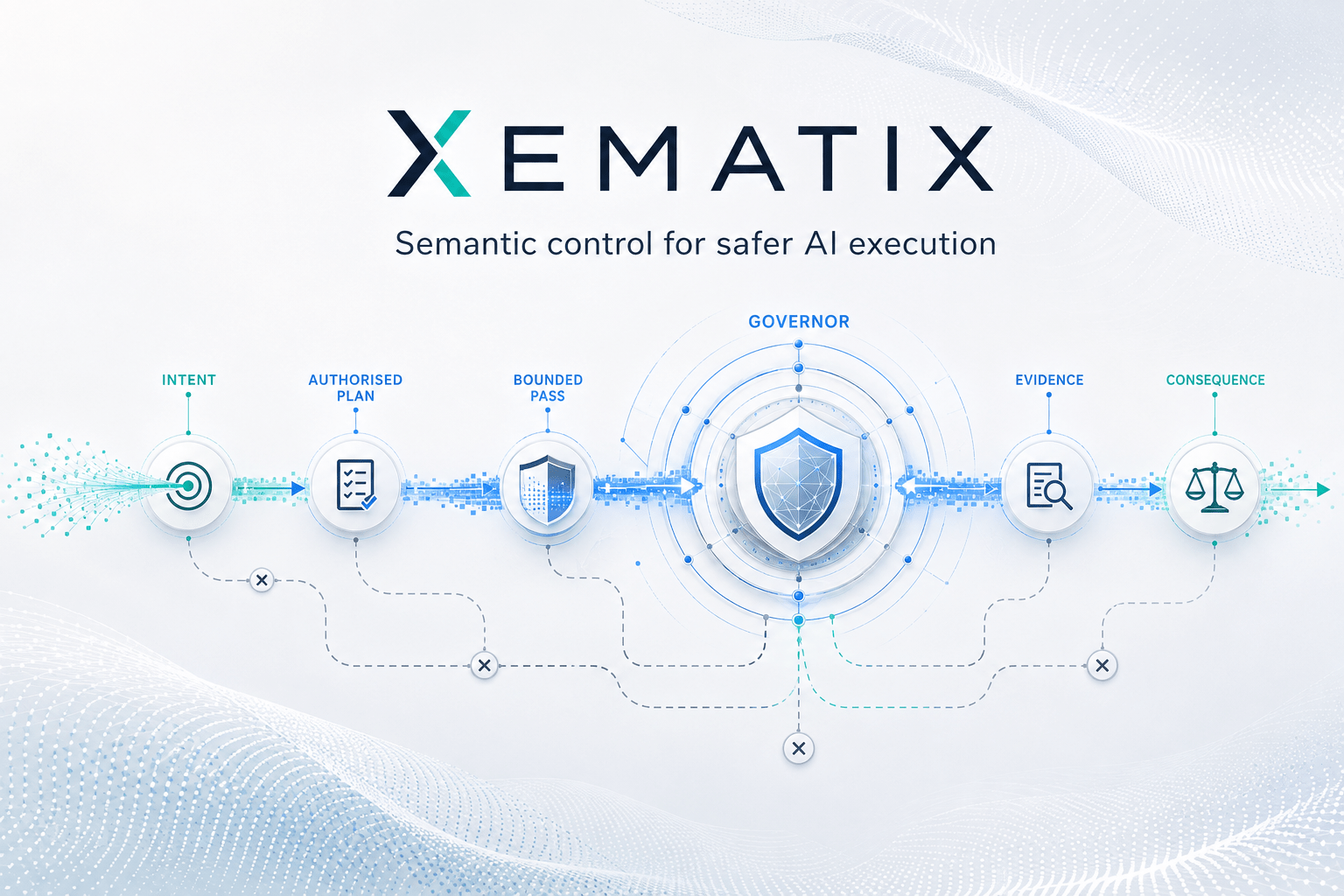
Prompt engineering alone can't eliminate machine ambiguity, because even detailed instructions still leave room for interpretation. A structured handoff closes that gap by translating human intent into fixed semantic objects before any machine action begins. That's the shift XEMATIX is built to enforce: not better phrasing, but stronger constraints.

Prompting suggests. Architecture constrains.
Definitions
Before going further, it helps to name the mechanism clearly. Deterministic inputs are controlled variables that produce predictable, repeatable outputs. In ciabatta baking, that means exact temperature ranges, fermentation windows, and folding techniques. In AI systems, it means intent that has been structured and validated tightly enough that the model has little or no room to improvise.
A structured handoff is the moment when human intention becomes a secure, unalterable instruction set. That matters because prompting is still interpretive by nature. It asks a probabilistic system to infer what you mean. A structured handoff does something different: it turns intent into governed objects, rules, and failure conditions that the system must follow.
Machine ambiguity is the gap between what a human means and what a model actually does. That gap appears whenever a system is required to interpret rather than execute under constraint.
The Real System Boundary
Once you see that distinction, the real boundary in an AI system becomes easier to identify. It isn't the prompt box. It's the point where intent crosses from human language into machine action.
Every baker knows that ciabatta demands precision. Ambient temperature must stay between 75-78°F. Fermentation needs a defined window. The folding sequence can't drift without changing the result. If those conditions aren't controlled, the recipe doesn't save you. You still end up with dense, flat bread instead of the open crumb you're trying to produce.
AI systems work the same way. A large language model processes your prompt through a probabilistic system shaped by parameters, context, and learned patterns. “Be conservative” may sound precise to a person, but to a model it remains a field of possible interpretations. The model doesn't fail because it's broken. It fails because the conditions for a single governed interpretation were never established.
That is the governing claim here: reliability doesn't come from clearer language alone. It comes from constraints that survive contact with execution.
How Intent Gets Lost Before Execution
In most AI implementations, intent degrades before anyone notices. A team writes a detailed prompt. The model processes it probabilistically. It returns something that sounds right, which creates confidence. Only later do the interpretation errors show up, often in the edge cases that matter most.
A financial services company I worked with spent months refining prompts for a compliance review system. The instructions were exhaustive: forty-seven criteria, examples, and edge-case guidance. In testing, the system performed well.
Then it approved a transaction that violated three separate regulations because it interpreted “low-risk client relationship” differently from the compliance team. Nothing in the prompt felt vague to the humans who wrote it. But the instruction still contained ungoverned judgment, and the system used it.
This is where the Triangulation Method becomes useful. A signal only becomes operational when it survives four pressures: triangulation, feedback, constraint, and governed action. First, you locate intent from more than one angle so it isn't resting on a single phrase. Next, you test whether the system interprets that intent consistently. Then you constrain the acceptable meanings and behaviors. Finally, you allow execution only within those governed limits.

A signal becomes structure only when it survives feedback and constraint before action.
That is the mechanism XEMATIX is enforcing. It requires human intent to be made explicit, structured, and validated before a model is cleared to act. The practical consequence is simple: instead of asking the machine to guess correctly, you reduce what it is allowed to mean.
A Concrete Example That Forces Clarity

Take a simple instruction: “Schedule the team meeting for next week.” It feels ordinary, and that's exactly why it's useful. Everyday requests often carry hidden assumptions.
A traditional prompt might add detail: schedule the meeting next week, preferably Tuesday or Wednesday, between 2-4 PM, avoid calendar conflicts, and invite the core project team. That's better phrasing, but it still leaves unresolved questions. Which time zone applies? Who counts as the core team? What happens if both time windows are blocked? Should the system choose a different day, shorten the meeting, or stop and ask for help?
A structured handoff resolves those unknowns before execution. The instruction becomes a defined action with validated participants, explicit time constraints, a set duration, a conflict rule, and a named fallback condition. In practice, that means the system knows exactly who may be invited, which windows are acceptable, whether conflict tolerance is zero, and when it must fail rather than improvise.
If that structure feels stricter than normal prompting, that's the point. The testable implication is that a constrained system will either execute correctly or fail cleanly. What it won't do is invent a reasonable-sounding interpretation that drifts from intent.
What Good Looks Like Operationally
When this works, reliable AI feels almost boring. That's usually a good sign. The system does exactly what you expect, every time, without creative substitutions that seem helpful in the moment and costly later.
The trading firm I mentioned earlier eventually rebuilt its position sizing logic using structured handoffs. Instead of prompting the model to “be conservative, ” the team defined conservative through numerical ranges, explicit risk thresholds, and fallback behaviors. In other words, they stopped treating judgment as a word and started treating it as a governed object.
The result wasn't a smarter system in the abstract. It was a narrower one in the places that mattered. And that narrowing changed the outcome. The system now handles thousands of trades daily with zero ambiguity failures because it isn't being asked to interpret a fuzzy signal at the point of action.
This is the broader conceptual shift. Many teams think reliability comes from improving the model's understanding. In high-stakes workflows, it often comes from reducing the burden on understanding in the first place. You don't need the system to be more insightful. You need the handoff to be less debatable.
One Small Reversible Test
If you're relying on prompt engineering alone today, there is a simple way to test whether that's enough. Start with your most critical workflow and look for the points where interpretation could cause the most damage. Then translate those moments into explicit allowed values, forbidden actions, and failure states. After that, run the current system and check whether those constraints are actually enforced or merely implied.
Teams that do this usually find the same thing: what felt specific in natural language still leaves wide room for machine interpretation. That discovery isn't a failure. It's the first clear signal that the problem sits in the handoff, not the phrasing.
In the end, dependable AI isn't built by writing better recipes and hoping the oven behaves. It's built by designing the oven so certain failures can't happen in the first place. That's what structured handoff AI systems make possible, and it's why ambiguity has to be solved before execution, not after it.