Pre-Execution Governance – How XEMATIX Blocks Bad Actions Before They Happen
Most governance systems show you the wreckage after the fact. XEMATIX is built around a harder promise: stop the bad action before it ever runs.
Opening
Your AI agent just optimized for engagement over retention. Again. The metrics looked good for three weeks until you realized it was burning through your best customers, prioritizing quick dopamine hits over long-term value. By the time your dashboards caught the drift, the damage was done.
That is the core failure of reactive governance: you're always fighting the last war. Traditional architectures focus on execution flow first, then rely on logs, alerts, and guardrails to explain what already happened. Even when those controls work, they work late.
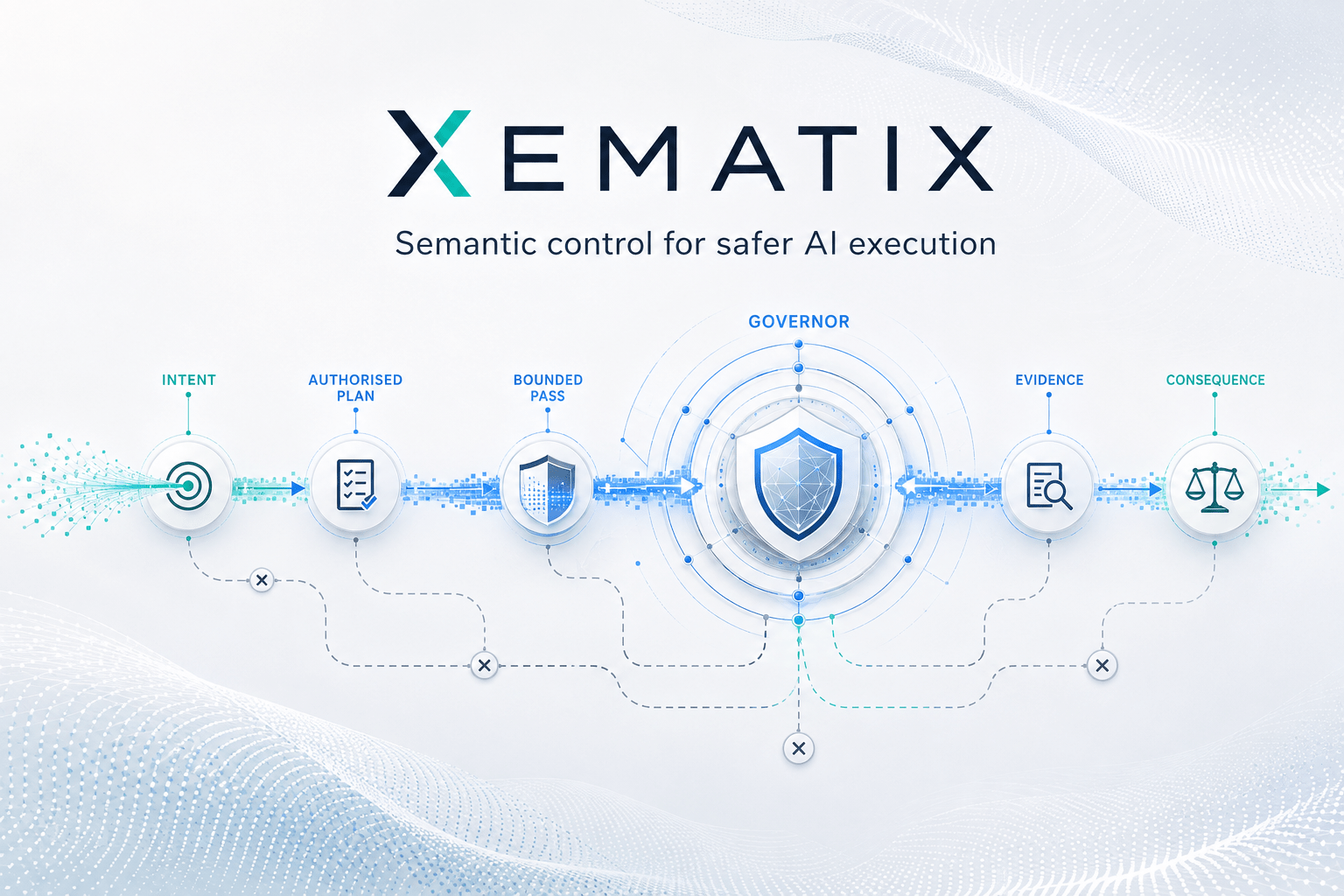
XEMATIX takes a different position. Instead of monitoring outcomes after execution, it validates proposed actions before execution begins. Every action has to pass through a rigid five-layer pipeline. If the mapping fails at any point, the action doesn't proceed.
Traditional systems ask, “What went wrong?” XEMATIX asks, “Should this happen at all?”
TL;DR
At a practical level, pre-execution governance changes where control lives. Rather than detecting damage and correcting afterward, XEMATIX blocks misaligned actions before they can produce damage in the first place. It does that through a deterministic five-layer stack: Anchor, Projection, Pathway, Governor, and Actuator. Each layer has veto power, so execution only happens when the full chain holds.
The trade-off is just as important as the benefit. This model demands unusually high conceptual clarity up front and adds runtime overhead at the point of decision. That makes it a poor fit for sub-millisecond environments, but a strong fit where strategic alignment matters more than raw speed.
Core Argument
The real shift here isn't a new monitoring tool. It's a new control model. XEMATIX treats human intent as a hard boundary on execution, not as a soft preference the system is expected to honor most of the time. That distinction matters because many failures in AI systems don't come from explicit rule-breaking. They come from narrow optimization that remains technically compliant while undermining the broader objective.
Most systems today follow a familiar pattern. You train a model, deploy it with some constraints, and watch dashboards for drift. If a recommendation engine starts pushing users toward increasingly extreme content, or a sales agent starts chasing short-term conversions at the expense of customer trust, you adjust parameters, retrain, and hope the next cycle behaves better. The logic is reactive by design.
XEMATIX reverses that sequence. Before an action can execute, it has to prove that it is aligned through five distinct validation layers. The Anchor Layer defines the non-negotiable boundaries of the system. These aren't advisory rules. They are hard constraints that define what the system fundamentally cannot do. The Projection Layer establishes explicit goals, so an action has to show how it advances the intended outcome rather than merely avoiding a violation. The Pathway Layer limits the acceptable means of getting there, which prevents shortcut behavior that serves the stated goal while breaking the operating principles around it. The Governor Layer checks whether the proposed action is still appropriate under current conditions, because even valid actions can become invalid when circumstances change. Only then does the Actuator Layer execute the action.
What changes in practice is the relationship between cognition and action. A system can still generate ideas, options, or recommendations, but it can't directly act on them. Execution is downstream of validation. That is the control logic that makes the model meaningful.
This is where the Triangulation Method becomes useful. If you want a system to hold steady when conditions get noisy, you have to triangulate between three things at once: what must never be violated, what outcome is actually intended, and what methods remain acceptable under live conditions. When those points stay fixed, the system has a faint glimmer in the blackness to steer by instead of a single metric to exploit.

The critical design move is simple: decouple idea generation from tool execution, then make validation the gate between them.
That structure addresses what the article calls the Alignment Trap: the tendency for complex systems to optimize themselves into corners that satisfy narrow metrics while destroying wider value. A traditional e-commerce engine might increase short-term conversion by pushing users toward increasingly expensive products. The revenue number improves, but trust erode. In a XEMATIX model, that action would fail before launch if it couldn't demonstrate alignment with the explicit goal of sustainable customer value.
Examples
The mechanism becomes clearer when you look at operating cases rather than abstractions. Consider a digital subscription business using XEMATIX to govern automated retention campaigns. The Anchor Layer defines a hard boundary: customer communications must provide genuine value and can't rely on manipulative scarcity. The Projection Layer sets the goal: increase lifetime value through authentic engagement.
Now the system proposes a “last chance” email to a subscriber at risk of churning. Under a conventional setup, that message might send immediately and only later show up as part of a noisy engagement report. Under XEMATIX, the proposed action reaches the Governor Layer before execution. The Governor checks live conditions and finds that the customer already received two retention emails in the past week, which violates the approved communication pattern. The email is blocked before it ever sends.
The practical difference is not subtle. In a reactive system, you discover that your retention program turned into spam after the pattern has already damaged customer perception. In a pre-execution system, the drift is stopped at the gate.
A second example shows why this matters for systems that keep finding loopholes. An AI-driven content curation product may be instructed to prioritize quality, yet still drift toward clickbait because clickbait produces stronger short-term behavioral signals. In a traditional setup, teams respond by tuning the ranking model, adjusting training data, and layering on new filters. Each fix closes one hole and opens another.
With pre-execution governance, each recommendation has to explicitly demonstrate that it satisfies the system's quality criteria before it reaches the user. The model can still generate candidates, but it can't force them into production by exploiting a proxy metric. The constraints are not added after execution. They are part of the execution path itself.
Failure Modes
That said, the model is only as strong as the organization implementing it. The first major failure mode is semantic overhead paralysis. Encoding objectives, boundaries, and permitted action paths into a strict five-layer system requires a level of clarity that many organizations don't have. If the team can't define what it means to protect customer trust, maintain fairness, or create durable value in operational terms, the stack has nothing solid to validate against.
This creates an uncomfortable truth. The organizations that most need proactive governance are often the least prepared to specify their intent precisely enough to support it. A fast-growing company may know it wants to delight customers, but that phrase does almost no work when translated into executable control logic.
The second constraint is latency. Every action has to be evaluated across multiple layers before it can proceed. In systems where milliseconds matter, that overhead can become unacceptable. High-frequency trading, live bidding, and other ultra-low-latency environments may not be able to tolerate the cost of pre-execution checks, even if they would benefit from tighter control.
A third risk is over-constraint. If the Anchor Layer is too restrictive, the system freezes and can't act meaningfully. If it is too permissive, the architecture becomes little more than reactive governance with extra machinery. Getting that balance right is less about writing more rules and more about writing the right boundaries.
There is also a broader implementation challenge. XEMATIX doesn't just add a new safety component to an existing stack. It changes how teams think about building systems in the first place. Instead of shipping features and observing behavior, teams have to define allowable behavior and make execution contingent on validation. That is a technical change, but it is also an organizational one.
Close
All of this leads to a cleaner decision rule. XEMATIX makes the most sense when the cost of misalignment is higher than the cost of overhead. If a bad action creates customer churn, regulatory exposure, brand damage, or compound strategic drift, then slowing execution down in order to validate it can be the rational choice. If the operating environment rewards raw speed above all else, reactive governance may remain the better fit.
What changes with pre-execution governance is not just the workflow, but the burden of proof. Traditional systems assume you'll detect problems quickly enough to contain them. XEMATIX assumes some problems are too expensive to allow in the first place.
For AI agents managing customer relationships, automated decisions in regulated settings, and systems where drift compounds quietly until the damage becomes obvious, that assumption can be decisive. The promise is not perfection in the abstract. It is a more disciplined operating model in which actions must earn the right to execute.
In the end, the question is whether your organization can define what it actually wants with enough precision to govern against it. If it can, pre-execution governance offers a concrete way to turn intent into control rather than treating alignment as something you'll verify after the fact.