From Feature Pile to Governed Machine – Why Upstream Governance Makes Software Commercially Durable
Most software doesn't fail because the idea was weak. It fails because growth turns a workable product into a tangle of exceptions, patches, and one-off rules.
The real shift isn't adding more controls at the edges. It's moving governance upstream so the system behaves like a machine, not a pile of features held together by vigilance.
Opening
Most software systems start life as a promising collection of features. Each new capability gets its own custom logic, its own permission checks, and its own way of handling errors. That feels fast and flexible at first, until you realize you've built a feature pile instead of a coherent machine.
The difference becomes obvious the moment the system has to do more than it was originally designed for. Add AI automation, support multiple clients, or investigate a critical failure, and the cracks show quickly. In a feature pile, every workflow invents its own rules. In a governed machine, the same logic repeats everywhere: intent first, constraints next, execution after that, then verification.
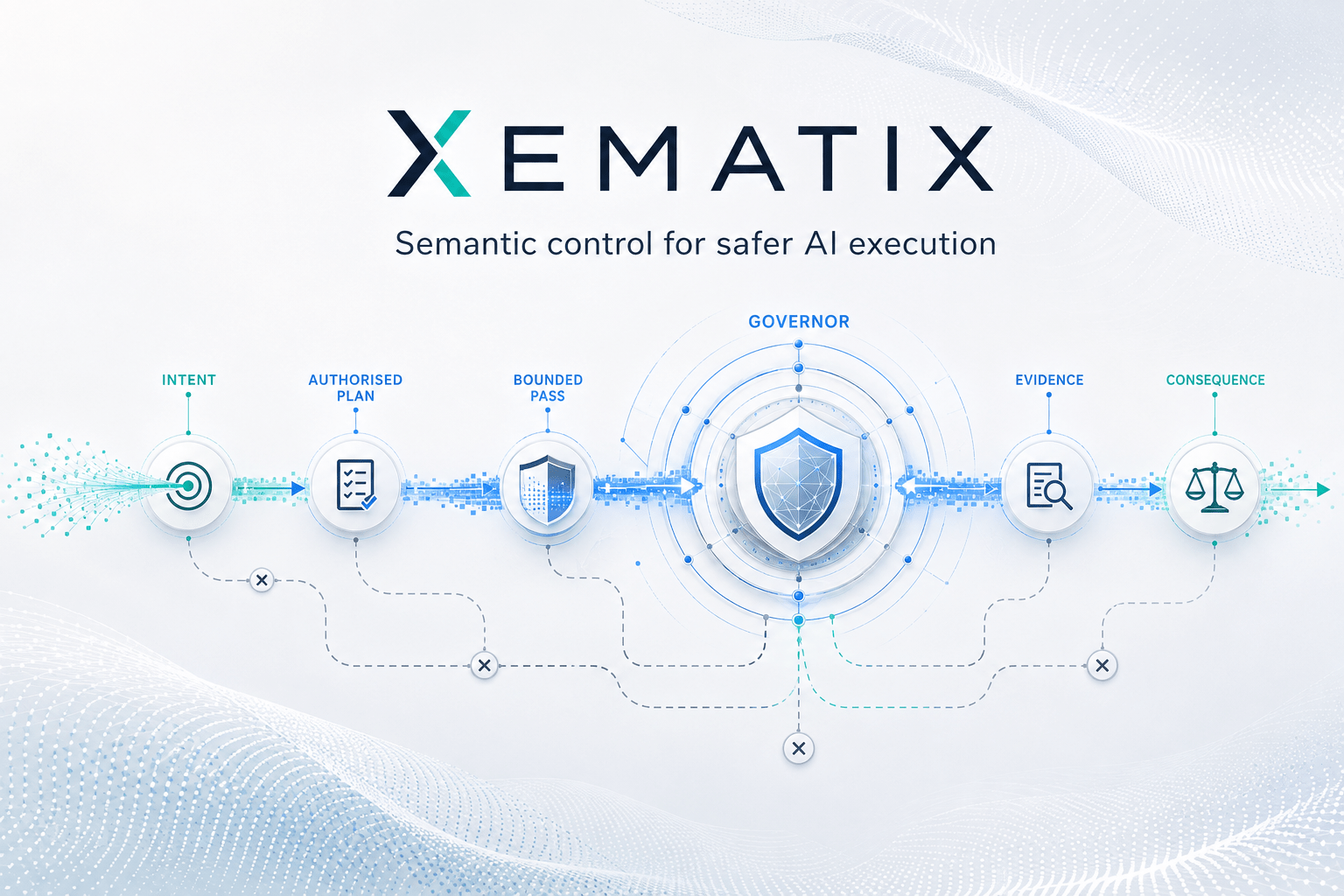
That is the shift XEMATIX represents. Instead of retrofitting safety and consistency after the fact, it puts them into the foundation.
Durable software isn't just software with more features. It's software whose decisions are made the same way every time.
TL;DR
The core move is simple: stop letting each component invent its own governance model. A feature pile spreads control logic across pages, workflows, APIs, and automations, which makes behavior inconsistent and maintenance expensive. A governed machine uses the same decision pattern everywhere.
The mechanism is the intent-constraint-execute-verify loop. It creates consistency without forcing every team to hardcode protections into every surface. The payoff is practical rather than abstract: safer AI automation, cleaner scaling, easier debugging, and the kind of operational seriousness that makes software commercially durable.
Definitions
A feature pile is a system where each workflow, page, or automated action implements its own governance logic. Over time, that produces inconsistent behavior and growing maintenance overhead because similar decisions are being made in different ways.
A governed machine is an architecture where the same four-step logic repeats across the system. Actions begin with intent, pass through constraints, move into execution, and end in verification. Because the contract is consistent, behavior becomes more predictable without requiring custom protections for every new feature.
Upstream governance means making control decisions at the architectural level instead of solving them one feature at a time. In practice, that means the system decides what is being attempted, what is allowed, what actually happened, and whether the outcome matched expectations before the consequences spread.
This matters because the loop is more than process language. It is the mechanism that turns abstract discipline into operating behavior. Intent names the action. Constraints define the envelope. Execution performs the work. Verification confirms that the result is acceptable. When that pattern repeats across the system, you stop relying on scattered local judgment and start getting reliable system-wide behavior.

Core Argument
The fundamental problem with feature piles is that governance shows up late. You build the feature first, then try to make it safe, scalable, and debuggable afterward. That approach feels efficient in the short term, but it creates friction that compounds with every new capability.
The first cost is inconsistent protection. User registration may follow one validation model while API endpoints follow another. Manual workflows may have one approval path while AI agents use a separate set of guardrails. When something breaks, you can't predict where the inconsistency lives because there is no single governing pattern underneath it.
The second cost is scaling friction. A new client often means rewriting permissions logic. A new workflow often means reinventing exception handling, approvals, or audit behavior. Instead of extending a proven system, the team keeps rebuilding local versions of the same control problem.
The third cost is debugging chaos. When a critical process fails, the evidence is scattered across systems, logs, and formats that weren't designed to tell one coherent story. Root-cause analysis becomes forensic work. You aren't tracing a machine. You're reconstructing a mess.
This is where upstream governance changes the shape of the problem. Once control logic becomes architectural rather than feature-specific, user actions, AI decisions, and system processes can all pass through the same contract shape. That doesn't just make the system cleaner. It makes it governable under pressure.
When governance lives upstream, complexity doesn't disappear. It becomes legible.
Consider what happens when an AI agent needs to publish content. In a feature pile, teams usually respond with bolt-on protections: prompt rules, output filters, manual review queues, and scattered approval checks. Some of those measures help, but they don't create one governing logic. In a governed machine, the agent declares its publishing intent, the constraint layer checks brand requirements and approval conditions, execution performs the publishing action, and verification confirms the content went live correctly. The important point isn't that there are more controls. It's that the controls are part of the same decision structure.
That is the decision bridge many teams miss. They want the speed and leverage of automation, but they run into the friction of unpredictability and inconsistent oversight. The belief underneath XEMATIX is that automation becomes trustworthy only when the system evaluates actions through a repeatable governing loop. Once that loop is in place, the decision condition changes: you no longer ask whether a new feature or agent is too risky in the abstract. You ask whether it can operate inside the same intent-constraint-execute-verify model as everything else.
The difference compounds over time. Feature piles require constant synchronization to keep protections from drifting apart. Governed machines tend to get stronger as they grow because each new component is shaped by the same architectural discipline. In the blackness of expanding complexity, that repeatable pattern is the faint glimmer that lets you keep moving without losing control.
Examples
The clearest place to see this is AI safety. Prompt engineering can influence behavior, but it can't govern consequences on its own. A governed architecture asks a more durable question before any action happens: what is this allowed to do? An AI writing assistant may intend to update a blog post, but the constraint layer checks permissions, brand requirements, and publishing conditions before execution proceeds. If something deviates, verification catches the mismatch before the change becomes live state. That is a stronger control model because it governs action at the system level, not just the language layer.
The same pattern matters in multi-client software. A SaaS platform serving different industries can reuse one governance contract while applying different client policies. A healthcare client may require stricter data handling and approval logic, while a marketing agency may need a different publishing flow. The policies vary, but the operating structure doesn't. That means adding a new client type becomes a matter of policy configuration inside a stable machine rather than a fresh round of governance engineering.
Debugging improves for the same reason. When a workflow fails inside a governed architecture, you can trace the lineage of the decision: what the system intended to do, which constraints applied, how execution proceeded, and where verification flagged the problem. Instead of hunting through disconnected logs, you follow a structured audit path. That turns failure analysis from guesswork into diagnosis.
I once worked with a team that spent three weeks debugging why their automated email campaigns were inconsistently failing. The issue wasn't the email service. Different parts of the system had different definitions of what approved for sending actually meant. One workflow treated internal review as sufficient. Another required an additional state change. Because the approval logic was fragmented, the failure looked random until someone reconstructed the hidden differences by hand. In a governed architecture, that contradiction would have surfaced much earlier because approval would have passed through one shared constraint model.
There is also a quieter but important benefit in operational handoffs. Human operators remain authoritative because AI works inside governed envelopes rather than becoming the hidden author of live state. When human judgment is required, the handoff happens at a defined decision point with clear rationale. It doesn't arrive as an emergency cleanup task after the system has already acted in ways no one can fully explain.
This is where the Triangulation Method becomes useful as a way of understanding the architecture. You can look at any action from three angles at once: what the system is trying to do, what boundaries shape that action, and what evidence confirms the outcome. XEMATIX gives that triangulation a repeatable operating form through intent, constraints, execution, and verification. The concept becomes memorable because the mechanism is concrete.
Close
The strategic benefit of upstream governance isn't just cleaner code or fewer bugs. It's commercial durability. Systems built this way are easier to trust, easier to extend, and much less likely to become sloppy in ways that only surface after automation, scale, or compliance pressure arrive.
That matters because software rarely breaks all at once. It usually drifts. Each exception seems manageable. Each workaround seems temporary. Then one day the system is hard to reason about, expensive to modify, and risky to automate. Upstream governance interrupts that drift by making control part of the architecture from the start.
So the real choice isn't between speed and structure. It's whether you pay the governance cost while the system is still shapeable, or later when you're retrofitting discipline into something that grew without it. Most commercially durable software isn't defined by technical perfection. It's defined by operational seriousness made repeatable. XEMATIX turns that seriousness into a machine.