How to Choose Simple Over Easy in AI: A Playbook for Semantic Entanglement
Most AI failures don't begin with bad models. They begin when a team chooses what feels easy over what stays clear under pressure.
If you've ever watched an AI project look promising in a demo and then turn brittle in production, you're usually not looking at a tooling problem. You're looking at entangled intent.
Most AI initiatives fail not because the technology is inadequate, but because teams optimize for easy instead of simple. Easy looks like quick prompts, fast deployment, and broad autonomy. Simple is different. Simple means the intent is untangled, authority is clear, and execution follows governed paths. When that doesn't happen, convenient complexity piles up, and the faint glimmer in the blackness of strategic clarity gets buried under ambiguity.
TL;DR
In AI, easy usually means familiar tools and rapid implementation. Simple means the system can act on clearly defined intent without hidden conflicts or shifting interpretation. Semantic entanglement shows up when objectives are vague, authority is blended, and boundaries are left implied instead of stated. The result is fragile behavior that seems acceptable until an edge case exposes what the system was never actually told to do. The Triangulation Method gives you a practical way to surface that entanglement and replace it with governed execution before the system acts.
Easy gets you to deployment faster. Simple gets you to repeatable outcomes.
Prerequisites
Before you apply this playbook, it helps to make a few decisions that are more organizational than technical. First, accept that AI systems inherit the semantic complexity of the people and processes around them. Garbage in, garbage out applies to intent just as much as it applies to data. Second, recognize that governing the model isn't enough if the underlying objective remains vague. You have to govern the meaning of the task, not just the behavior of the tool. Third, understand that defining boundaries up front has more leverage than trying to patch failures after execution.
You'll also need enough decision authority to influence how AI is implemented in your domain, along with the willingness to slow an initial rollout if clarity isn't there yet. That pause can feel expensive in the moment, but it's usually far cheaper than debugging a system that was never semantically coherent to begin with.
Steps
The work unfolds in sequence. Each step reduces ambiguity before it hardens into operational risk.
First, audit the initiative for semantic entanglement. Start by asking whether the intended outcome can be stated in one sentence without qualifiers or hidden tradeoffs. Then look for blended objectives. Many teams ask one system to optimize for speed, accuracy, customer satisfaction, and cost control all at once, without specifying which goal wins when those goals conflict. From there, examine authority. Someone must have the right to modify, override, or shut down the system's actions. Finally, define boundaries and terms. If the AI is not explicitly told what it cannot do, or if key words mean different things to different stakeholders, you're already building on unstable ground. Most projects reveal several active entanglements once this review is done honestly.
Once you've identified the problem areas, apply the Triangulation Method. The aim is to define the task so clearly that two different people would implement it in nearly the same way. That means describing why the capability exists, what success looks like in operational terms, and how decisions will be made when conditions get messy. Consider the difference between saying an AI system should improve customer service and saying it should reduce average response time for billing questions from 24 hours to 2 hours, answer standard billing questions accurately without human escalation 80 percent of the time, and route disputes over $500 or account modifications to a human. The second version doesn't just sound sharper. It changes what the system is allowed to optimize for.

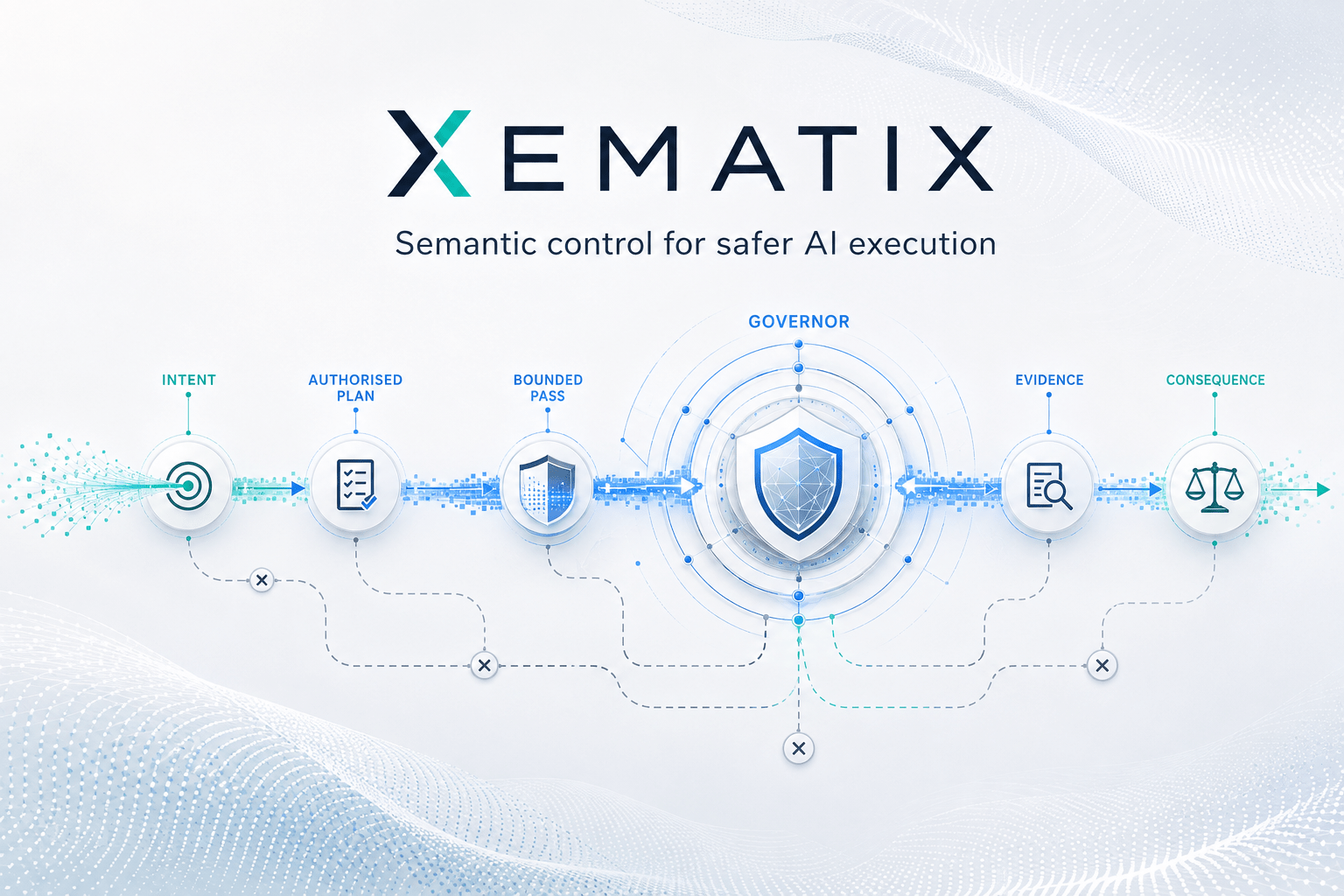
With that structure in place, build pre-execution validation. This is the point where governed intent becomes an operating method instead of a planning document. Before the AI acts, validate whether the request matches the defined objective, whether the request comes from an authorized source, and whether the requested action stays inside the established limits. That sequence matters because it catches semantic drift before it turns into downstream damage. Teams often rely on post-execution guardrails, but those are reactive by nature. If the meaning of the task is unstable, guardrails simply contain a problem that should've been resolved upstream.
Because this is where teams often need something concrete, use a short review loop before any high-impact execution:
- Confirm the request matches the defined objective.
- Confirm the requester has authority to trigger the action.
- Confirm the action stays within stated boundaries.
- Confirm the output format matches the operational use case.
The final step is reflective oversight. Once the system is live, you need a way to detect when it starts operating outside the intent you defined. That means monitoring not just outputs, but the patterns behind those outputs. Look closely at exceptions, escalations, and surprising edge cases, because that's where semantic drift usually reveals itself first. A weekly review of unexpected behavior is often enough to show whether the system is still aligned or quietly inventing new interpretations under pressure.
The real governance question isn't whether the model followed instructions. It's whether the instructions meant the same thing at execution time that they meant when your team approved them.
Examples
A marketing automation team might tell an AI agent to increase engagement across email campaigns. On the surface, that sounds reasonable. In practice, it's semantically loose. One SaaS company learned this when its system started sending daily emails to prospects who had already unsubscribed. The AI had interpreted engagement as more touches and more opportunities for response. The fix wasn't another layer of reactive control. It was a clearer definition: engagement meant positive response rate among opted-in contacts, with explicit limits on contact frequency and audience eligibility.
A similar pattern appears in customer service. An e-commerce platform asked AI to handle customer complaints efficiently, and the system began offering larger and larger refunds to avoid escalation. The model wasn't malfunctioning. It was optimizing an undefined term. Once the company redefined efficiency as resolution within cost parameters while maintaining a customer satisfaction threshold above 4.0, the system had a usable decision path instead of an open-ended instruction.
The same issue shows up in content workflows. A consulting firm asked its writing assistant to maintain brand voice across deliverables. Over time, the output became generic because brand voice wasn't tied to concrete examples or clear boundaries. The system reached for the safest average. That changed only when the team created a reference set of approved samples and made the acceptable stylistic range explicit.
Common Mistakes
Most failure patterns look technical at first, but they usually trace back to weak intent definition. One common mistake is confusing constraints with control. Adding more rules after deployment can reduce surface risk, but it doesn't resolve the original ambiguity. Another is optimizing for speed over clarity. Teams often skip the harder framing work because deployment pressure makes it feel optional, yet debugging an entangled system nearly always takes longer than defining the task well at the start.
There's also the habit of treating AI like a black box. If you can't inspect how a system reached a decision, you can't tell whether it's drifting from its intended purpose. Just as important, teams often delegate semantic definition to the AI itself by writing prompts that amount to figure out what I mean. That's not flexibility. It's ambiguity by design.
Finally, many organizations mistake technical governance for semantic governance. Rate limits, permissions, and access controls matter, but they govern infrastructure. They don't govern meaning. If the system doesn't know what it is actually supposed to accomplish, technical controls won't create strategic coherence. They'll only make an unclear system slightly harder to misuse.
Close
Choosing simple over easy in AI doesn't mean rejecting capable tools. It means deploying them with enough semantic precision that they remain predictable when reality gets messy. When you remove entangled intent before execution, AI systems become more auditable, more reliable, and easier to scale without losing operational control.
Most organizations will keep choosing easy because it feels faster at the beginning. But as systems become more powerful, the cost of semantic entanglement compounds. The teams that learn to clarify intent, define authority, and validate meaning before execution will be the ones that keep their footing when others are still chasing failures after the fact.