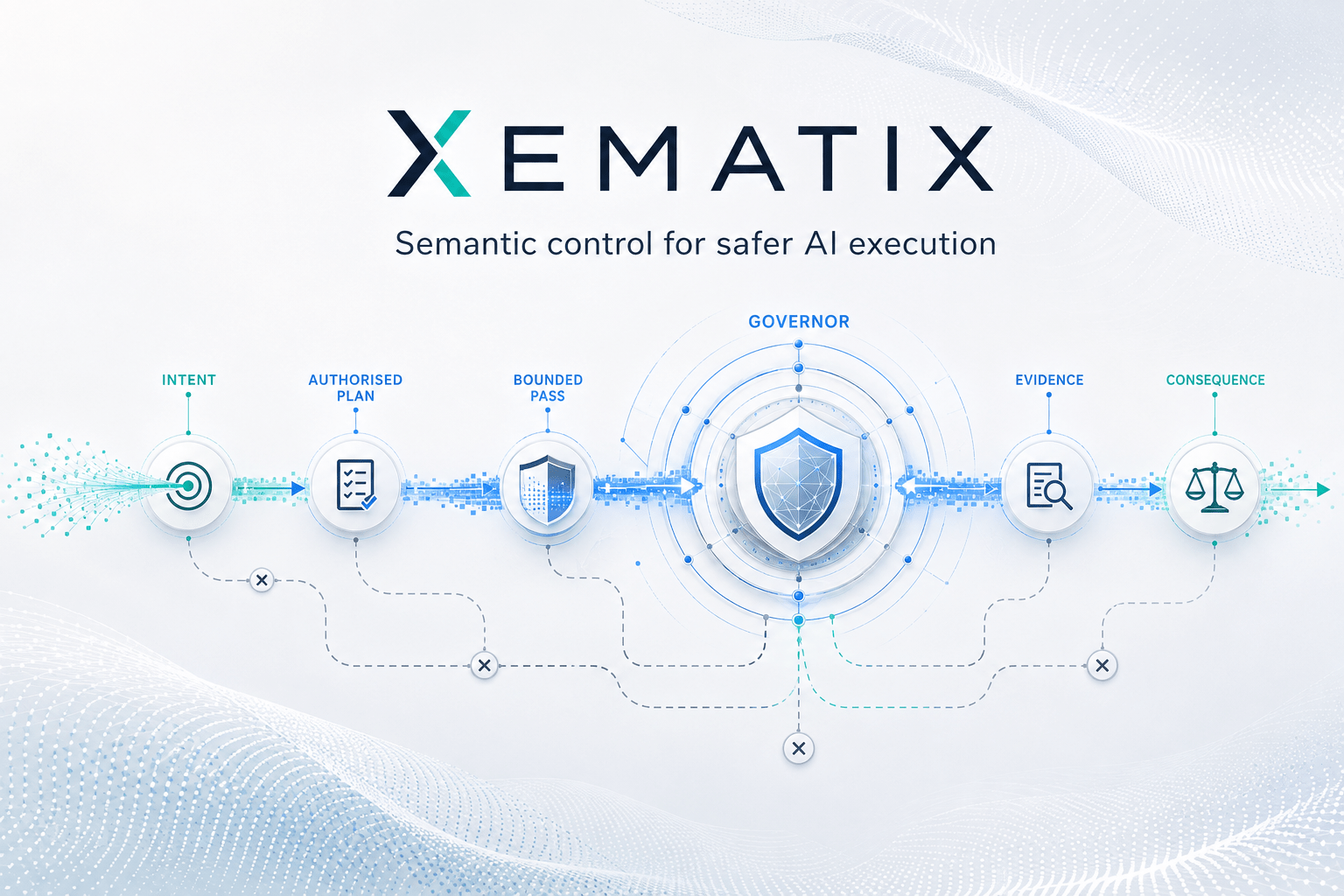
Most teams don't have an effort problem. They have a reliability problem.
Work starts with clarity, then slips into drift, rework, and scattered output. What looks like a tooling issue is often a missing control layer between intent and execution.
Why Your Team Can't Finish What They Start – The Missing Control Layer Between Intent and Execution
Your best people are drowning in half-finished work. Projects begin with clear direction, then break apart into revisions, side paths, and avoidable confusion. Decisions get made in meetings, only to dissolve by Thursday. Even the AI tools meant to increase output can make the situation worse, accelerating motion without improving follow-through.
The usual diagnosis misses the mark. This isn't mainly a strategy problem, a talent problem, or a software problem. It's a control layer problem: the cognitive infrastructure that helps someone stay aligned with a chosen direction, recover after interruption, and finish work without losing the thread.
In practical terms, the strategic claim is simple. Modern organizations often fail to execute not because they lack intelligence, ambition, or systems, but because too many individuals can't reliably maintain intention under real working conditions. Once that control layer is weak, every other investment underperforms. Tools add speed without stability. Process adds structure without follow-through. Meetings create decisions that don't survive contact with interruption.
The Hidden Constraint Nobody Names
Most leaders explain execution failure through external factors. Goals weren't clear enough. Process wasn't tight enough. The tool stack wasn't integrated enough. Those issues can matter, but they often sit downstream from something more basic.
Watch what happens when someone tries to complete a demanding piece of work. They begin focused. Then Slack pulls them away. They return, but the mental model they were holding has thinned out. They spend ten minutes rebuilding where they were, make partial progress, then get derailed again by a “quick question” that fractures the task a second time. By the time the work is finished, it has been restarted several times under slightly different assumptions.
That's not just poor time management. It's the absence of a reliable control layer between intent and action. The person can't hold direction steady across interruptions, can't preserve enough structure to resume cleanly, and can't always detect when their thinking has drifted off the original path.
Execution doesn't usually fail in the meeting where intent is set. It fails in the hours after, when attention is interrupted and no mechanism restores the original line.
Once you see this, a familiar pattern becomes easier to explain. Smart people still produce fragmented work. Strong teams still need multiple rounds of clarification. Reasonable plans still break down into avoidable rework. The issue isn't that the work never gets done. It's that the work arrives distorted, requiring correction because the original intention wasn't held intact from start to finish.
This is where desire, friction, belief, mechanism, and decision conditions come together. Leaders want reliable execution. The friction is constant interruption, context switching, and cognitive drift. The belief gap is that many still assume better tools or tighter process will compensate. The mechanism is different: individuals need a trainable way to preserve intention, notice drift, and recover alignment. The decision condition follows from that logic. If execution repeatedly decays between decision and delivery, the next strategic move isn't another platform rollout. It's strengthening the control layer that keeps work coherent under pressure.
How AI Makes the Gap Wider
That weakness becomes more visible, not less, in AI-enabled environments. AI tools are built to amplify output, but they amplify whatever mental state the user brings with them. If someone's thinking is clear, structured, and stable, AI can extend that advantage. If they're scattered, uncertain, or drifting, AI will accelerate the drift.
Consider a marketing manager using ChatGPT to draft campaign copy. She begins with a clear brief. Midway through the interaction, she gets pulled toward a tangent about brand voice that wasn't central to the original task. The system follows her lead, generating polished material around the new direction. The output sounds good, but it now solves the wrong problem. She has more words, not more progress.
That matters because AI removes friction from production, not from judgment. It can compress drafting time, summarize information, and generate options quickly. What it can't do is reliably preserve a human operator's original intent when that operator has lost hold of it. If the internal line wavers, the machine scales the wobble.
AI is an efficiency multiplier, but efficiency is only useful when direction is stable.
This is why some organizations feel more chaotic after adopting advanced tools. The technology is functioning as designed, yet the surrounding system becomes noisier. More content gets generated. More tasks move faster. More outputs circulate. But if the people directing those systems can't hold a clear aim or recover from drift, the organization doesn't gain precision. It gains velocity without control.
What Good Looks Like in Practice
The alternative isn't perfect concentration. It's recoverable focus. In strong execution cultures, people still get interrupted, redirected, and overloaded. The difference is that they can return to a task without having to mentally start over each time.
Imagine a product manager pulled into an urgent customer call halfway through writing a feature spec. When she returns, she doesn't simply reopen the document and continue typing from the last line. She briefly reconstructs her intention. What problem was this spec meant to solve? What constraints shaped the recommendation? What decision was the document supposed to support? That short reset helps her detect where the interruption nudged her thinking off course. She corrects it before drift turns into rework.
That kind of performance can look subtle from the outside, but it changes outcomes. Fewer revision cycles. Clearer decision support. More consistency between what was intended and what gets delivered. The faint glimmer in the blackness is that execution starts to feel less mysterious once you recognize that reliability lives in the return, not just the start.
This is also why the Triangulation Method matters. Reliable performers don't depend on uninterrupted momentum. They repeatedly orient around three points: the intended outcome, the present task, and the condition of their own attention. That ongoing triangulation lets them catch drift before it hardens into wasted effort. The result is not heroic discipline. It's steadier completion.

Why Better Tools Won't Fix This
From a management perspective, the natural response is to improve the external system. Add project management software. Standardize communication. install AI assistants. Build cleaner dashboards. Each step appears rational, and sometimes each step helps at the margins. But none of it addresses the core failure if the individual control layer remains weak.
A startup founder might assemble Notion, Slack, Linear, and Loom to streamline operations. Six months later, the team still misses deadlines and still delivers work that requires multiple revisions. The platforms are not broken. They capture tasks, document conversations, and make coordination visible. Yet the basic pattern remains because the system is organizing instability rather than correcting it.
This is the strategic distinction many organizations miss. Information architecture is not the same as attention architecture. External tools can store, route, and display information, but they can't maintain a person's internal line of effort during disruption. If someone can't hold a clear intention for even a short stretch of complex work, more software simply creates more surfaces where fragmentation can occur.
That doesn't mean tools are irrelevant. It means their value is conditional. They become force multipliers only after a reliable control layer is in place. Before that, they often multiply noise.
The strongest counterposition says execution problems are mostly structural, not cognitive. Clarify roles, tighten accountability, improve process design, and results will follow. There's truth in that. Structure matters. Ambiguity creates waste. Poor management creates drift. But that explanation breaks down when the same teams, with clear goals and capable leadership, still produce work that unravels between planning and delivery. At that point, structure is no longer the whole story. The remaining variable is whether people can preserve direction once the work leaves the meeting and enters the churn of the day.
Training as the Alignment Mechanism
If that's the mechanism of failure, it also points to the mechanism of improvement. The solution isn't better slogans about focus, and it isn't a search for superhuman employees. It's training people to build the control layer that connects intention to execution under ordinary working conditions.
In one consulting firm, senior associates were trained on a small set of attention-stability practices. The aim was operational, not therapeutic: hold intention during complex analysis, detect when thinking drifts from the original question, and recover context quickly after interruption. Within eight weeks, client deliverables required 40% fewer revision cycles, and project timelines became more predictable.
The significance of that example isn't just the improvement itself. It's the leverage. When cognitive reliability increases, the same people, using the same tools, inside the same workflows, begin producing materially better outcomes. That tells you the bottleneck was not raw intelligence or effort. It was the missing layer that kept intention coherent long enough to become finished work.
If you need a simple operating pattern, the Triangulation Method can be expressed in four steps. Before returning to interrupted work, pause briefly. Re-state the intended outcome in plain language. Check whether the current task still serves that outcome. Then resume only after you've corrected any drift.
This isn't wellness language dressed up for business. It's operational training for cognitive reliability. You already accept that people need training to use systems, equipment, and procedures safely under pressure. Attention deserves the same seriousness because it governs whether decisions survive contact with the workday.
Once that becomes clear, the strategic implication is hard to avoid. Reliability, not mere productivity, is the deeper advantage. Teams that can maintain direction through interruption finish more of what they start, waste less effort in rework, and use AI and process tools with far better judgment. The organizations that pull ahead won't be the ones with the most software or the loudest urgency. They'll be the ones that build the control layer others assume is already there.