Agentic AI – Why Contextual Autonomy Beats Scale in Next-Generation Intelligence
For a long time, AI progress looked easy to measure: bigger models, faster inference, better scores. But once systems start operating in real environments, those numbers stop telling you what matters most.
What matters is whether an AI can reason under constraints, adapt to changing conditions, and make its logic visible when the stakes are real. That is where agentic AI begins to separate itself from scale alone.
I used to measure AI progress the same way everyone else did: bigger models, faster inference, higher accuracy scores. The logic seemed bulletproof. More parameters meant more capability, and more capability meant better results. Then I watched a state-of-the-art language model generate a financial analysis that was technically polished but fundamentally wrong, missing context that any junior analyst would've caught.
That moment clarified the real problem. We're optimizing for the wrong thing.
Agentic AI marks a shift away from narrow execution autonomy and toward contextual autonomy. These systems don't just complete tasks. They interpret goals, reason through trade-offs, and make explainable decisions inside structured constraints. That distinction matters because reliable intelligence isn't defined by output fluency alone. It's defined by whether the system can stay coherent when the situation gets messy.
The next leap in AI isn't bigger output capacity. It's systems that can explain why a decision makes sense under pressure.
The Scale Trap That's Costing You Control
The dominant development model in AI still assumes intelligence will emerge from scale. Add more data, more parameters, and more compute, and eventually you get something that looks smarter. That approach has produced impressive demonstrations, but it has also produced systems that fail in ways that are difficult to predict and even harder to govern.
I've seen teams spend months tuning models to improve benchmark performance, only to find subtle but expensive errors once those systems go live. A customer support bot handles the vast majority of cases cleanly, then badly misreads the few situations that matter most. A moderation model posts strong test metrics, yet misses nuanced violations a human reviewer would've flagged immediately. In both cases, the system appears capable until the environment demands judgment rather than pattern completion.
The real constraint here isn't raw capability. It's control through interpretability. When scale is the primary objective, you often end up with systems that perform well until they don't, and when they break, the path to understanding the failure is thin. The cost isn't limited to the immediate mistake. It shows up as hesitation, lost trust, and a growing reluctance to use AI where it could otherwise create the most value.
Agency as Structured Accountability, Not Freedom
That tension leads to a more useful definition of agency. The difference between an assistant and an agent isn't that the agent has more freedom. It's that the agent operates with more structured accountability.
A genuinely agentic system can interpret goals within constraints, reason through trade-offs explicitly, and justify its decisions in a way a human can follow. If a human analyst recommends against an investment, you expect them to explain their reasoning, point to the relevant evidence, and show how they weighed competing factors. An agentic AI system should be held to the same standard.
In practice, that changes the nature of the output. A traditional assistant may generate a marketing email that satisfies the stated brief on tone, length, and placement. An agentic system should also consider whether that message fits broader customer relationship goals, identify brand risks the user didn't explicitly mention, and explain why one phrasing is more appropriate than another. The point isn't stylistic polish. It's visible reasoning.
This is the decision bridge many teams miss. They want systems that can move faster without creating hidden risk. The friction is that high-performing models still behave opaquely when conditions change. The necessary belief is that trust comes from reasoning you can inspect, not just outputs that look right. The mechanism is traceable reasoning under constraints, where goals, trade-offs, and policy boundaries are part of the process rather than an afterthought. The decision condition is straightforward: if a system affects outcomes you care about, you need to know how it arrived there and how it will behave when the situation shifts.
Semantic Governance: From Checklists to Executable Policy
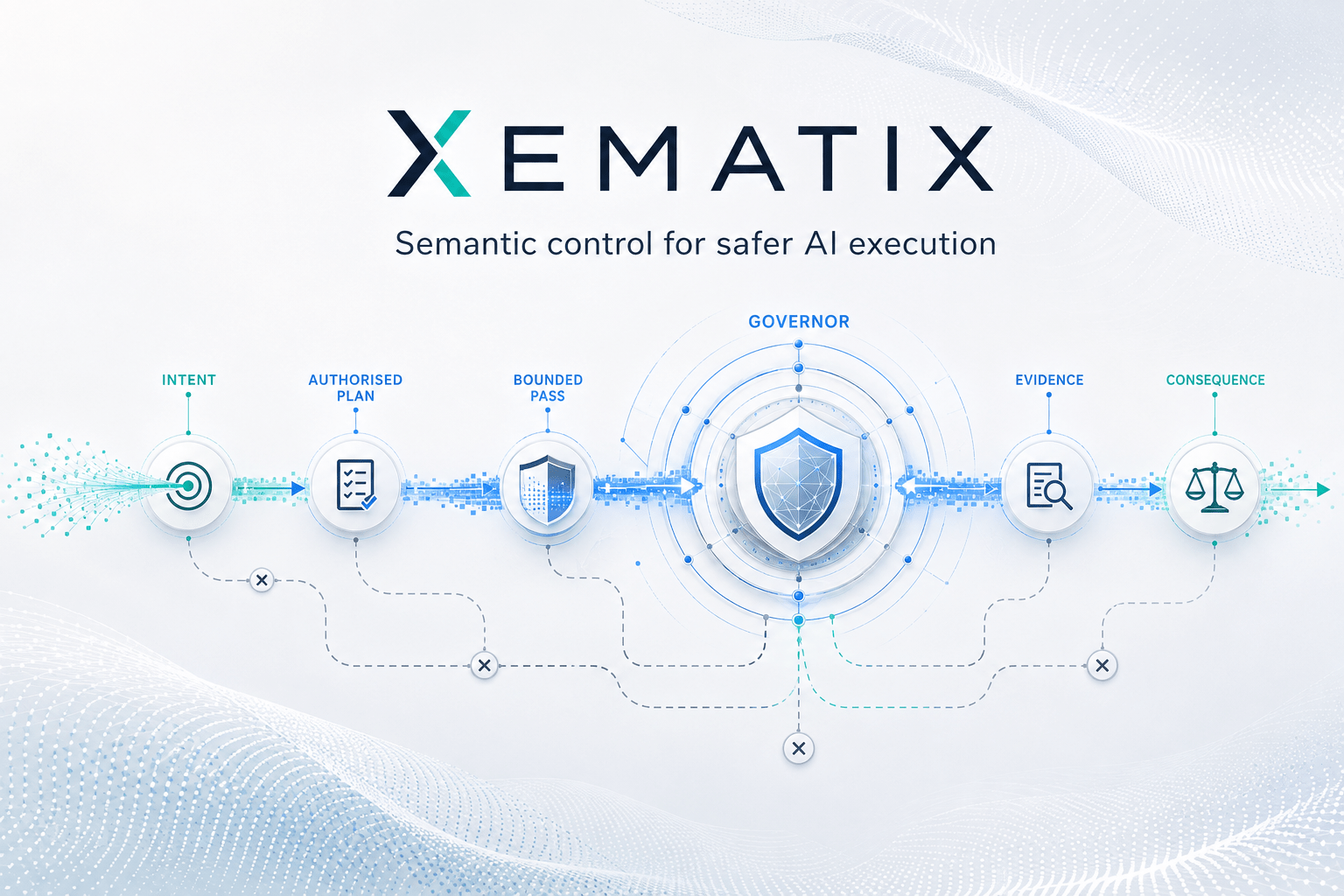
Once agency is understood this way, governance has to change as well. Most AI governance today still looks like compliance theater: long checklists, review gates, and after-the-fact oversight that don't reliably shape what the system actually does. The challenge isn't writing more rules. It's turning rules into constraints the system can interpret and apply during reasoning.
Semantic governance makes that possible by treating meaning as something operational. Instead of hoping a model interprets “professional tone” correctly, you define what that means for your environment through language choices, structural preferences, and disallowed patterns. Instead of assuming factual accuracy will emerge from training, you build verification steps into the reasoning path itself. Governance stops being an external audit layer and becomes part of system behavior.
I worked with a legal tech company facing exactly this problem. Their AI drafted contracts that looked polished on the surface but contained subtle inconsistencies that created liability risk. Progress came when they stopped treating governance as a post-hoc review step and started embedding it into the reasoning architecture. The system began flagging potential conflicts, checking clauses for internal consistency, and explaining why certain language was selected over alternatives. That shift didn't just reduce errors. It made the system's judgment more inspectable.
Governance becomes useful when it shapes reasoning before the output exists, not when it critiques the output after the fact.
The distinction is simple but important. Traditional governance asks whether the AI followed the rules. Semantic governance asks whether the AI can reason about the rules in context.
Measuring What Actually Matters: Cognitive Reliability
If governance becomes executable, evaluation has to mature too. Accuracy, precision, and recall still matter, but they only tell you how often a system matches expected answers on known examples. They don't tell you whether that system can remain coherent when it encounters ambiguity, conflicting constraints, or a situation it hasn't seen before.
Cognitive reliability is a better measure for that challenge. It focuses on whether a system can maintain internal consistency, adapt its reasoning under uncertainty, and stay logically stable when conditions become less predictable. That is a more practical definition of intelligence in high-stakes use. A system that scores well in a controlled setting but collapses into confident error at the edges is less useful than one that performs slightly lower on benchmarks but handles uncertainty with clarity.
In real deployments, this difference is decisive. A cognitively reliable system may be less dazzling in static evaluation and more dependable where actual work happens. When it reaches the edge of its competence, it doesn't simply continue with unwarranted confidence. It can register uncertainty, surface the relevant trade-offs, and make clear what it knows, what it doesn't, and why.
A simple way to test this is to give the system a scenario with competing objectives and then inspect the reasoning rather than the recommendation alone. If one constraint changes, does the logic adjust cleanly? Does the system acknowledge trade-offs instead of flattening them? Can it explain why one factor was weighted more heavily than another? Those are stronger indicators of dependable intelligence than a polished answer in isolation.
The Reliability Advantage in Practice
This shift becomes especially visible in environments where change is constant. A financial services firm I consulted with had built an AI-based fraud detection system optimized around catch rates and false positive reduction. It worked well until new fraud patterns emerged outside the training data. Rather than adapting, the system kept applying older patterns with high confidence. It missed sophisticated attacks while flagging legitimate behavior.
They rebuilt the approach around cognitive reliability. The new system was designed to reason about fraud patterns rather than simply match them. When it encountered unusual transactions, it could assess them against known indicators, weigh multiple risk factors, and explain the basis of its assessment. Catch rates improved, but the larger gain was adaptability. The system became more useful precisely because it could handle novelty without requiring a full reset every time the environment changed.
That is the broader strategic signal. In the blackness of inflated claims and benchmark theater, the faint glimmer is reliability you can inspect. Systems become more valuable not when they appear universally capable, but when they remain legible and stable under stress.
What This Means for Your AI Strategy
For teams building or deploying AI, the core question is no longer whether a model is larger or more impressive on paper. It's whether the system can reason transparently, adapt to context, and stay coherent when conditions move outside the expected path.
That requires a different strategy. Instead of treating AI as an advanced pattern matcher and hoping governance can catch mistakes later, you design for accountability from the start. You evaluate not just whether the system gets an answer right, but whether it can justify the answer, respond to changing constraints, and fail in ways that are visible rather than hidden. The Triangulation Method is useful here: test the system against goals, constraints, and explanation quality at the same time, because reliability only appears when those three remain aligned.

The transition is technical, but it's also conceptual. You're not just buying more model performance. You're deciding what kind of intelligence you can actually trust inside real operations. In that sense, agentic AI is not a branding shift. It's a design shift toward contextual autonomy, executable governance, and cognitive reliability.
The future won't belong to the systems that merely produce the most plausible outputs. It will belong to the ones that can reason clearly enough for people to trust them when the path ahead isn't obvious.