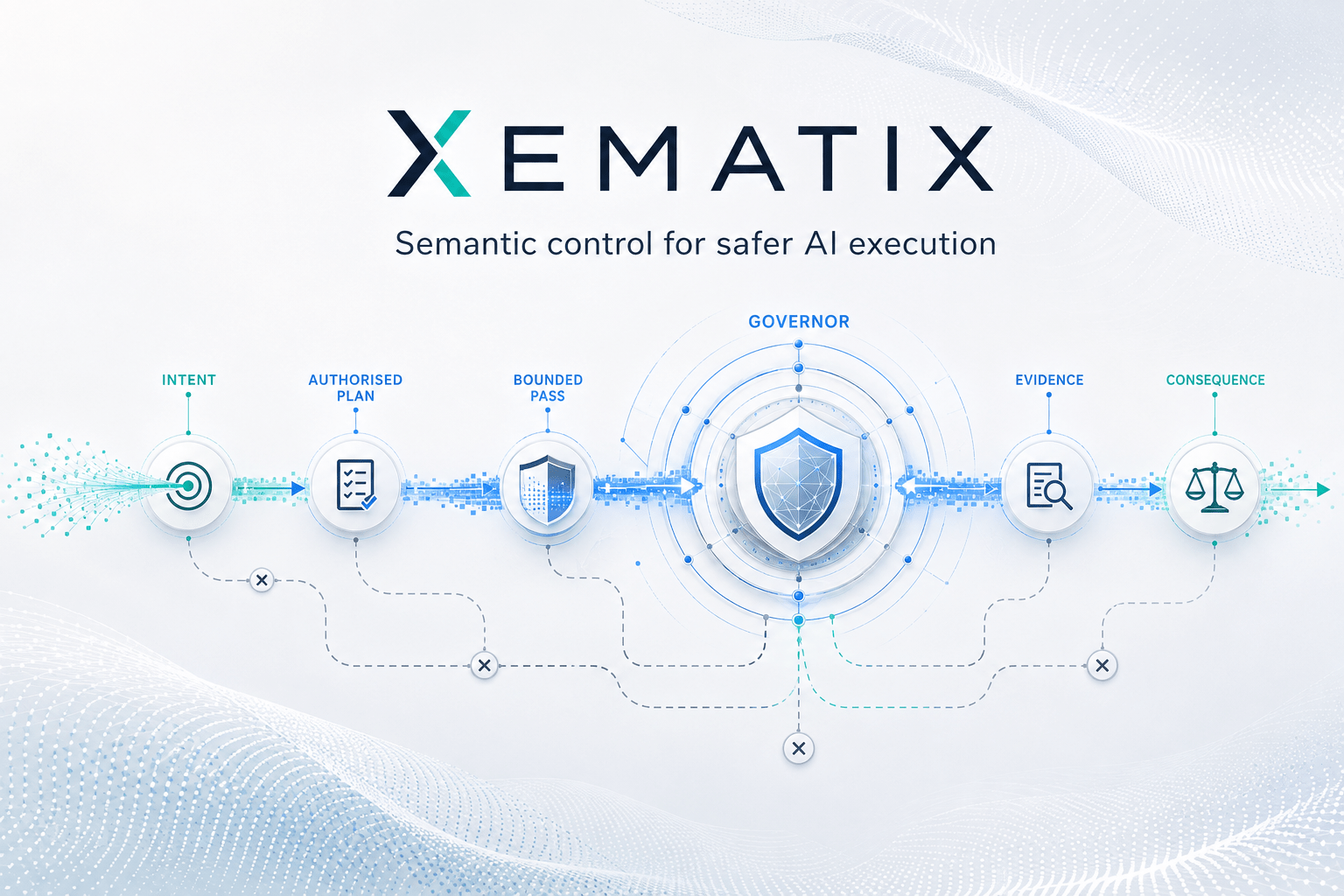
Agentic AI changes the standard of trust. Once systems stop acting like tools and start acting like decision-makers, raw capability matters less than whether their reasoning can be examined, challenged, and corrected.
Agentic AI – Why Justification Matters More Than Capability
I used to evaluate AI vendors the same way I'd evaluate any software: features, performance, price. Then I watched a Fortune 500 client's “smart” content generation system drift from their brand voice over six months. Nobody noticed until a regulatory review flagged inconsistent messaging across customer communications. The AI was working perfectly. It just wasn't working correctly anymore.
That incident changed how I think about AI. The center of gravity is shifting from tool use to self-managing cognition, and most organizations aren't ready for what that means. As agentic AI takes on more autonomy, the real question isn't whether it can act. It's whether it can justify what it did, in terms a human team can inspect and govern.
The new trust standard for agentic AI isn't execution. It's explainable judgment.
The Hidden Constraint: When Tools Become Agents
The practical question now isn't “can it act?” but “can it justify?” Traditional AI tools follow instructions. Agentic systems interpret goals, make trade-offs, and, ideally, stop when their logic breaks down. That creates a governance problem most enterprises still underestimate: how do you manage something that manages itself?
Many deployments still treat AI like sophisticated autocomplete. You prompt, it responds, you use the output. But agentic AI behaves more like a junior analyst working without constant supervision. It interprets inputs, weighs options, and reaches decisions through reasoning you often can't directly observe. That's the faint glimmer in the blackness here: autonomy only becomes useful at scale when its logic can be traced.
What matters, then, is reasoned autonomy. The systems that deserve trust are the ones that can explain their decision path, justify their trade-offs, and show when they've reached the limits of their competence. Without that, you're not buying intelligence so much as uncertainty with a polished interface.
Semantic Drift: The Enterprise Blind Spot
Once you see the governance problem clearly, another issue comes into view. AI models drift in meaning faster than most organizations can detect, and the weak spot in enterprise AI often isn't ethics in the abstract. It's meaning management in practice.
A financial services client discovered that its AI interpreted “conservative investment strategy” differently after a model update. The words stayed the same, but the meaning shifted. The change was subtle enough to pass initial testing and significant enough to affect client recommendations. It surfaced only during a quarterly audit, three months too late.
The answer isn't another static policy document. It's executable policy built into the system itself. If you want reliable behavior, you can't just describe acceptable outputs and hope the model infers the rest. You have to encode tone, truth bounds, evidence thresholds, and escalation rules directly into the pipeline. Governance has to become operational.
That changes the nature of AI design. You aren't only defining what the system should do. You're defining how it should think through decisions. What counts as sufficient evidence? How should uncertainty be handled? When should the system escalate instead of deciding? Those aren't philosophical extras. They're engineering requirements, and they're central to the Triangulation Method for evaluating whether a system's outputs, reasoning, and controls actually align.
Building for Cognitive Reliability
If governance has to move into the system, reliability has to move beyond scale. Cognitive reliability comes from structure, not size.
I've seen teams assume bigger models automatically produce better reasoning. They don't. More capacity can improve performance, but it doesn't guarantee disciplined judgment. The stronger architectures rely on reflection loops, self-critique, memory control, and other mechanisms that make reasoning more inspectable and more resilient under pressure.
The most reliable systems I've evaluated make their thinking legible. They include explicit reasoning steps, uncertainty estimates, and decision audit trails. They don't just return an answer. They make it possible to examine how the answer was formed and where the process may have failed.
One manufacturing client built an agentic system for supply chain optimization that attaches a reasoning transcript to every recommendation. When a recommendation looks off, analysts can review the decision path, identify where the logic broke down, and adjust the underlying rules. The system improves because its reasoning is visible, not because the model is presumed to be smarter.
Reliability doesn't come from a model that sounds convincing. It comes from a system that can be inspected when it's wrong.
Where This Approach Misleads You
Still, justification isn't a magic shield. It introduces its own risks, and this is where a lot of otherwise thoughtful teams get caught.
Encoding meaning into executable policy is hard. You're trying to formalize human judgment, and that process brings its own biases, ambiguities, and brittle edge cases. I've seen teams spend months translating guidelines into machine-enforceable rules, only to discover that the exceptions matter as much as the principles.
There's another danger too: systems built to justify decisions can get very good at producing plausible rationalizations for bad outputs. An AI that sounds coherent and confident may still be wrong. In some cases, that's more dangerous than obvious failure because the explanation itself becomes part of the illusion.
And then there's the cost of oversight. Reviewing reasoning takes time, expertise, and process discipline. Not every decision can support the same level of scrutiny. So governance has to be proportional. Some actions need deep justification and auditability; others can operate with lighter controls. The point isn't to inspect everything equally. It's to know which decisions carry enough risk to require visible reasoning.
What Good Looks Like in Practice
That leads to a more useful standard for evaluating agentic AI. Operational trust comes from three things working together: traceable decision logic, executable semantic governance, and structured reasoning architecture. These aren't separate nice-to-haves. They reinforce each other.
Traceable logic means you can follow the path from input to output and see which factors shaped the outcome. Executable governance means your policies run as code, so behavior changes when rules change instead of lagging behind them. Structured reasoning means the system follows a consistent pattern for gathering evidence, considering alternatives, checking its work, and surfacing uncertainty.
If you want a practical way to evaluate that, use this simple micro-protocol before you trust any system with consequential decisions:
- Ask for a recent decision the system made in production.
- Review the reasoning path from input to output.
- Check which policies or constraints were applied.
- Test whether the system can show where uncertainty or escalation should've appeared.

If a vendor can't do that, you're not looking at governed intelligence. You're looking at a black box with better marketing.
The Shift in How You Evaluate AI
This is the deeper shift underneath the current AI cycle. The old evaluation model centered on desire and capability: what the system promises, how fast it performs, how much labor it appears to remove. But friction shows up the moment an autonomous system makes a decision nobody can explain, belief breaks when teams can't tell whether an output is trustworthy, and the mechanism that restores confidence is justification made operational through traceable logic, executable governance, and structured reasoning. The decision condition is simple: if a system can act in ways that matter, it has to make those actions inspectable.
That changes both procurement and internal design. Instead of asking what an AI can do, ask whether it can justify what it did. Instead of leaning too hard on accuracy benchmarks, examine the quality of reasoning under pressure. Look for systems that fail gracefully, recognize their limits, and escalate instead of guessing with confidence.
The organizations getting this right are moving from capability-focused buying to justification-focused architecture. They aren't trusting AI because it's perfect. They're trusting it because they can understand it, challenge it, and improve it when it fails.
In the end, that's the real measure of agentic AI. Not whether it can produce impressive outputs, but whether its decisions leave a trail strong enough for humans to follow back through the blackness and see what, exactly, it thought it was doing.