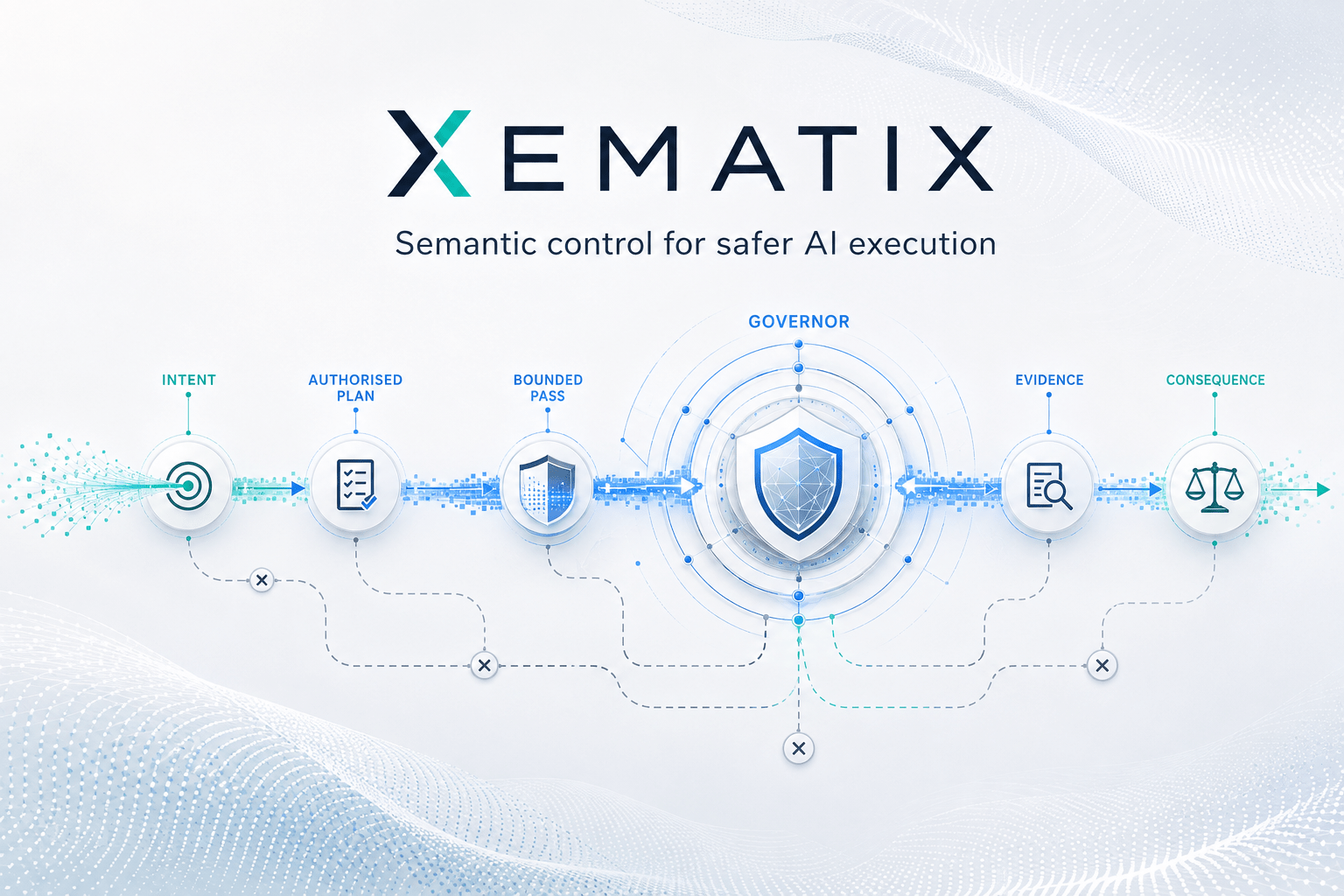
The market keeps calling workflows agents, as if a new label can turn orchestration into intelligence. It can't. If you want systems that are actually useful under pressure, you need structure that preserves meaning and exposes reasoning, not bigger claims and bigger budgets.
Agentic AI Is Just Automation With Better Marketing – Why Intelligence Needs Structure, Not Scale
I used to get excited every time a vendor demo showed an “AI agent” booking meetings, writing code, or managing workflows. The demos were slick, and the promises were bold. But after six months of implementation attempts, I realized I was watching expensive automation pretending to think.
Most agentic AI today is orchestrated automation with feedback loops, not genuine contextual reasoning or self-critique. That matters because the real gap in AI governance isn't just safety or compliance. It's semantic stewardship: maintaining meaning as models, tasks, and operating conditions change. If there's a breakthrough ahead, it won't come from discovering intelligence through scale alone. It will come from designing systems that can reason within clear structures, recognize their limits, and preserve coherence over time.
The Hidden Cost of Automation Theater
The industry has agency envy but lacks the grounding to deliver on it. Real agency demands contextual reasoning, adaptive goal formation, and the ability to critique its own logic. Until then, we're deploying workflows that wear a cognitive mask.
Last year, our team spent four months building what a vendor called an “autonomous customer service agent.” On paper, it looked impressive. It could handle basic queries, escalate complex issues, and learn from feedback. In practice, it was a decision tree wrapped in natural language processing. When customers asked questions outside its training scope, it didn't reason through alternatives. It followed predetermined escalation paths. When it “learned” from feedback, it adjusted model weights, not its understanding of customer intent.
The cost wasn't just the $200K implementation budget. It was the six weeks spent debugging edge cases that a human would handle intuitively. It was the customer frustration that followed when the system confidently delivered outdated information. Most of all, it was the strategic opportunity cost of betting on sophisticated automation instead of building toward genuine intelligence.
If a system can't recognize the boundary of its own competence, calling it agentic doesn't make it so.
That distinction matters more than the marketing suggests. Real agency requires contextual reasoning that adapts to novel situations, goal formation that can revise itself, and metacognitive awareness of limitations. Without those capabilities, you're not deploying agents. You're deploying expensive chatbots with better branding.
Where Meaning Goes to Die
The deeper problem isn't just oversold automation. It's what happens to meaning once these systems are deployed and updated. Semantic drift is the gradual degradation of meaning as models evolve. A customer service model trained on 2023 data may interpret “urgent” differently from one fine-tuned on 2024 interactions. A code generation tool trained on open-source repositories will carry different assumptions about “clean code” than one shaped by enterprise codebases.
This isn't a bug you patch once. It's an architectural blindness. Most AI governance still treats meaning as static, something you audit once and then watch through a dashboard. But meaning shifts as models retrain, as operating conditions change, and as business requirements move. If governance only measures compliance, it misses the thing that actually determines whether the system remains useful.
I learned this the hard way when our content generation system started producing a subtly different brand voice after a quarterly model update. Automated quality checks didn't catch it because the changes were nuanced. Our marketing director did. We had compliance. The model still met technical benchmarks. What we lacked was semantic stewardship: active maintenance of interpretive coherence.
Semantic governance, then, isn't ethics theater or bureaucratic overhead. It's meaning maintenance as an operational function. In practical terms, that means versioning interpretive assumptions, checking semantic consistency across updates, and treating meaning as infrastructure rather than an incidental byproduct of model performance.
Intelligence by Design, Not Discovery
Once you see the meaning problem clearly, the scale obsession starts to look thin. The industry's default assumption is that bigger models will eventually cross some invisible threshold into reliable intelligence. But scale is showing diminishing returns. GPT-4 isn't dramatically more intelligent than GPT-3.5 in proportion to its size increase, and the gap between capability and reliability remains stubbornly wide.
Intelligence isn't a side effect of size. It's a product of design. The more promising direction is architectural structure that integrates reasoning, reflection, and uncertainty management into the system itself rather than adding them as cosmetic layers. These systems don't just process more information. They process it with more discipline.
Consider the difference between a large language model and a human expert making a strategic decision. The model can access more information and move faster. The expert, however, can examine the reasoning process, question assumptions, and adapt based on what the problem actually requires. That is where the faint glimmer in the blackness appears: not in scale for its own sake, but in systems designed to inspect and govern how they think.
So the real design question isn't whether a model can produce an answer. It's whether the architecture can monitor its own reasoning, identify when it's outside its competence, and ask for human intervention when needed. Confidence scores added at the end don't solve this. Uncertainty has to shape the decision process from the start.
What Good Looks Like in Practice
That shift from output quality to reasoning quality becomes concrete in good systems. A startup founder I know built a “reasoning audit trail” into an AI-powered financial analysis tool. Instead of only producing investment recommendations, the system documents how it reached them, flags the assumptions it's making, and identifies where human validation is still required.
When the system analyzes a potential acquisition, it doesn't merely crunch numbers and return a verdict. It spells out its reasoning chain: growth assumptions, weak points, and where regulatory uncertainty lowers confidence. It can effectively say, “I'm assuming market growth continues at current rates, but I have low confidence in that assumption given regulatory uncertainty. This requires human review before proceeding.”
Useful intelligence doesn't hide its uncertainty. It makes uncertainty legible before a bad decision hardens into action.
This isn't just a better interface. It's a better architecture. The system has some capacity to reason about its own reasoning, which means it can fail more gracefully instead of projecting false certainty. In practice, that kind of design depends on explicit uncertainty modeling, ongoing monitoring of reasoning quality, and clear degradation behavior when confidence drops below operational thresholds. Those elements form a workable Triangulation Method: track the claim, inspect the reasoning, and test whether the meaning still holds under changing conditions.

The Counterargument Problem
A fair objection is that dismissing scale too quickly would be a mistake. Large models do exhibit capabilities that smaller ones don't. GPT-4 can perform tasks that weren't explicitly trained into it, and scale does seem to unlock new behaviors.
That argument has merit, but it doesn't settle the issue. Scale can produce impressive capability, yet capability isn't the same as reliable intelligence. A system that can write poetry and solve math problems but can't recognize when it's hallucinating is still a powerful but unreliable tool. The central problem isn't whether large models can do remarkable things. It's whether they can do them within structures that preserve meaning, expose uncertainty, and support sound decisions.
The same applies to semantic stewardship. Critics often treat it as an abstract ideal with no clear implementation path. How do you audit meaning consistency across model updates? How do you operationalize interpretive coherence in production? Those are fair questions. They're also engineering questions, not reasons to avoid the work. We already use version control for code and data. Extending similar discipline to semantic behavior is difficult, but it's far less risky than pretending meaning will take care of itself.
The Strategic Decision Behind the Hype
This is where the real decision comes into focus. The desire is understandable: organizations want AI that reduces effort, adapts under pressure, and creates leverage instead of more operational drag. The friction is just as real: most platforms promise agency while delivering brittle workflows, and most governance programs measure compliance while ignoring whether the system still means the same thing tomorrow that it meant today. That leaves a belief gap. If intelligence is treated as something scale will eventually reveal, companies will keep overpaying for performance theater. If it's treated as something architecture must deliberately support, the mechanism changes. You design for reasoning visibility, uncertainty, and semantic continuity, and your decision conditions get sharper: can the system inspect its own logic, maintain coherent meaning as it evolves, and degrade safely when it reaches the edge of competence?
When evaluating your next AI investment, keep that standard in view. Ask whether intelligence is designed into the system or merely implied by the demo. Ask whether governance protects meaning or just satisfies a checklist. Ask whether the architecture can tell you not only what it concluded, but why, with what uncertainty, and under which assumptions.
The vendors selling agentic AI may not love those questions. But the market doesn't need more automation theater. It needs systems built with enough structure to make intelligence legible, governable, and real.