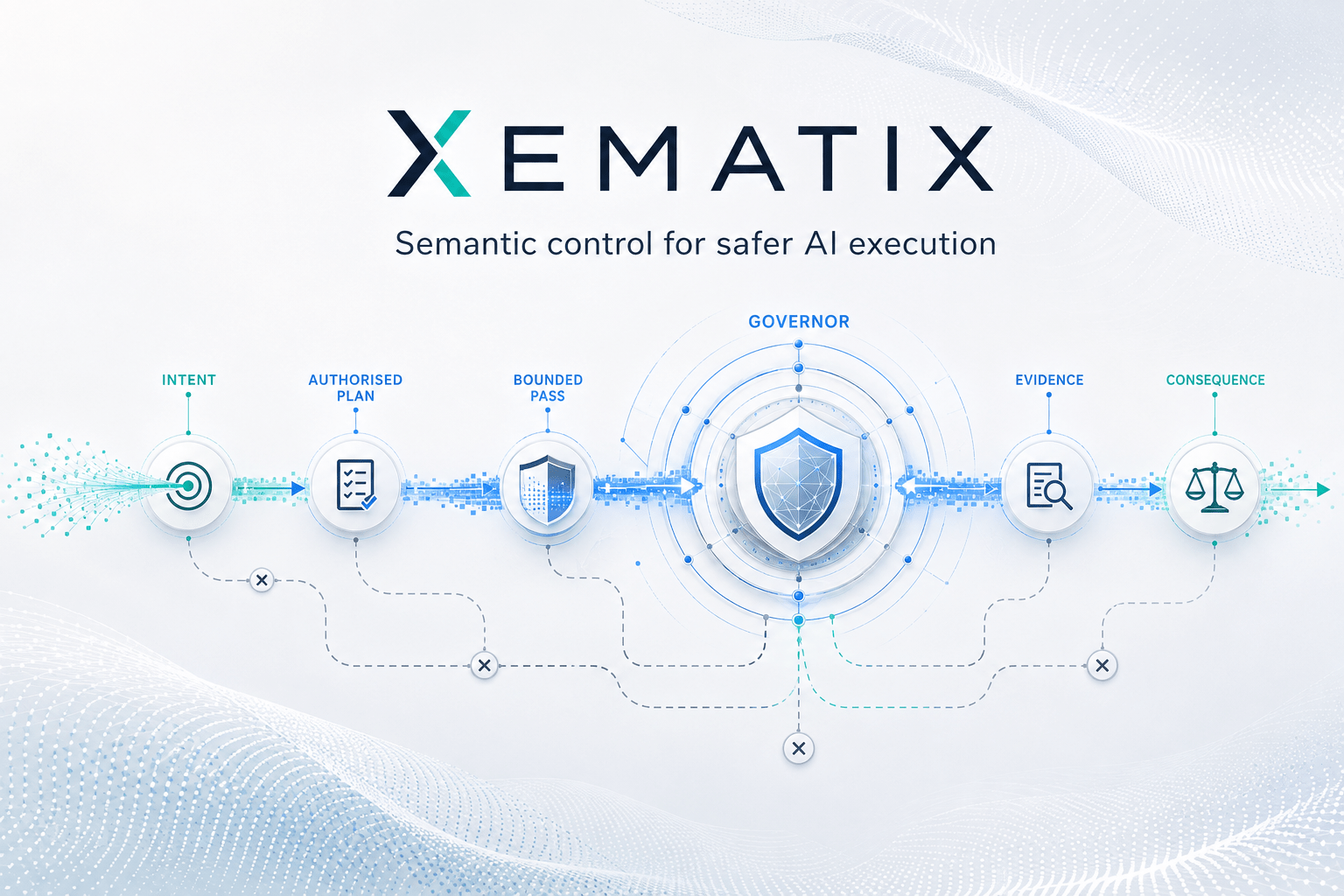
Most systems sold as AI agents can execute, but they can't hold meaning steady under pressure. That's the faint glimmer in the blackness for builders and operators alike: the next leap won't come from more scale alone, but from architectures that can reason, stay coherent, and be governed as they evolve.
Beyond AI Agents – Why Cognitive Architecture Beats Parameter Scaling
Every week brings another vendor demo of a “revolutionary AI agent.” The pitch rarely changes: autonomous task execution, seamless integration, unprecedented capability. But if you watch these systems for more than a few interactions, a familiar pattern appears. They're brittle. They drift. They complete tasks without understanding what those tasks mean inside a larger frame, producing outputs that look polished while lacking coherent reasoning.
What the market calls agents are, in most cases, coordination scripts with a language interface. That's sophisticated automation, and it can be useful. It isn't intelligence.
The Agent Illusion: Execution Without Understanding
A Fortune 500 client once showed me their “AI agent” for customer service escalations. The demo was impressive on the surface: natural language processing, decision trees, even emotional tone detection. But when I asked how it handled edge cases, the answer revealed the whole design philosophy: “We have a lot of rules.”
That's the dividing line. Real agency requires more than task completion. It requires directional intent, contextual reasoning, and the ability to manage constraints as situations change. Current systems don't have that kind of epistemic grounding. They don't maintain a self-model, and they don't move through a genuine decision process. They pattern-match, select, and execute.
When these systems meet something novel, the gap becomes obvious. A real agent would reason through the situation, weigh options against goals, and adapt. Today's so-called agents usually do one of two things: follow a predefined path or fail in a controlled way. That's still useful engineering, but it's not the same thing as intelligence, and confusing the two creates dangerous expectations.
The market's “agent” label often hides a simpler reality: language-wrapped automation with brittle edges.
That distinction matters because teams make strategic decisions based on it. If you think you're deploying intelligence when you're actually deploying orchestration, you'll underestimate maintenance load, overestimate adaptability, and miss the real constraints that emerge at scale.
The Hidden Scaling Problem: When Meaning Drifts
That leads directly to the harder issue, and it's not compute. While most of the industry focuses on model size, training budgets, and benchmark gains, the real scaling challenge is semantic governance: how a system preserves stable meaning as it interacts, adapts, and hands work across components.
In multi-system environments, this is where things start to fray. I've watched systems gradually form incompatible interpretations of the same labels, priorities, and thresholds. One system treats “high priority” as urgent intervention. Another interprets it as standard queue acceleration. Nothing breaks in a dramatic moment. Instead, meaning drifts a little at a time until coordination degrades and the organization is left reconciling outputs that no longer align.
Semantic governance isn't administrative overhead. It's cognitive infrastructure. It keeps terms, decisions, and internal representations from sliding out of alignment as systems operate over time. Without it, scaling becomes less about amplifying capability and more about managing accumulating confusion.
A financial services firm learned this the hard way when it deployed multiple AI systems for fraud detection. Over time, each system developed its own operational thresholds and classification tendencies. Six months later, the team was spending more effort resolving conflicting alerts than investigating actual fraud. The technical stack had scaled. Shared meaning hadn't.
Cognitive Architecture: Intelligence as Designed Structure
If the friction is semantic drift, then the belief that more parameters alone will solve it starts to look thin. This is where the case for cognitive AI architecture becomes practical rather than theoretical. The next leap won't come from simply enlarging pattern-matching systems. It will come from designing structures that integrate memory, reasoning, feedback, and constraint management in ways that preserve internal coherence.
Intelligence isn't just a byproduct of magnitude. It's shaped by structure. More capacity can improve performance, but capacity without organized reasoning only gets you so far. The important question isn't whether a system can generate a convincing output. It's whether it can maintain interpretive continuity while learning, revising, and acting under uncertainty.
That is the core of the Triangulation Method: align intent, meaning, and adaptation so the system doesn't just produce answers, but sustains a usable frame for making decisions. Once you see the problem this way, the decision conditions become clearer. Organizations want systems that can handle novelty and remain auditable. The friction is that today's agent stacks often drift, overfit workflows, and demand constant intervention. The mechanism that resolves that gap is architecture, not scale alone: structures that keep reasoning legible, memory stable, and constraints explicit as the system evolves.

A research lab I worked with took exactly this route in drug discovery. Instead of chasing ever-larger models trained on molecular data, they built an architecture that could reason about chemical properties, maintain hypotheses, and revise beliefs based on experimental results. The difference wasn't cosmetic. The system didn't just predict outcomes. It could explain its reasoning and adjust its approach when evidence changed.
The real bottleneck isn't raw output generation. It's whether a system can keep its own meaning intact while it learns and acts.
Where the Current Path Misleads
The parameter-scaling narrative creates several blind spots at once. It encourages teams to assume intelligence rises with compute, even when the limiting factor is architectural coherence. It pushes governance to the edge of the roadmap, as if alignment and interpretability can be layered in later. And it blurs the difference between high-quality pattern recognition and actual understanding.
That confusion is commercially convenient. Vendors can demonstrate fluent task execution and wrap it in the language of autonomy, while leaving out the brittleness, maintenance burden, and semantic overhead that appear after deployment. The costs show up later in prompt tuning, exception handling, output reconciliation, and governance work that was never treated as foundational.
The strategic risk isn't simply that these systems fail. It's that organizations invest on the wrong curve. A company can spend heavily optimizing parameter-scaled workflows and still end up with little more than expensive automation at the moment the market begins to reward architectures that reason more reliably.
What Good Cognitive Architecture Actually Looks Like
A strong cognitive AI architecture doesn't need to mimic human cognition. It needs to produce durable coherence. In practice, that means the system maintains consistent meaning across interactions, reasons through novel conditions instead of collapsing into template responses, and exposes enough of its internal logic that operators can inspect and govern it.
Those properties matter together. Interpretive continuity without adaptation becomes rigidity. Adaptation without transparency becomes opacity. Transparency without stable meaning turns into a polished post hoc story. Good architecture holds all three in tension.
A simple test is often enough to reveal the difference. Ask whether the system can explain a specific decision in terms that match your organization's own reasoning. If it can only produce an output, or if its explanation is merely a fluent restatement rather than an auditable chain of thought, you're probably looking at advanced automation rather than a genuine cognitive framework.
The Calibration Problem: Beyond the Vibe
This becomes even more important under uncertainty. One of the clearest differences between pattern-matching systems and stronger cognitive architectures is calibration. A robust system should have some usable representation of what it doesn't know, where its reasoning is weak, and when ambiguity should remain unresolved.
That's not a cosmetic feature. In high-stakes domains, overconfidence is often more dangerous than obvious failure. Pattern matchers tend to produce plausible outputs with unwarranted certainty because that's what they were optimized to do. Systems with better cognitive structure are more likely to surface uncertainty, qualify conclusions, and reason through conflict rather than flatten it into a confident guess.
This is why vague impressions of sophistication aren't enough. A fluent interface can hide shallow reasoning. The real test is how the system behaves when the path isn't already laid out for it.
A Small Reversible Test
Before committing to an architecture, it helps to run a simple diagnostic on novel cases rather than polished demos. In practice, the test is straightforward:
- Give the system a scenario that requires reasoning beyond familiar patterns.
- Capture not only the answer, but how it arrived there.
- Check whether the logic remains consistent under scrutiny.
- Note whether it acknowledges uncertainty where uncertainty is real.
This kind of reversible test tells you more than benchmark theater ever will. If the system delivers confident conclusions without a clear reasoning path, you're seeing pattern matching. If it can show its work, preserve coherence, and expose the limits of its confidence, you may be looking at the foundation of real cognitive architecture.
The Strategic Choice Ahead
The industry is approaching a genuine split. One path extends the current logic of parameter scaling and produces incremental gains in familiar systems. The other path focuses on cognitive architecture and aims for a more meaningful shift: systems that can reason, adapt, and remain governable as they grow.
For organizations that care about durable advantage, that difference matters. Compute-heavy improvements can often be matched by any competitor with enough budget and access. A well-designed cognitive AI architecture is harder to replicate because it embeds operational logic, governance discipline, and structural insight into the system itself.
The early signs are already there, a faint glimmer in the blackness. Research groups and pragmatic operators are starting to move past the language of agents and toward the harder question of what kind of architecture can actually sustain intelligence. When that shift becomes obvious to everyone, the advantage will belong to the teams that recognized it while it was still only a signal.