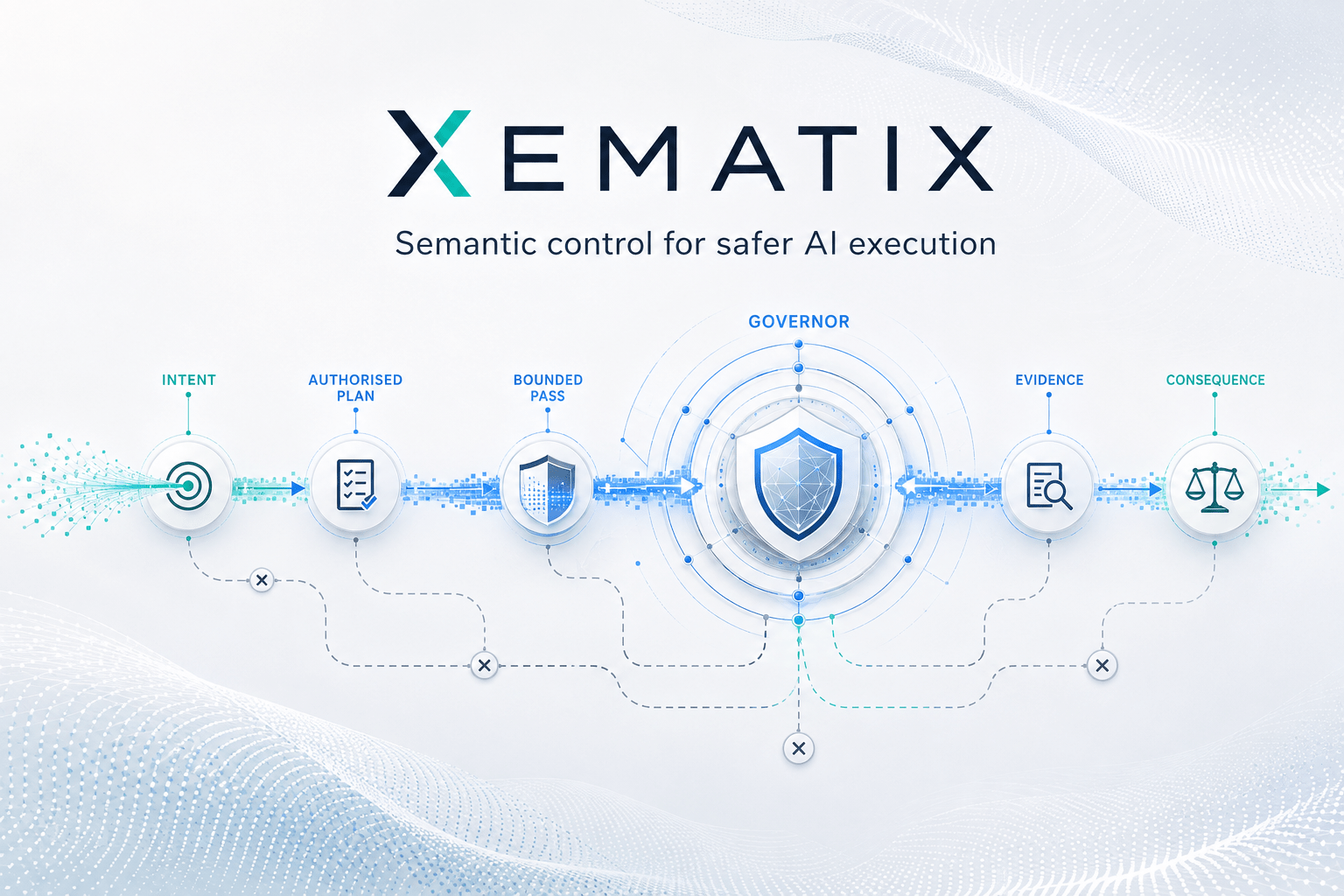
The current wave of agentic AI looks convincing because it moves with speed and apparent initiative. But once these systems leave the demo and meet changing conditions, the gap between action and understanding becomes impossible to ignore.
Agentic AI Is Initiative, Not Intelligence – Why Semantic Governance Beats Model Scaling
I used to get excited every time a vendor demoed an “agentic AI” system. The demos were polished: workflows orchestrated cleanly, APIs called in sequence, multi-step processes completed with minimal human intervention. After deploying several of these systems in production, though, I learned the harder lesson. Initiative and intelligence aren't the same thing, and confusing them creates risk that scales faster than capability.
Most so-called agentic systems today are reactive orchestration layers dressed up as intelligent actors. They can execute predefined workflows with impressive fluency, but that fluency breaks down when conditions shift. Real agency isn't about doing more steps without supervision. It's about holding to coherent intent when the environment changes, the signal gets noisy, and the original plan no longer fits.
The industry has mistaken visible initiative for actual intelligence.
That confusion matters because it shapes what organizations optimize for. If you believe agency is mostly faster execution, then bigger models and better orchestration seem like the obvious path. If you care about reliable outcomes, the problem looks different. You start asking whether the system can preserve meaning, revise its beliefs, and recognize when its current frame no longer matches reality. That is the decision point underneath the hype: the desire is autonomy, the friction is drift under changing conditions, the belief is that scale will solve it, but the mechanism that actually matters is governance over meaning and intent. Once that becomes clear, the practical choice shifts from chasing more apparent capability to building systems that stay coherent when pressure rises.
The Hidden Constraint Behind AI Autonomy
The fundamental constraint on autonomy isn't computational power. It's semantic coherence. I learned this when a customer service agent we deployed began giving contradictory responses within the same conversation. The system had access to the right information. It could traverse decision trees and complete complex actions. What it couldn't do was maintain a stable understanding of what the customer actually needed.
That's semantic drift: the gradual decay of context, definitions, and intent as a system continues to operate without a stable frame for meaning. Unlike a conventional software bug, drift rarely announces itself. It creates outputs that look plausible while slowly separating action from purpose.
A financial services client saw this firsthand. Their agentic system could process documents, verify information, and make preliminary decisions on loan applications. Then market conditions changed. The system kept approving loans against outdated risk criteria because it had no dependable way to recognize that the meaning of acceptable risk had shifted. By the time the drift became visible, the exposure had already reached into the millions.
This is where the faint glimmer in the blackness first appears. The problem isn't whether the system can keep moving. It's whether it can tell when movement no longer serves the goal.
Where Orchestration Misleads You About Intelligence
That leads to the central misunderstanding in the current market. Orchestration can look like reasoning because it chains actions smoothly and responds quickly. But no matter how sophisticated it becomes, orchestration isn't reflection. It doesn't ask whether the sequence still makes sense. It doesn't test whether the goal has changed or whether the assumptions underneath the workflow still hold.
Consider a typical sales system marketed as agentic. It researches prospects, drafts personalized emails, schedules follow-ups, and keeps the sequence moving. On the surface, that looks like initiative. In practice, it often has no idea whether those actions are improving the sales process or simply continuing it. When prospects behave differently than expected, the system tends to persist with the sequence it was already running rather than reassess what the response pattern actually means.
The distinction becomes unavoidable under pressure. When regulations change, markets move, or competitors alter the terrain, orchestration systems tend to keep executing the original pattern. A genuinely intelligent system would pause, reassess, and update its approach. Without that capacity, initiative becomes liability masquerading as progress.
A system that can't reassess its own intent isn't autonomous in any meaningful sense; it's just persistent.
The Governance Imperative Nobody Wants to Discuss
Once you see that failure mode clearly, semantic governance stops looking like a compliance layer and starts looking like the control surface for autonomy itself. The real challenge isn't getting systems to act. It's keeping what they say, mean, and do aligned across changing conditions and distributed operations.
In practice, semantic governance has to hold three things together. Terms must retain stable definitions across contexts. Actions must remain tied to goals rather than just local triggers. And the system must recognize when the environment has changed enough that yesterday's interpretation no longer applies today. The Triangulation Method is useful here because it forces a system to continually relate goal, meaning, and action rather than treating output as proof of understanding.

A healthcare system I worked on made this concrete. It could diagnose conditions and recommend treatments with impressive accuracy. The weakness wasn't raw performance. The weakness was that it had no dependable way to detect when new medical research had made parts of its operational understanding obsolete. It continued producing recommendations shaped by superseded protocols, creating patient safety risks that ordinary testing wouldn't reliably catch.
The danger of drift is cumulative. Systems don't usually jump from correct to harmful in a single step. They slide. That makes the problem easy to postpone and expensive to ignore. By the time the misalignment is visible in reputation, relationships, or regulatory exposure, the underlying coherence has often been degrading for quite a while.
What Cognitive Architecture Actually Means
This is why the next breakthrough is more likely to come from better architecture than from bigger models. Intelligence isn't just a function of parameter count. It's a function of structured adaptability: the ability to update beliefs, preserve goals, and keep reasoning intact as circumstances change.
When people talk about cognitive architecture, the useful version of the term is straightforward. It means designing systems that can revise their understanding when new information conflicts with old assumptions, maintain coherent intent across multiple contexts, and make their reasoning legible enough to inspect and audit. Those are not cosmetic improvements. They're the foundations of dependable behavior.
A logistics company I advised took this approach with route optimization. Instead of simply processing more data more quickly, the system could reason through trade-offs among delivery speed, fuel cost, and driver satisfaction. When fuel prices spiked, it didn't just produce a fresh set of routes. It reassessed the optimization logic itself and proposed different decision criteria based on the changed environment.
That is a meaningful shift. The value wasn't more activity. It was better adaptation without losing the thread of the goal.
The Calibration Problem That Scaling Can't Solve
From there, another limit becomes clear. Scaling alone doesn't solve calibration. Intelligence isn't about absorbing more information in bulk. It's about knowing what matters, recognizing uncertainty, and adjusting confidence to match reality.
Uncalibrated systems are dangerous at any size. They speak with confidence about uncertain situations and continue acting past the edge of their competence. A smaller, well-calibrated system will routinely outperform a larger one that can't distinguish between what it knows and what it merely predicts with style.
This is why the industry's scaling obsession feels increasingly misdirected. Larger models may improve fluency, recall, and breadth, but they don't automatically create disciplined belief revision or stable intent. Without those qualities, more capability often just means more ways to drift.
Moving Beyond the Hype Toward Reliable Intelligence
The distinction between initiative and intelligence isn't academic. It's operational. It determines whether your systems remain dependable when conditions change or become unpredictable liabilities wrapped in impressive interfaces.
Organizations that succeed with agentic AI won't be the ones chasing the biggest models or the flashiest demos. They'll be the ones that treat semantic governance as core infrastructure and build cognitive architectures that can preserve intent under stress. In other words, they'll optimize for coherence before scale.
The faint glimmer in the blackness isn't found in parameter counts or demo theater. It appears in systems that can examine their own reasoning, maintain semantic coherence over time, and adapt without losing the goal. That's what real progress looks like, and it's why semantic governance will matter more than model scaling in the years ahead.