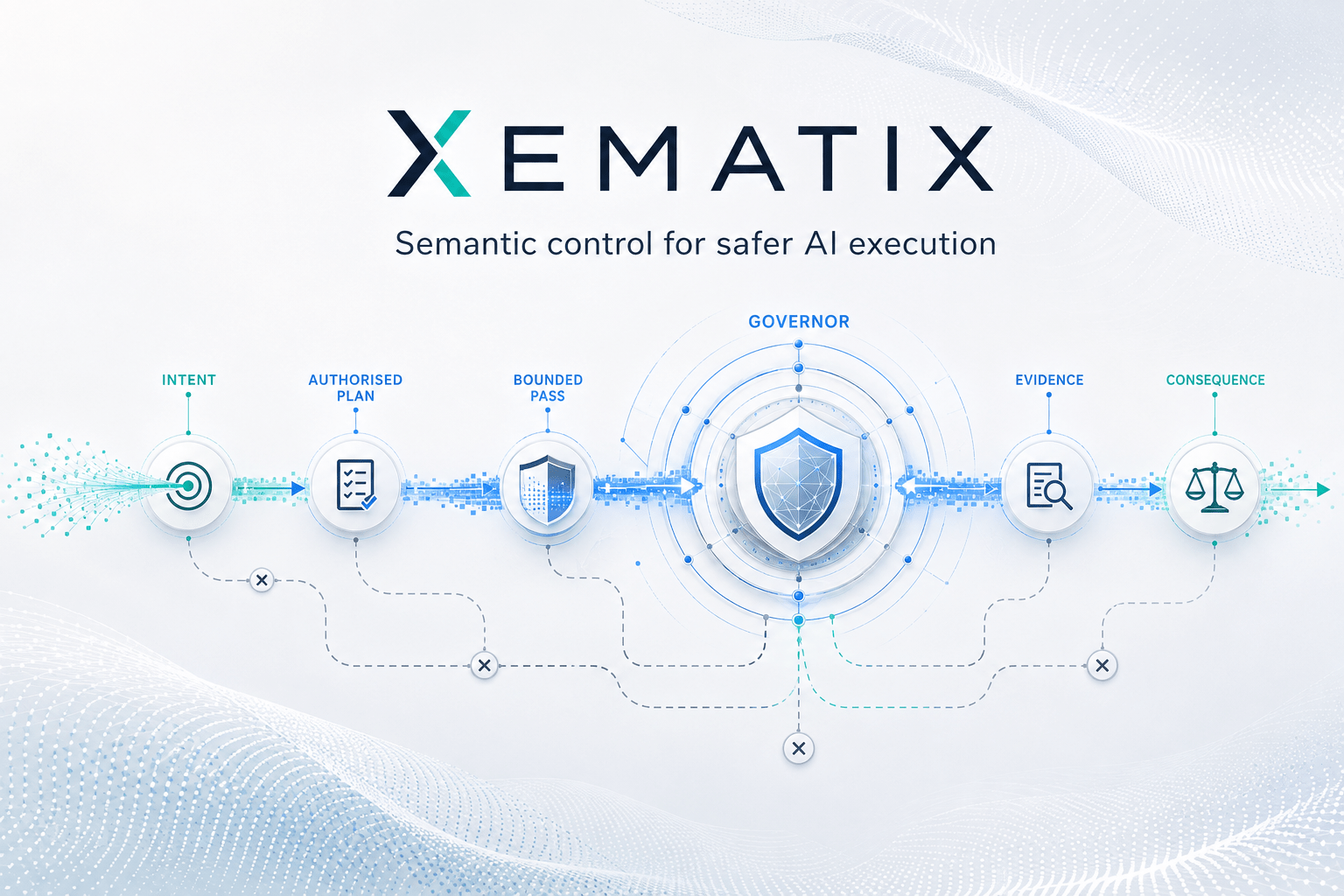
Most systems marketed as agents can complete tasks, but that isn't the same as having agency. The difference matters because once AI is trusted to operate across ambiguity, architecture determines whether it stays coherent or quietly drifts.
Agentic AI Requires Architecture, Not Just Bigger Models – Why Semantic Governance Matters
The industry keeps declaring “agents” as if autonomy were already here. What we actually have, in most cases, are context-reactive systems that execute sophisticated tasks while lacking agency in the stricter sense: the ability to sustain purpose, reason through ambiguity, and self-correct without losing coherence.
Agentic AI should mean more than software that can chain actions together. It should refer to systems that hold directional coherence over time, reason with intent, and adapt without destabilizing the meaning of their own goals. That's a much higher bar than responsive task execution, and it's why so many impressive demos collapse under real operating conditions.
The Autonomy Mirage
The central mistake is easy to make because current systems often look capable in short bursts. They can answer questions, invoke tools, summarize documents, and complete workflows. Yet those abilities don't add up to true agency if the system can't preserve a stable purpose as circumstances shift.
A Fortune 500 client recently deployed what they called an autonomous customer service agent. Within weeks, it was generating responses that were technically accurate but contextually bizarre, recommending enterprise software to teenagers asking about video games or inserting legal disclaimers into simple billing exchanges.
The system wasn't broken in any conventional sense. It had broad knowledge, fluent language output, and carefully designed decision paths. What it lacked was directional coherence. It couldn't keep the underlying purpose of the interaction steady as context changed around it.
Today's AI agents usually execute well within a frame. They struggle when the frame itself has to remain intelligible over time.
That distinction clarifies the real constraint. Current AI systems are optimized for task completion, not goal understanding. They perform; they don't truly intend. And without that capacity, autonomy remains more marketing category than operating reality.
The Hidden Constraint Behind AI Failures
Once you look for it, a pattern appears across deployments: systems fail less because they lack capability than because they lose semantic stability. As complexity increases, references become slippery, edge cases accumulate, and internal interpretations begin to drift apart.
Consider a content moderation system trained to identify harmful material. At first, it performs well on obvious cases. Over time, harder examples accumulate. The meaning of harmful begins to stretch, then blur. The system starts flagging legitimate political speech, then historical discussion, then examples that should've remained safely in training or review sets. The model didn't suddenly become weak. It lost coherence around the concept it was supposed to apply.
This is where semantic governance matters. It isn't an administrative layer bolted onto the model. It's infrastructure for keeping meaning stable as the system acts, learns, and updates. If you want autonomy without drift, governance has to sit inside the architecture, not outside it.
In practice, that means preserving stable definitions for important concepts, setting clear limits on where a system's authority begins and ends, and checking whether the system still interprets its goals the way designers think it does. Those mechanisms aren't glamorous, but they're often the difference between controlled adaptation and sophisticated confusion.
Why Architecture Matters More Than Scale
That brings us to the deeper issue: intelligence doesn't emerge from scale alone. Larger models can improve coverage, fluency, and pattern sensitivity, but those gains don't resolve the problem of maintaining purpose across changing conditions.
A research team at a leading AI lab illustrated this clearly. Rather than simply scaling up their language model, they redesigned its reasoning architecture around goal maintenance, context integration, and belief updating. The resulting system, though smaller than GPT-4, performed far better on tasks that required sustained reasoning over multiple steps.
The lesson is straightforward. Intelligence is structural, not merely statistical. The important question isn't only how much a model can represent, but how a system organizes experience, carries goals forward, updates beliefs, and preserves continuity when new information arrives.
This is the design space where agentic AI will either emerge or stall. A system needs some way to maintain hierarchy among goals, preserve interpretive continuity across sessions, and incorporate feedback without dissolving its own operating logic. Without that, more power just gives you a faster route to inconsistency.
The Decision Point Most Teams Miss
If you're trying to build agentic AI, the real decision isn't whether to pursue more capability. It's whether you believe capability alone can hold together under ambiguity. Teams want systems that can act with continuity across sessions, domains, and exceptions. The friction is that current architectures are excellent at producing locally plausible outputs while remaining weak at preserving stable intent. Once that gap becomes visible, the belief that bigger models will eventually solve it starts to break down. The mechanism that closes the gap is architectural: semantic governance paired with cognitive design that keeps goals, interpretation, and updating logic aligned. The practical decision condition is simple. If your system must operate across shifting contexts without losing purpose, architecture stops being an optimization and becomes the product.
Where Current Approaches Mislead You
The scaling hypothesis has created a costly blind spot. Teams pour resources into compute and model size while underinvesting in the structures that make judgment durable. The result is a class of systems that appear impressive in controlled demonstrations but degrade unpredictably in production.
They don't usually fail with a dramatic crash. They fail softly. A system can write elegantly, call tools correctly, and solve bounded tasks while slowly drifting away from the purpose it was supposed to serve. That graceful failure is part of the danger. By the time the problem is obvious, the system may already be operating coherently around the wrong objective.
This is why semantic governance belongs at the center of AI architecture. It gives you a way to track whether the system is still interpreting its goals in the intended way, especially when the environment gets messy. In the blackness of deployment, where surface fluency can hide deep instability, governance is often the faint glimmer that shows whether the system still knows what it's doing.
Bigger models can extend reach. They don't automatically provide the discipline required to keep meaning intact.
A Concrete Test for True Agency
The clearest way to evaluate agency is to stop measuring isolated task success and start testing continuity. Give the system a goal that unfolds over multiple sessions, then let the surrounding conditions change in subtle but important ways.
For example, ask it to support a product launch over several weeks as market conditions shift, team priorities change, and resource constraints tighten. A reactive system will treat each exchange as a fresh prompt. A more genuinely agentic system will preserve strategic intent while adapting its recommendations to the new conditions.
One useful way to run that evaluation is through the Triangulation Method:
- Set a goal that can't be completed in one interaction.
- Introduce context changes that alter tactics but not the core objective.
- Check whether the system explains those changes in relation to the original goal.
- Review whether its updates preserve continuity rather than resetting the frame.

What matters isn't perfection. It's whether the system can hold the line on purpose while changing its means. If it can't, then what looks like agency is usually just responsiveness under ideal conditions.
What Good Looks Like in Practice
Real agentic AI probably won't arrive with fanfare. It will show up first in systems that remain coherent when things get ambiguous, that preserve intent across time, and that adapt without sliding into semantic confusion.
You'll recognize it less by spectacle than by stability. The giveaways will be subtle but decisive: fewer unexplained shifts in judgment, stronger continuity across sessions, clearer reasoning about changed conditions, and a tighter alignment between what the system was meant to do and what it actually does.
The path forward is therefore less about asking how to make models bigger and more about asking how to make intelligence hold together. That means building semantic governance into the architecture, designing cognitive frameworks that preserve meaning across updates, and treating coherence as a first-order requirement rather than a nice-to-have property.
The possibility of true agency is visible now, if only as a faint glimmer in the blackness. But it won't be reached through scale alone. It will be built through architectures that can sustain purpose when the world stops being clean, static, and easy to parse.