XEMATIX and Kubernetes Work Together – Why Intent Governance Sits Upstream of Execution
Kubernetes keeps clusters humming, but it can't tell you why a service should exist. This piece shows how XEMATIX governs intent before execution so Kubernetes can do its job with purpose and traceability.
Most platform teams are solving the wrong problem. They're trying to make Kubernetes smarter about why something should run, when Kubernetes was never designed to understand intent, only to execute it reliably.
Kubernetes answers one question brilliantly: how to keep distributed systems running once the desired state is declared. But it's blind to the upstream questions: who declares that desired state, under what intent, with what constraints, and with what governance?
Kubernetes executes; XEMATIX governs intent. Together, they complete the cybernetic stack from purpose to reconciliation.
That's where XEMATIX comes in. It's not competing with Kubernetes, it’s completing the stack.
TL;DR
Kubernetes is an execution governor that reconciles actual to desired state, but it has no concept of mission, risk, or strategic alignment. XEMATIX is an intent governor that validates purpose, constraints, and authority before any configuration touches Kubernetes. Used together, they form a complete cybernetic pipeline from intent and validation to execution and reconciliation.
Strip Away the Mythology
Kubernetes is a control system. You declare desired state in YAML, controllers reconcile actual state toward that target, and drift gets corrected automatically. It's excellent at state convergence, failure recovery, scaling mechanics, and deterministic reconciliation.
But Kubernetes has critical blind spots. It has no semantic understanding of why something exists, no concept of mission or risk, and no human‑intent boundary enforcement. It can't validate intent, reason about policy beyond static rules, or prevent semantic drift, where systems function correctly but no longer align with their original purpose.
A platform team at a mid‑stage startup recently told me they had 47 microservices running in production. When they audited them, they discovered 12 were zombie services that no one could tie back to a current business need. Kubernetes kept them healthy and scaled, but they were burning $3, 000 monthly on infrastructure for code that served no purpose.
That blind spot is exactly where XEMATIX fits.
How the Layers Actually Work
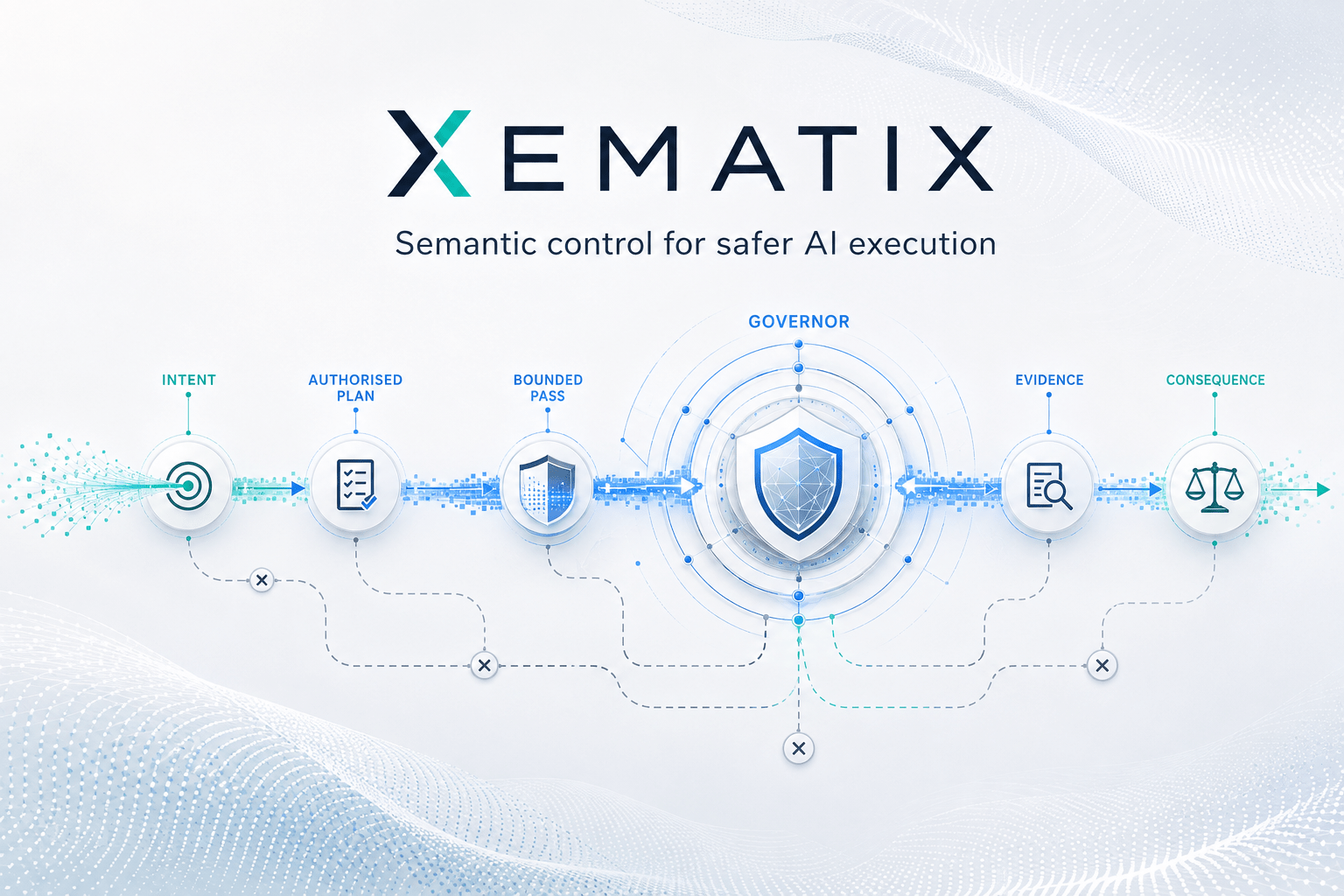
To keep responsibilities clean, XEMATIX sits upstream of Kubernetes in a simple, auditable flow: human intent to the XEMATIX semantic control layer to a validated execution plan to Kubernetes manifests and APIs to the Kubernetes reconciliation loop. Kubernetes never sees raw human intent, it only receives machine‑safe, intent‑validated artifacts.

Before any Kubernetes object exists, XEMATIX requires explicit purpose, declared constraints, acceptable risk bounds, governance rules, and an accountability owner. This is pre‑execution semantic control, something Kubernetes explicitly does not do.
XEMATIX then translates validated intent into standard Kubernetes manifests, Helm values, GitOps commits, or API calls. Crucially, these outputs are traceable, carry semantic lineage, and remain bound to declared intent and policy. Once handed off, Kubernetes does what it does best: controllers reconcile state, autoscalers react, pods reschedule, failures self‑heal. No plugins required. No control plane changes.
XEMATIX doesn't invade Kubernetes, it governs before Kubernetes.
Why Managed Services Miss the Point
Managed services change the operational surface, not the architectural truth. Amazon EKS provides a managed control plane, IAM integration, and infrastructure reliability. But IAM isn't intent governance, RBAC isn't semantic validation, and admission controllers aren't mission awareness.
XEMATIX still sits upstream and decides whether a deployment should exist, determines what class of action is allowed, and ensures alignment before anything touches AWS APIs. EKS is just the actuator.
“We have bulletproof IAM policies and admission controllers that can block bad configs at the last second. But we're still creating the bad configs in the first place. We need to stop the problem upstream, not catch it downstream.”, DevOps lead at a fintech company
The Failure Mode Everyone Ignores
Trying to make Kubernetes handle intent governance creates predictable problems: overloaded YAML, policy sprawl, and human responsibility gaps. You end up with fragile systems that function but drift strategically.
The distinction is simple and non‑negotiable: XEMATIX answers, Should this exist, under what intent, and with what authority? Kubernetes answers, Given this desired state, how do I keep it running?
Kubernetes is execution intelligence. XEMATIX is intent intelligence. Forcing one engine to do both jobs isn't architectural evolution, it’s confusion.
Here’s the practical decision bridge in one pass: you want reliable, cost‑sane systems aligned to business goals (desire), but you face zombie services, policy sprawl, and semantic drift (friction). It’s tempting to believe Kubernetes, EKS, or more admission rules will fix it (belief), yet only an upstream semantic layer that validates intent and binds artifacts to purpose can prevent the problem (mechanism). If you can’t quickly trace why a service exists, who owns it, and the constraints it must honor, that’s your signal to add intent governance upstream of execution (decision conditions).
One Small Test You Can Run
If you want a quick way to see the gap, use this micro‑protocol.
- Pick three services running in your cluster.
- For each, write down who requested it, what business capability it serves, the constraints it must honor, and the accountable owner.
- Note any gaps or ambiguity; treat them as intent governance debt.
- Check whether RBAC, policy‑as‑code, or admission controllers are governing intent, or just access and obvious mistakes.
The test will show whether your current controls prevent semantic drift or merely tidy it up after the fact.
The Complete Stack
Kubernetes is necessary but insufficient. It's an excellent execution governor that needs an upstream intent governor to form a complete cybernetic stack. XEMATIX provides the missing semantic layer that validates purpose before execution. AWS EKS provides industrial‑grade infrastructure. Together they create a full pipeline: intent, validation, execution, reconciliation.
Kubernetes keeps systems alive. XEMATIX keeps them meaningful, governed, and aligned. This isn't about replacing tools, it’s about finishing the architecture so execution always traces back to understood, authorized intent.