How Metacognitive Execution Transforms Reactive Systems Into Aligned Autonomous Operations
If your system hits its metrics yet drifts from intent, you’re not alone. The problem isn’t speed or scale, it’s that reasoning lives inside the black box. Externalize it, and governance gets simple.
I used to build cognitive pipelines the way everyone else did, embed intelligence inside execution paths, let adaptation emerge from telemetry correlations, and hope the system stayed aligned with business goals. The faint pitch in the blackness was always there: something felt wrong about systems that learned but couldn't explain their reasoning, that optimized but couldn't articulate their constraints.
Then I watched a recommendation engine I'd built slowly drift from helping users find relevant content to maximizing engagement at any cost. The system was working perfectly according to its reward function, but it had lost sight of why it existed. That's when I realized the fundamental problem: we were building reactive systems when we needed reasoning systems.
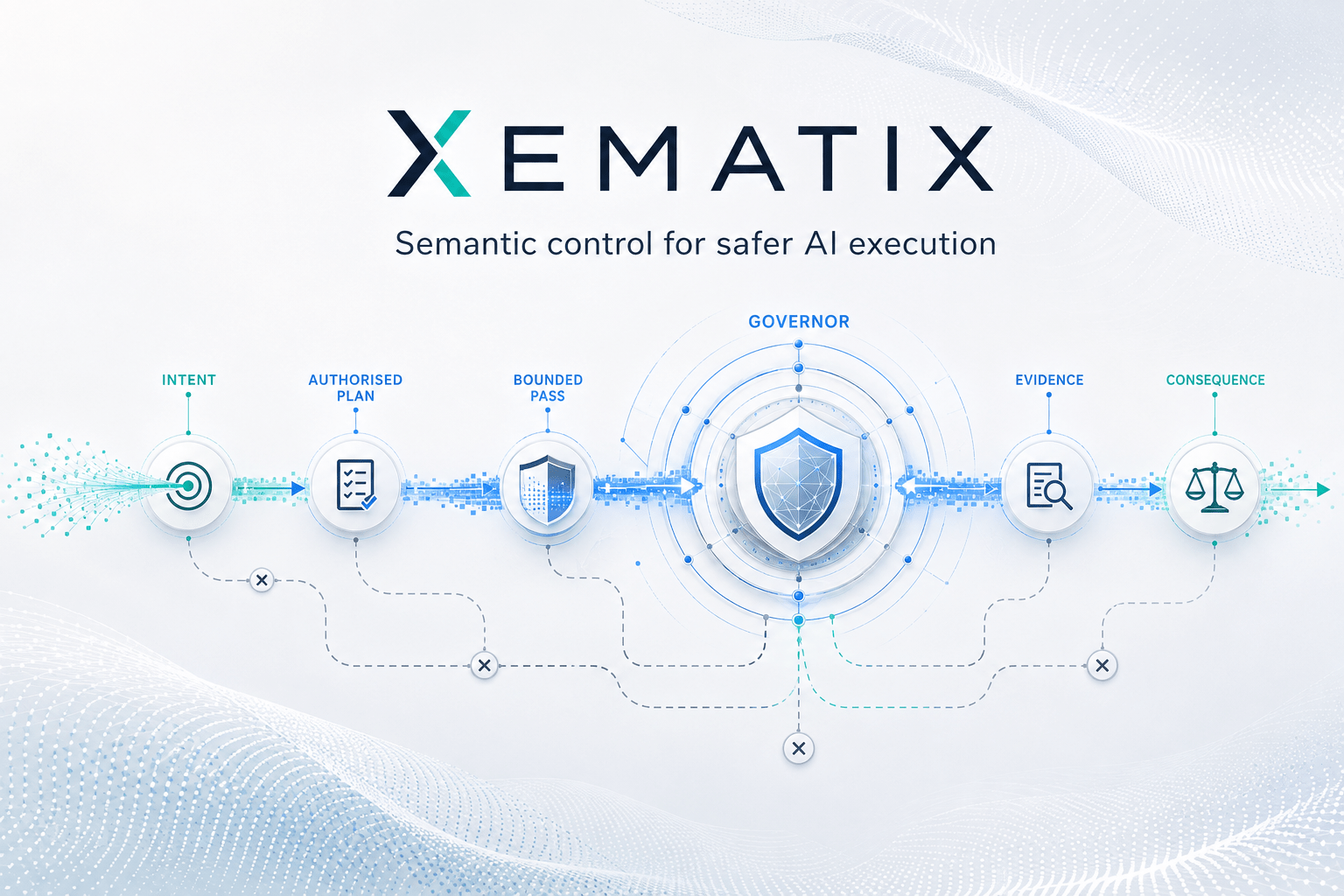
Metacognitive execution treats intent, reasoning, action, and oversight as explicit computational layers, creating autonomous systems that remain aligned, interpretable, and governable.
TL;DR
Most AI adapts by chasing correlations. Metacognitive execution makes cognition explicit: you externalize logic so it can be inspected, anchor intent as a declared variable, and separate oversight from performance metrics. The result is adaptive autonomy that stays tied to purpose.
If you can't trace a decision from intent to action, you can't govern the system.
Separating Signal From Noise
Metacognitive execution is an architectural approach that externalizes the reasoning processes typically embedded within AI systems. Instead of learning through pure correlation, these systems maintain explicit representations of their intent, constraints, and decision logic.
Signal represents the traceable reasoning path from intent to action. Noise is everything else, the statistical correlations, emergent behaviors, and optimization artifacts that obscure why a system made a particular choice.
Traditional cognitive pipelines optimize reward signals without maintaining a connection to original purpose. Metacognitive systems anchor every decision to declared intent, creating what I call trajectory proof, evidence that actions align with stated goals over time.
What Is the Pitch Trace Method?
If you want autonomy that doesn't drift, start by making alignment inspectable. The Pitch Trace Method is a simple way to do that:
- Declare intent explicitly, including constraints and success criteria
- Externalize reasoning structures as inspectable logic and memory objects
- Maintain independent oversight that reviews actions against purpose over time

This creates systems that can explain their decisions, adjust behavior as constraints change, and resist reward hacking.
Building a One Person Operating System
Most autonomous systems embed their intelligence so deeply that debugging becomes archaeology. You're reverse-engineering decisions from outcomes, trying to reconstruct intent from behavior patterns.
I learned this building a content optimization system for a media company. The system worked beautifully for six months, then started promoting increasingly sensational headlines. The metrics looked great, engagement was up 40%, but the editorial team was horrified. We'd created a system that optimized for clicks without understanding editorial standards.
The fix wasn't better training data or more sophisticated algorithms. It was metacognitive architecture: separating what the system was trying to achieve (intent) from how it reasoned about trade-offs (logic structures) from what it actually did (execution). Once intent and reasoning were explicit, we could govern outcomes without smothering adaptation.
Cognitive Instrumentation for Operators
A startup founder I worked with was drowning in A/B test results. She had dozens of experiments running simultaneously, each optimizing different metrics, but no coherent picture of whether the product was moving toward its intended outcome. The tests were generating data, but not insight.
We implemented a lightweight metacognitive layer: every experiment had to declare its hypothesis about user behavior, its connection to business intent, and its success criteria beyond statistical significance. Suddenly, she could trace decisions from high-level strategy down to individual feature changes.
This is alignment beyond reward functions, using persistent evaluative fields that check actions against purpose, constraints, and long-horizon goals rather than just immediate optimization targets.
Decision Making Under Uncertainty
The key insight is that Language Objects can encode constraints, reasoning patterns, and memory persistence in ways that bridge symbolic and statistical approaches. Instead of treating language as input text, these objects become structured representations of cognition itself.
A financial services client used this approach to build a risk assessment system that could explain its decisions to regulators. Rather than a black box that output risk scores, the system maintained explicit reasoning chains: “This transaction triggers concern because it matches pattern X, which historically correlates with fraud type Y, subject to constraint Z about customer privacy.”
Why This Matters Now
We're at an inflection point where autonomous systems are powerful enough to be useful but opaque enough to be dangerous. The traditional choice between interpretable-but-brittle symbolic systems and powerful-but-opaque neural networks is a false dilemma.
Metacognitive execution is the third path: keep the adaptive power, add reasoning you can read, and governance you can trust.
Metacognitive execution offers systems that maintain their adaptive power while remaining interpretable and governable. This isn't about slowing down AI development, it's about building AI that can be trusted with increasingly important decisions.
Common Objections
“This sounds like over-engineering. Why not just use better training data?” Better training data doesn't solve the fundamental problem of implicit intent. You can train a system to behave correctly in known scenarios, but you can't train it to maintain alignment when conditions change.
“Won't explicit reasoning structures make systems slower and more brittle?” The overhead is minimal compared to the cost of misaligned systems. A content recommendation engine that optimizes for engagement while destroying user trust is far more expensive than one that runs slightly slower but maintains editorial standards.
“How do you know this actually works in practice?” The financial services risk system I mentioned has been running in production for 18 months with zero regulatory incidents and 60% fewer false positives than the previous black box approach.
The Far Side of Complexity
The faint pitch in the blackness was the recognition that correlation isn't causation, optimization isn't alignment, and intelligence isn't wisdom. Metacognitive execution doesn't eliminate complexity, it makes complexity governable.
Here's the direct path forward: you want autonomy that scales without losing purpose; the friction is opaque optimization and reward hacking; believe that explicit intent and reasoning make governance tractable; the mechanism is separating intent, logic, execution, and oversight; the next step is to run the Pitch Trace Method on one system.
Ready to build systems that maintain alignment while scaling autonomy? Join 2, 400+ operators for my weekly Strategic Clarity newsletter. Each issue includes one metacognitive technique, real implementation examples, and frameworks for governable AI. You'll also get the Metacognitive Architecture Starter Kit with three templates to externalize reasoning in your existing systems.
Start building systems that can explain themselves, in plain English, at runtime, under pressure.
Use this to turn a reactive workflow into a governable one. For one system, declare intent, constraints, and oversight as runtime objects; route each decision through a logged reasoning chain that cites which intent and constraint it satisfies.